
A new analysis from Kaiser Family Foundation makes clear that the story of health coverage in the United States over the past decade is not one of steady progress. It is one of uneven expansion shaped — and often undone — by policy shifts. Drawing on American Community Survey data from 2010 through 2024, the report shows that while the Affordable Care Act significantly reduced uninsured rates across all racial and ethnic groups, it never closed the structural gaps that determine who has access to care and who does not.
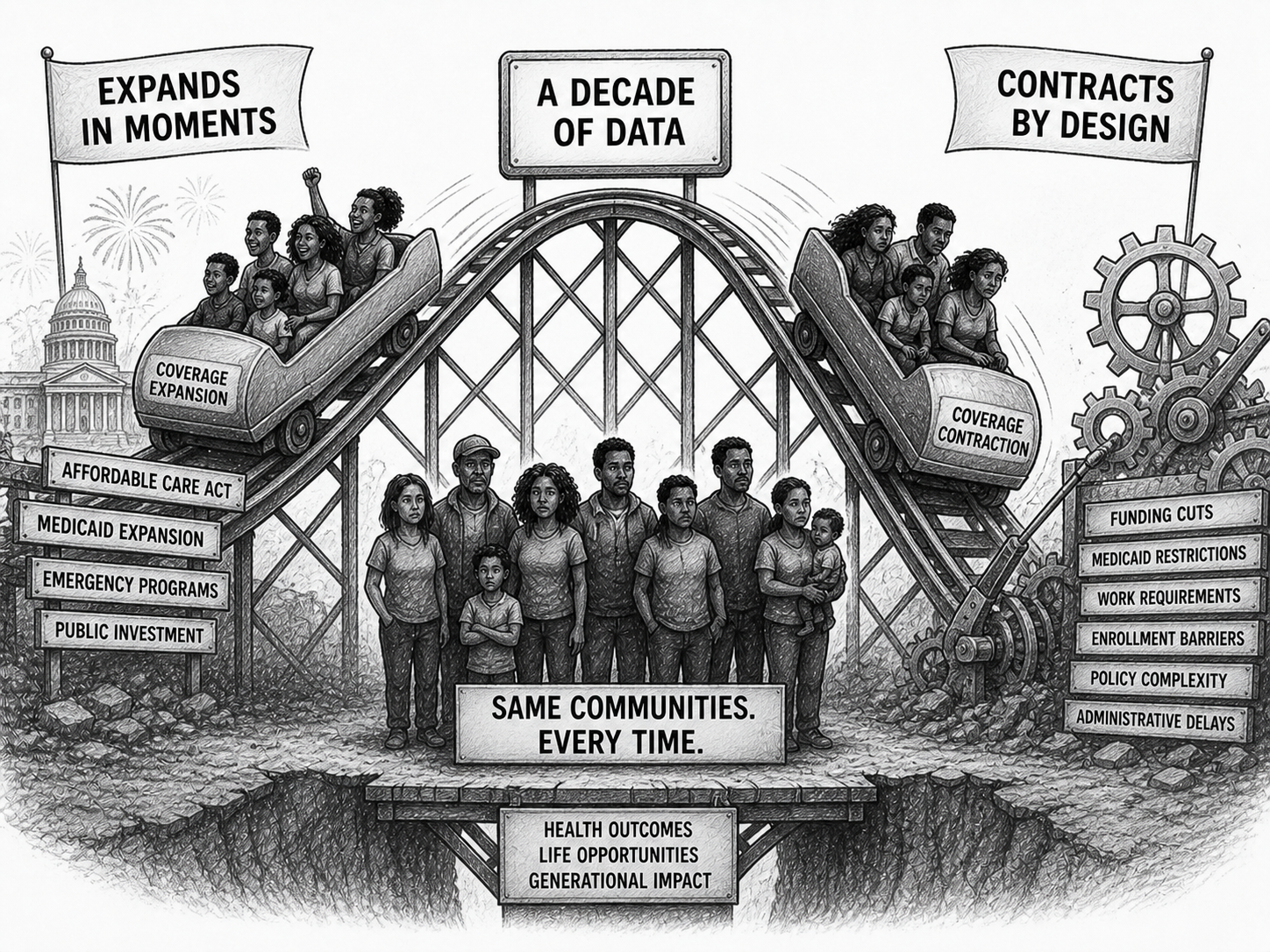
The early years of the ACA marked the most significant period of coverage expansion, particularly between 2014 and 2016. Hispanic, Black, Asian, and American Indian and Alaska Native communities saw the largest gains — signaling that policy intervention can materially widen access. But those gains came with a ceiling. Even at peak improvement, these same groups remained more likely to be uninsured than their white counterparts, revealing that expansion alone does not resolve the underlying inequities embedded in employment, income, and access to private insurance markets.
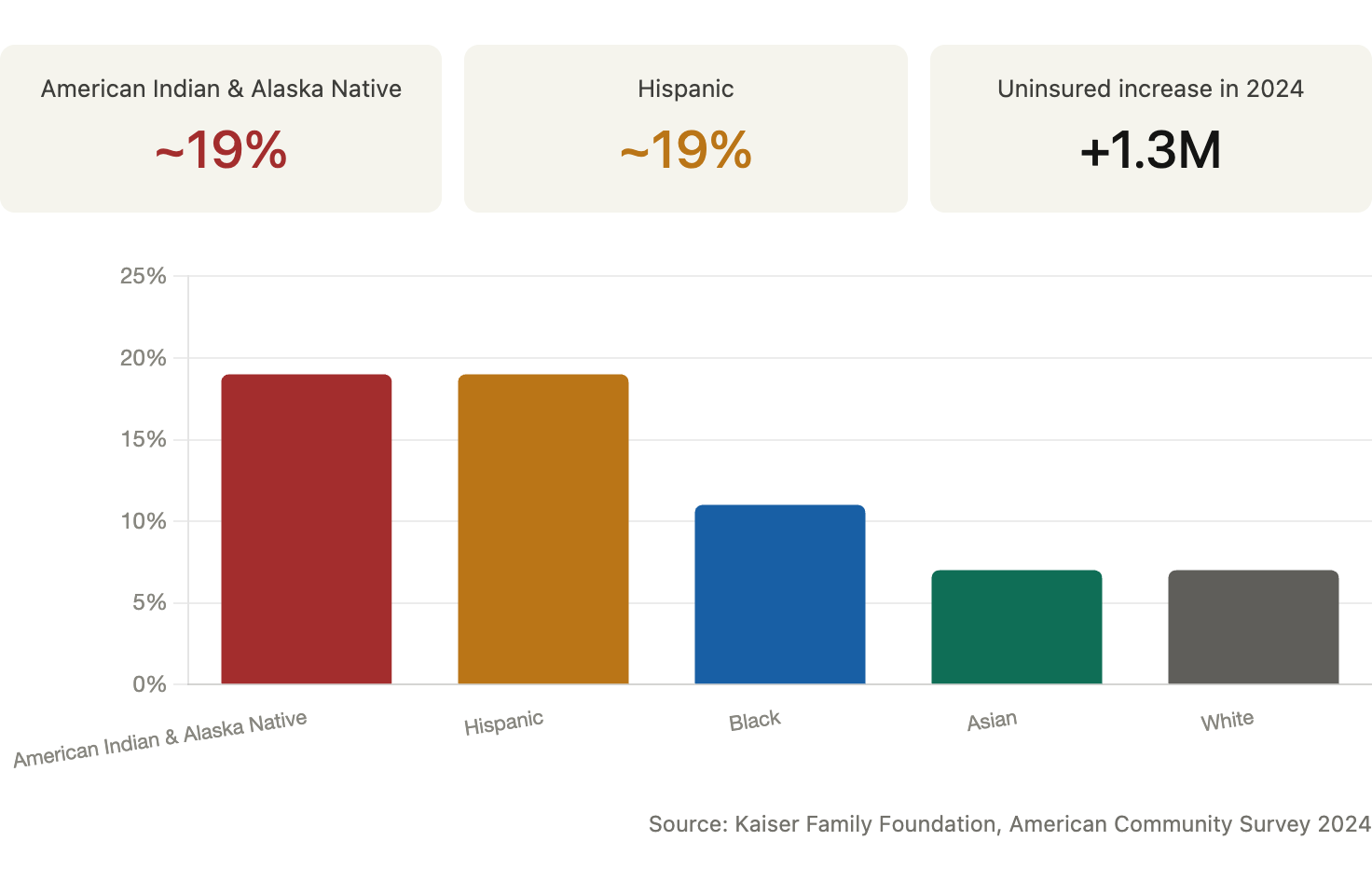
That tension became more visible in the years that followed. Beginning in 2017, coverage gains began to reverse as federal policy shifts reduced outreach, tightened eligibility processes, and reshaped enrollment dynamics. The pandemic temporarily disrupted that decline. Emergency protections — including continuous Medicaid enrollment and enhanced subsidies — stabilized coverage and drove uninsured rates down through 2023. But those gains were policy-dependent, not structural. As those protections expired, the system reverted. In 2024, the uninsured population rose again, adding more than 1.3 million people without coverage and marking the first increase since 2019.
This pattern is not new to SSC’s coverage. Medicaid work requirements are already in motion — work requirements, eligibility redeterminations, and immigrant restrictions structured to land after the 2026 midterms, with the CBO projecting 7.8 million Americans losing coverage by 2034. The impact on Black maternal health is among the most acute expressions of that contraction — Medicaid funds 65% of births to Black mothers, and the programs measurably reducing Black maternal mortality are being defunded at the same time coverage is being cut. And as Mexico moves toward universal healthcare — committing to doctor visits, hospital care, and essential medications at no cost to patients — the contrast with a U.S. system that distributes access through employment, geography, and eligibility thresholds becomes harder to ignore.
By 2024, the disparities are clearly patterned. American Indian and Alaska Native and Hispanic populations face uninsured rates approaching 19% — more than double the rate for white individuals. Black communities remain significantly more likely to be uninsured, while Asian populations, though lower overall, still reflect variation across subgroups. These differences are not incidental. They reflect a system where access to employer-sponsored coverage, affordability of private plans, and state-level policy decisions intersect unevenly across populations. Medicaid and public coverage programs help narrow these gaps, but they function more as a buffer than a structural correction.
Geography further reinforces these disparities. States that have not expanded Medicaid — many concentrated in the South — continue to produce higher uninsured rates across nearly every group, with Black individuals more likely to fall into the coverage gap and Hispanic and Asian populations facing additional barriers tied to immigration eligibility rules. Even among those without coverage, access is uneven: roughly half are eligible for assistance, but eligibility does not ensure enrollment, and for many — particularly immigrants — it does not exist at all.
The trajectory ahead points toward renewed contraction. KFF projects that recent policy changes — including Medicaid and ACA marketplace cuts and the expiration of enhanced subsidies — could increase the uninsured population by more than 14 million by 2034. Because communities of color are disproportionately represented in these programs, they are positioned to absorb the largest share of those losses. The implication is not just a rise in the uninsured rate. It is a widening of disparities that have persisted across every phase of expansion.
What the data ultimately reveals is a system that expands access in moments but distributes stability unevenly over time. Coverage in the United States is shaped as much by policy timing as by structural design. Without addressing the underlying conditions that determine access — employment, geography, and eligibility — each cycle of expansion risks reproducing the same gaps it set out to close.