
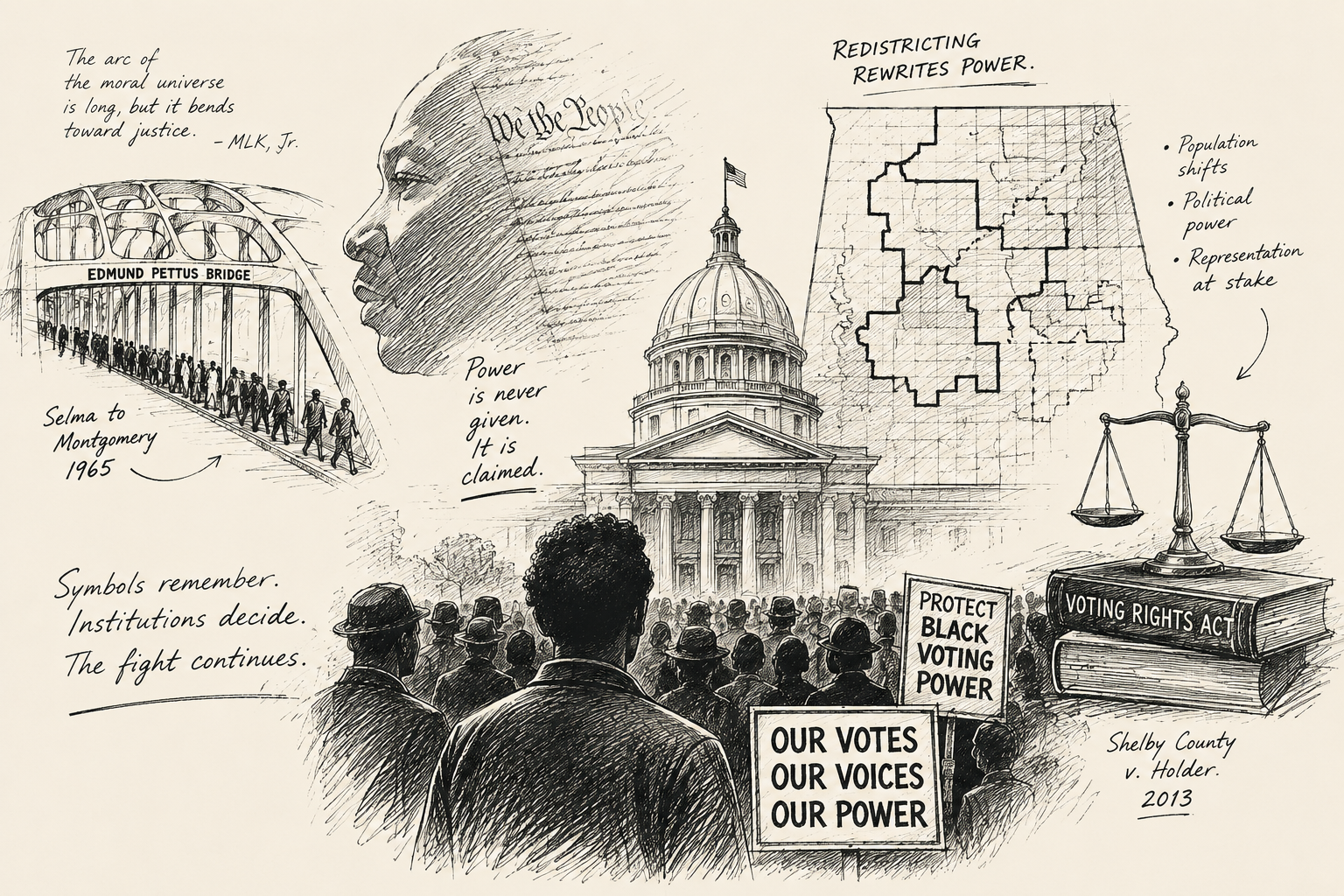
Thousands of demonstrators marched from Selma to Montgomery this week to protest coordinated efforts to weaken Black voting representation across Southern states. The rally reached the Alabama Capitol nearly six decades after Martin Luther King Jr. stood at those same steps during the Selma voting rights movement — placing contemporary legal battles on ground that American civil rights history already occupied. Organizers centered the gathering on renewed threats to majority-Black congressional districts after years of court challenges and state-level resistance to federal voting protections. The symbolism was legible to everyone present. The deeper tension was harder to name: many protections once treated as settled law are being openly renegotiated.
The immediate context is congressional redistricting. Since the Supreme Court’s 2013 Shelby County v. Holder decision eliminated key federal preclearance requirements, states previously subject to federal oversight gained substantially more latitude over election administration and district boundary changes. Civil rights organizations argue that many states used that latitude to dilute Black political representation. Alabama became a national test case when federal courts repeatedly found the state’s congressional maps unconstitutional — maps drawn despite Black residents comprising roughly 27 percent of the population.
What makes the moment significant is not the legal fight in isolation, but the institutional repositioning unfolding around it. Modern voting restrictions rarely arrive in explicitly racial language. They move through neutral administrative terminology: election integrity, district efficiency, procedural consistency. That framing is not incidental. It shifts the debate away from historical exclusion and toward technocratic management — converting structural political questions into the appearance of routine governance decisions. The outcome can still dramatically reshape representation while appearing disconnected from race altogether.
The economic stakes embedded in that shift are consistently underreported. Political representation determines resource allocation: infrastructure investment, school funding, hospital access, housing policy, labor protections. District maps determine which communities are heard when public money moves. The Montgomery rally was not only about preserving civil rights symbolism. It was about protecting access to the systems that shape material conditions in everyday life. Those two things are not separable.
There is also a generational dimension beneath the surface. Many younger Americans encounter the civil rights movement primarily through commemorative framing — bridges, speeches, museum exhibits, documentary footage. What they are increasingly confronting instead is that many of those foundational fights were never fully resolved. The Selma bridge now functions simultaneously as historical landmark and as active evidence of unfinished governance disputes. That changes the emotional meaning of civil rights history itself. The past is no longer being remembered as completed progress. It is being revisited as an open negotiation.
The mainstream framing — partisan conflict between Democrats and Republicans — understates what is actually happening. The deeper dynamic is institutional scarcity. As demographic shifts reshape political coalitions across Southern states, control over district boundaries functions as a mechanism for stabilizing power during periods of rapid social change. Texas, Georgia, Florida, and Alabama are all working through versions of the same underlying pressure: populations are diversifying faster than governing coalitions are adapting.
The Montgomery rally ultimately exposed a growing contradiction between ceremonial commitment and operational reality. American institutions continue publicly celebrating civil rights milestones while simultaneously contesting the durability of the systems those movements built. That contradiction is becoming harder to contain because public memory now collides directly with contemporary governance decisions. The question is no longer whether the civil rights era changed America. The question is how much of that change institutions remain willing to operationally sustain — and who gets to decide when the answer is enough.