
September 30, 2026
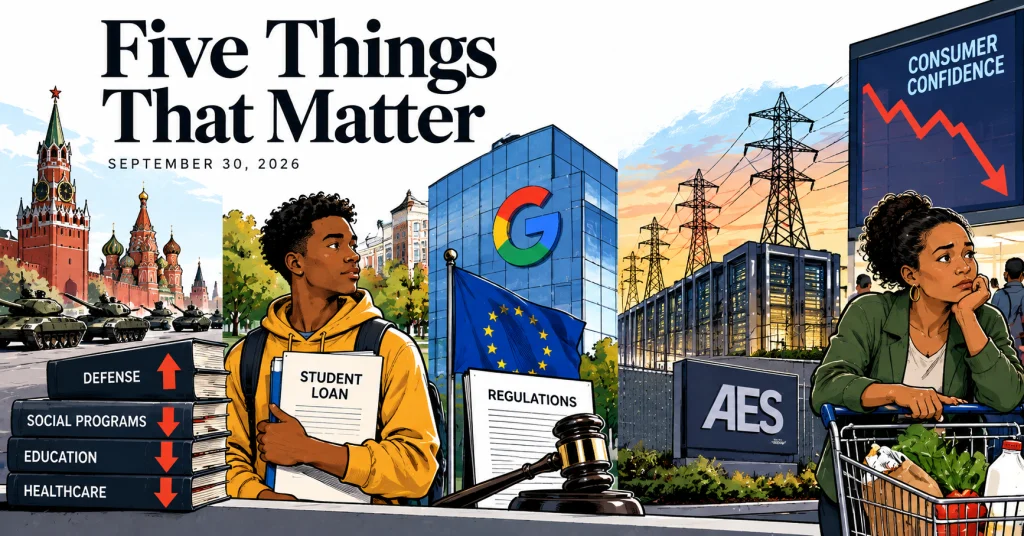
Today’s five stories are about systems absorbing pressure in different ways. Russia is redirecting civilian spending toward war. Student-loan borrowers just received more time to qualify for a meaningful interest-rate discount. Google is fighting an EU order that would force it to share parts of its search infrastructure with AI competitors. Private-equity ownership of electric utilities is drawing new scrutiny as data centers increase demand for power. And consumer confidence has fallen to a level not seen in more than a decade even though Americans have continued spending.
1. Russia Is Cutting Social Spending While Defense Costs Keep Rising
Russia plans to spend 17.1 trillion rubles, or about $202.6 billion, on defense in 2027, roughly 27% more than originally budgeted and its highest level since the war in Ukraine began, according to Reuters. Finding that money increasingly means taking it from other parts of the state. Fiscal documents reviewed by Reuters show planned spending on social policy falling 7%, education declining 6% and healthcare dropping 6.8%, while infrastructure, agriculture and other economic programs are set for a 7.4% reduction. Russia has already drawn on reserve funds, increased borrowing and raised taxes as the costs of the war have accumulated over more than four years. Debt servicing is becoming another expense, projected to consume 9.4% of total spending in 2027 and 10.6% by 2029 as high interest rates collide with greater borrowing. Russian officials have said military objectives take priority, while the government’s budget figures have repeatedly required substantial revisions as war costs exceeded earlier projections. The numbers show how prolonged military spending eventually reaches households indirectly: not only through taxes and inflation, but through the schools, healthcare, pensions and infrastructure governments have less room to fund.
2. Student-Loan Borrowers Have Three More Months to Lock In a Lower Interest Rate
Federal student-loan borrowers have been given until December 31 instead of September 30 to enroll in automatic payments and receive a one-percentage-point interest-rate reduction, according to The Washington Post. The extension may look like an administrative deadline change, but a full percentage point can translate into meaningful savings for borrowers carrying balances for years. Automatic-payment discounts are not new, but the expanded incentive comes as federal student-loan repayment has become more expensive and complicated for millions of households navigating changing repayment rules. The Education Department is effectively using price to encourage a specific behavior: move borrowers into automatic payments, reduce missed payments and make monthly collection more predictable. For borrowers, the calculation works in the opposite direction, because agreeing to automatic withdrawals can lower borrowing costs but requires enough cash-flow stability to guarantee money will be available when payments are pulled. That can make the benefit easier to use for households with predictable income than for borrowers whose earnings fluctuate from week to week. Extending the deadline gives borrowers additional time to make that decision, but the structure still rewards people who can commit their bank accounts to a fixed monthly schedule.
3. Google Is Fighting an EU Order to Share More of the Infrastructure Behind Search
The European Union wants Google to make parts of its search ecosystem more accessible to competitors, including AI companies such as OpenAI, and Google is taking the dispute to court. Reuters reports that Google has challenged two orders issued under the EU’s Digital Markets Act requiring it to give AI developers access to services available to its Gemini model and provide rival search engines with access to some Google search data. European regulators argue that dominant technology platforms should not be able to use infrastructure built at enormous scale to prevent emerging competitors from developing viable alternatives. Google says the requirements could expose sensitive search information and weaken privacy protections, particularly if user histories must be shared or anonymized for use by competitors. The European Commission says its orders contain safeguards and has said it will defend them in court, while privacy-focused search rival DuckDuckGo has backed the EU approach. The confrontation gets at a problem becoming more important as AI products depend on enormous datasets, distribution networks and existing platforms: competition may require access to infrastructure that incumbents consider proprietary. The rules are scheduled to take effect next year, making the court fight one of the clearest tests yet of whether governments can force dominant technology companies to open systems that helped create their market power.
4. The Fight Over Data Centers Is Reaching the Companies That Own the Power Grid
A proposed $33.4 billion acquisition of power company AES is drawing opposition from a bipartisan group of U.S. lawmakers concerned that private-equity ownership could eventually push electricity costs higher as data centers place heavier demands on the grid. Reuters reports that lawmakers have asked the Federal Energy Regulatory Commission to reject the transaction involving BlackRock’s Global Infrastructure Partners, Swedish private-equity firm EQT and other investors. AES owns regulated utilities in Indiana and Ohio, while the lawmakers argue that private-equity investors typically seek returns of 15% to 20%, potentially creating pressure to extract more revenue from utility assets. Their letter also raises concerns about possible conflicts because BlackRock has investments connected to the rapidly growing data-center sector, one of the biggest new sources of electricity demand. AES says the acquisition would not change regulated utility rates and argues that access to additional capital would help fund grid investments. Shareholders and Ohio regulators have already approved the deal, leaving federal approval as one of the remaining hurdles. The dispute shows how the AI infrastructure boom is extending well beyond chips and data centers themselves: attention is moving toward who owns the electricity networks required to keep those facilities running and who ultimately pays for the upgrades.
5. Americans Feel Worse About the Economy Even While They Keep Spending
U.S. consumer confidence fell sharply in September, with the Conference Board’s index dropping to 81.9 from 88.6 in August, close to its lowest level in roughly 12½ years, according to Reuters. The decline comes even as consumer spending has remained comparatively resilient and employers continue to lay off relatively few workers. Households are instead responding to a collection of pressures that accumulate outside a single economic indicator: higher fuel and grocery prices, rising mortgage costs, interest rates and increasing concern about future employment. The gap between how the economy is performing and how people feel about it has become increasingly important because confidence can eventually influence spending even when income and employment initially hold steady. Savings rates have already fallen, suggesting some households are maintaining consumption by drawing down financial cushions rather than because their purchasing power has improved. The deterioration also cuts across age, income and political groups, making it harder to explain as dissatisfaction concentrated in a single segment of the population. The question heading into the final quarter of the year is whether households continue spending despite feeling increasingly insecure, or whether pessimism finally begins changing what they buy, postpone or abandon altogether.