On Thursday, April 24, Jimmy Kimmel delivered a mock White House Correspondents’ Dinner speech on his show, dressed in a tuxedo and standing behind a podium. Among the lines: “Look at Melania, so beautiful. Mrs. Trump, you have a glow like an expectant widow.” The joke played on the widely observed perception that Melania Trump rarely appears happy in public alongside her husband. It aired. It circulated. And then, two days later, a gunman opened fire outside the lobby of the Washington Hilton where the actual Correspondents’ Dinner was taking place, wounding a Secret Service agent before being subdued. By the time Monday arrived, Trump and his allies had recontextualized the joke as a call to violence. The performance had become evidence. That transition is what this piece is about.
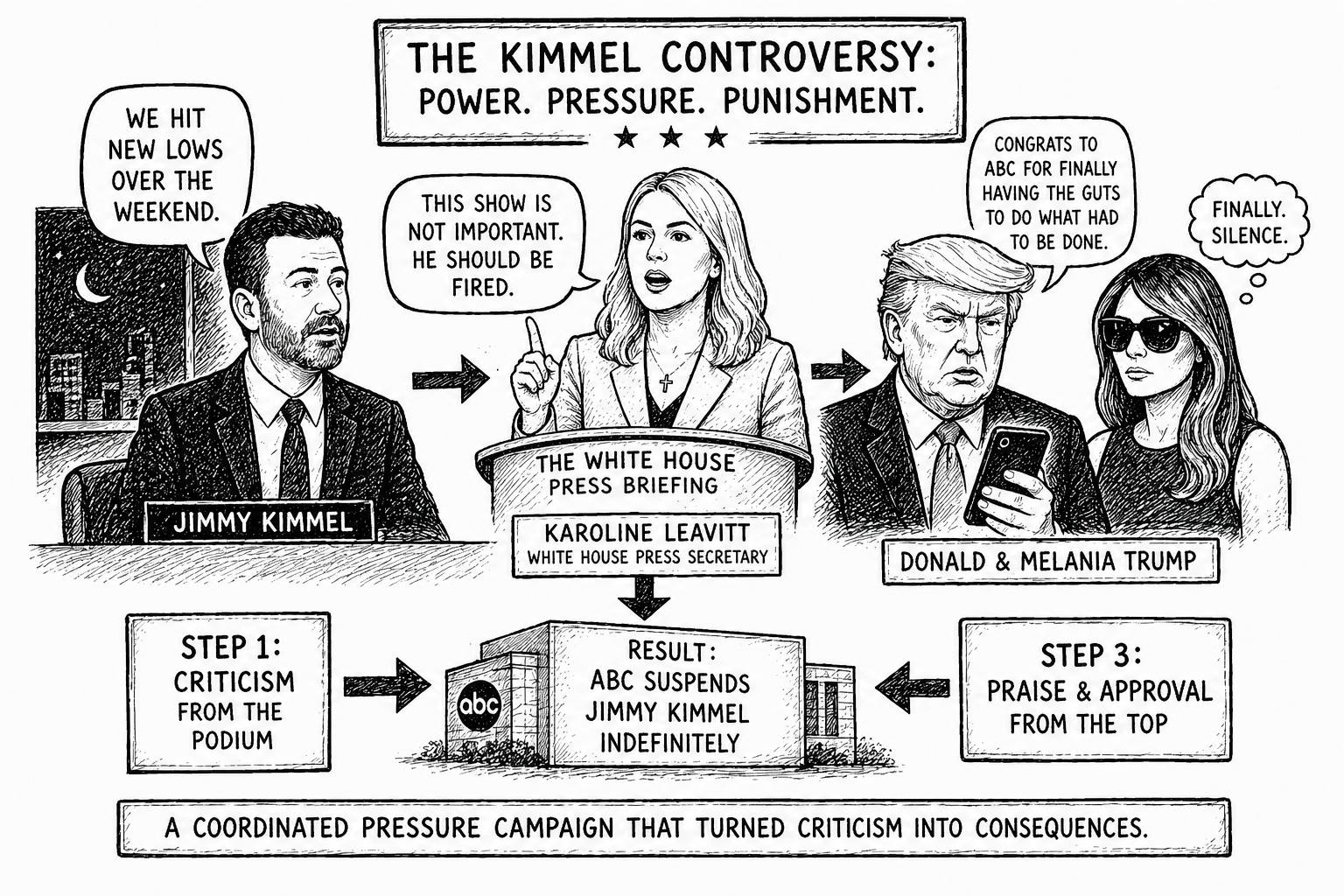
A late-night monologue is no longer a contained event. The Kimmel clip did not circulate as a full segment with timing, tone, and audience context intact. It moved as a fragment — clipped, reframed, and redistributed across platforms that reward clarity and reaction over nuance. The White House spokeswoman Karoline Leavitt told reporters: “Just two days prior to the shooting, ABC’s late-night host Jimmy Kimmel disgustingly called First Lady Melania Trump an expectant widow. Who, in their right mind, says a wife would be glowing over the potential murder of her beloved husband?” That framing did not engage with what Kimmel said. It replaced it. The joke stopped functioning as performance and started functioning as something else — material that could be pointed to, argued over, and deployed within a broader narrative about rhetoric, tone, and consequence.
That shift is structural. Once a piece of content enters a political environment, it is no longer governed by intent. It is governed by use. The speed of that transition is what defines this moment. A joke can be created, extracted, and reassigned meaning within hours. By the time full context is available, the dominant interpretation has already taken hold. Platforms reward what travels fastest and provokes the strongest reaction. The version that spreads is rarely the most complete. It is the most legible, the most charged, and the most adaptable for reuse. This is not a new condition — it is an old one with new infrastructure behind it, and as SSC documented in its examination of how Dave Chappelle’s work was absorbed into political messaging he never consented to enter, the creator becomes a respondent in a conversation they did not start. Kimmel called it “a light roast” and said it was “not, by any stretch of the definition, a call to assassination.” That clarification came after the reframing had already circulated at scale. The original meaning was chasing a version of itself it could not catch.
This is not Kimmel’s first encounter with this dynamic. In September 2025, ABC indefinitely pulled his show after conservative backlash over comments Kimmel made in the aftermath of Charlie Kirk’s assassination — remarks about MAGA attempting to capitalize on the killing — prompting FCC Chair Brendan Carr to threaten ABC affiliates. The show was reinstated within a week after the ACLU circulated a letter signed by dozens of public figures calling the removal a threat to free speech. What that episode established — and what this one confirms — is that the machinery for converting comedy into consequence is now fully operational and has been used successfully before. A media strategist described Kimmel’s current position plainly: “With the president, the First Lady, FCC pressure and affiliates all part of the atmosphere, that’s not just criticism — that’s power applying pressure.”
Comedy relies on exaggeration, implication, and layered meaning. Political discourse tends to flatten those layers into direct claims. When both operate inside the same distribution system, ambiguity narrows. A joke that depends on interpretation is recast as a statement that demands judgment. The performance becomes position. What follows is escalation — reactions generate attention, attention sustains the cycle, and political figures responding publicly extend the lifespan of the moment, pulling it into a broader loop of commentary, rebuttal, and amplification. Melania Trump called Kimmel “a coward” and urged ABC to “take a stand.” Trump called the joke “far beyond the pale” and demanded Kimmel be immediately fired. Each response added another layer of circulation. The content was no longer moving on its own. It was being carried forward by the responses attached to it.
The broader implication is not about Kimmel specifically. It is about the conditions under which comedy now operates. The first joke that got him suspended cost Kimmel his show for a week and created lasting anxiety among ABC affiliates about whether his presence was worth the regulatory risk. The second joke landed two days before a shooting that the administration immediately weaponized as context. Neither outcome required Kimmel to intend harm. The system does not require intent. It requires material — something that can be extracted, reframed, and used. Once politics absorbs a joke, it no longer belongs to the person who told it. In a system where the cost of saying something is unevenly distributed depending on who you are and who has the power to respond, that asymmetry is the story. The joke is just where it started.