
Moving out of Harlem was a necessity, not a choice. I loved it — the density, the culture, the feeling that everything worth paying attention to was happening within walking distance. But love doesn’t negotiate with a landlord. The math stopped working before I was ready for it to, and when it did, I left. That calculation is not unique to me. It is happening across income levels, across boroughs, across the demographic groups that have historically defined what New York actually is. The city is not losing its appeal. It is losing the people who made it worth appealing to.
Between 2019 and 2023, New Yorkers who moved out of the city earned $68 billion more than those who moved in. In 2025, New York City lost 114,000 more residents to other U.S. cities than it gained — and in 2024, it lost more low- and middle-income residents than high-income ones, with more New Yorkers in the bottom 40% of earners leaving than those in the top 40%. The city is not being abandoned by people who couldn’t make it. It is being abandoned by people who did — and still couldn’t stay.
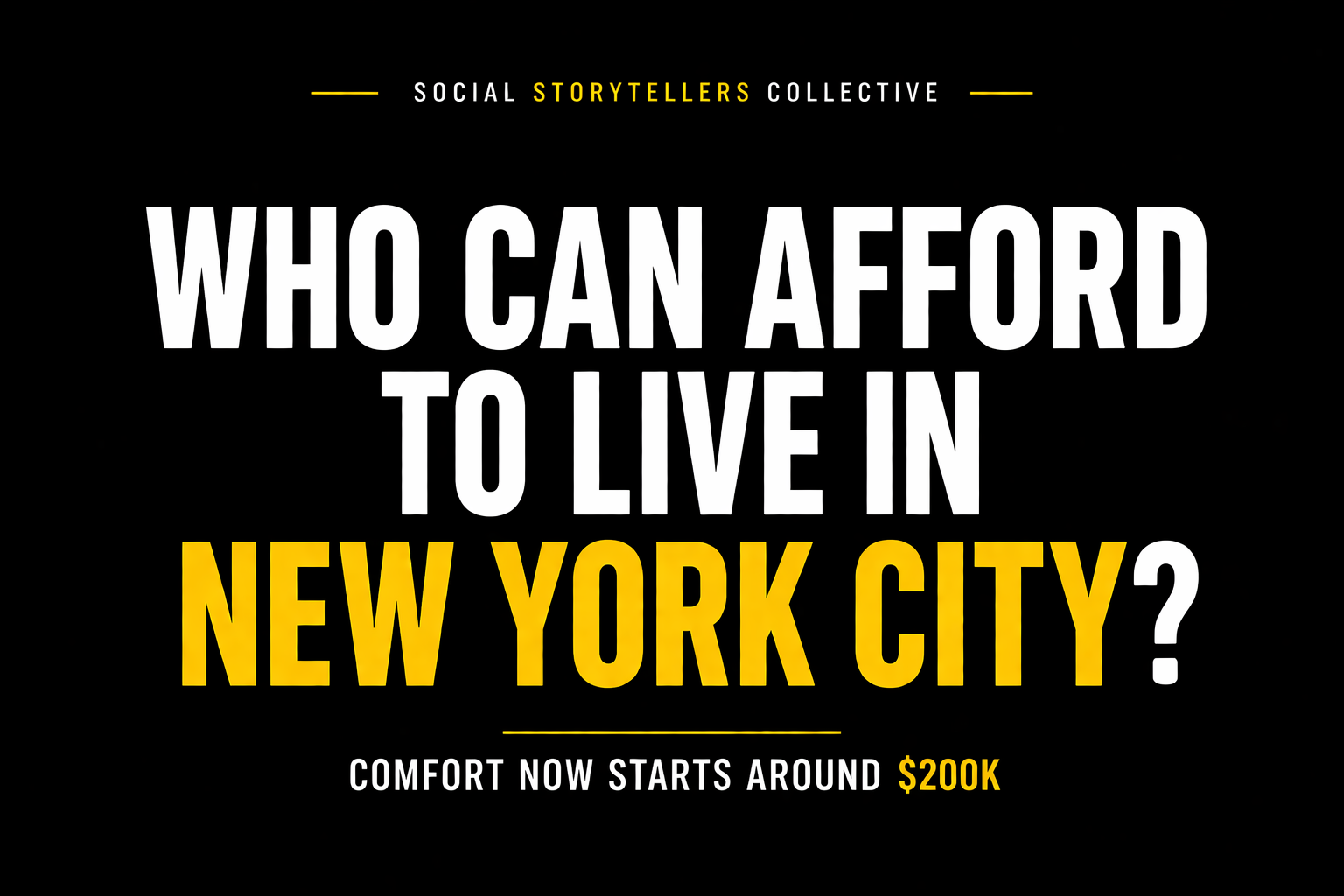
The housing numbers explain why. Manhattan’s median rent for a one-bedroom apartment hit an all-time high of $4,200 in early 2025. Asking rents citywide are now 15.2% higher than they would have been if the pre-pandemic trend had continued, rising at roughly twice the pace they were before 2020. Using the traditional benchmark that housing should consume no more than 30% of income, a resident would need to earn roughly $140,000 to $160,000 annually just to meet that standard on a one-bedroom in Manhattan. But that is mathematical affordability, not lived experience. Once taxes, transportation, groceries, healthcare, and everything else the city requires to function daily are factored in, the threshold for comfort rises significantly. In practice, absorbing New York rather than constantly reacting to it begins somewhere around $200,000 a year. The city’s median household income is $76,577. The gap between those two numbers is where the filtering happens.
That filtering is not abstract. It shows up in who is leaving and where they are going. Most people leaving New York are staying relatively close — heading to Long Island, Westchester, and nearby states like New Jersey, Connecticut, and Pennsylvania — while others are moving farther to Florida, California, and Texas. Millennials are leaving faster than any other generation. Hispanic New Yorkers are leaving faster than their white and Black neighbors. These are not random patterns. They are the predictable outcomes of a housing market that has priced out the people most likely to be paying rent rather than carrying a mortgage, working in service industries rather than finance, building community rather than managing capital.
Industries that depend on moderate wages — hospitality, retail, education, public service — face growing instability as workers move farther away or exit the region altogether. Job growth slowed in 2025, with losses in trade, food service, accommodation, and construction, even as finance and information kept growing. That divergence is the labor market version of the same filtering happening in housing. The city is retaining the industries that serve high-income residents and losing the industries that serve everyone else. Cultural ecosystems — independent artists, small business owners, the informal economy of a neighborhood — become harder to sustain when both residential and commercial rents price out the people who built them.
New York has historically offset domestic outmigration with international immigration, replenishing its population with new arrivals who contribute labor, culture, and economic energy. That dynamic has kept the city dense and dynamic even as costs rose. But immigration patterns have shifted under current federal enforcement priorities, and the replenishment model that masked domestic losses for years is under its own pressure. Immigration does not eliminate the affordability gap. It shifts who is navigating it. When the cost of entry rises high enough, even that buffer begins to thin.
What it would take to rebalance the equation is not unclear. Housing supply would need to expand at a scale that meaningfully affects pricing, particularly in the middle-income range where the gap is most pronounced. Wage growth would need to align more closely with the cost of living in sectors that sustain the city’s daily function. Policy decisions — from zoning to transit investment to tenant protections — would need to operate in coordination rather than isolation. Affordability is not produced by one system. It is the outcome of many interacting at once, usually slowly, rarely in time to catch the people already leaving.
I made my calculation and moved on. Millions of others are making theirs right now. New York City remains one of the most economically powerful and culturally influential places in the world. Demand to live there has not weakened. But demand alone no longer determines access. The city is increasingly defined by a threshold — the level of income required to participate without constant financial strain. As that threshold rises, the question shifts from who is drawn to New York to who can actually remain. For a lot of people who loved it the way I did, the answer is becoming clearer every month.
New York City is the first installment of City Signals, SSC’s ongoing series on what cities reveal about who they’re built for. The Houston installment publishes May 1 and Miami on May 4. Future cities in the series include Boston, Washington D.C., Los Angeles, Dallas, Austin, and San Francisco.