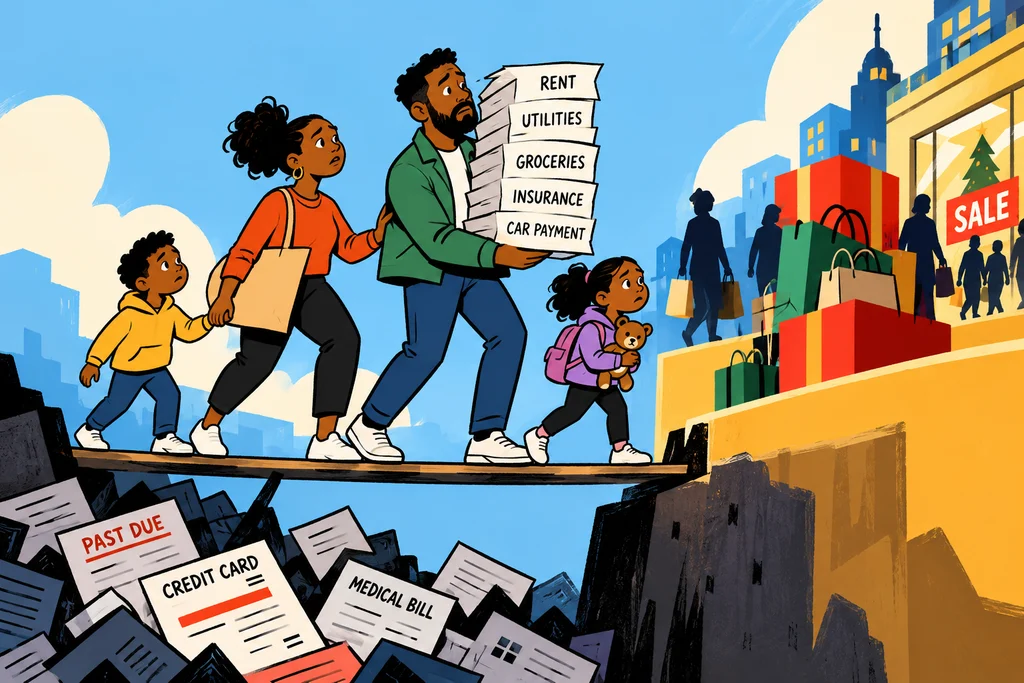
There is a version of the American economy that shows up in headlines, and there is the version that shows up in a checking account three days before payday. In the first, spending is strong and holiday sales are forecast to top $1 trillion. In the second, the rent cleared, the car note is due Friday and a $400 surprise would mean choosing which bill waits. I think we spend too much time measuring the first economy and not nearly enough time listening to the second.
Millions of Americans are living in what I would call the paycheck-to-paycheck economy, where every dollar is assigned before it arrives and there is no cushion for the unexpected. The exact share depends on who is asking: a January survey by the fintech company MX found 62% of adults say they live paycheck to paycheck, while Debt.com’s 2026 budgeting survey put it at 48%. Even the lower figure means nearly half the country is one broken transmission away from a crisis.
The Numbers Behind the Feeling
The Federal Reserve’s latest survey of household finances, released in May, found that 63% of adults would cover a $400 emergency with cash or its equivalent. That number has not moved in three years and is still below the 68% recorded in 2021, which means more than a third of adults would have to borrow, sell something or go without paying. Sixteen percent said they had not paid all of their bills the month before, and price increases remained Americans’ most common financial worry, cited by just over nine in 10 adults.
The cushion is thin across the economy, too. Americans saved just 4.1% of their disposable income in August, and after inflation, disposable income did not grow at all that month, according to the Bureau of Economic Analysis. Prices measured by the government’s preferred inflation gauge were up 3.4% from a year earlier.
When the paycheck runs out, the credit card fills the gap. Americans carried $1.263 trillion in credit card balances in the second quarter, up $54 billion from a year earlier, and nearly 7% of those balances slipped into serious delinquency, the Federal Reserve Bank of New York reported. The bank said new delinquencies on credit cards and auto loans “remain at elevated levels.”
This Is Not Just About Budgeting
The standard advice for living paycheck to paycheck is personal: cut the lattes, cancel the streaming services, build an emergency fund. Some of that is useful, and I believe in budgeting. But advice aimed at individual habits misses how much of the squeeze is built into the system around them.
Rent takes a bigger share of income than it did a generation ago, child care can rival a mortgage, insurance premiums keep climbing and grocery prices never came back down after the pandemic. Those are not discretionary purchases a family can trim. At the same time, job security is thinner than it looks, as profitable companies like eBay cut workers even while growing, and a layoff can wipe out whatever buffer a household managed to build.
It is not only low-wage workers caught in it, either. SSC has reported on households earning more than $500,000 a year that still live paycheck to paycheck, often because their costs grew to match their income. That is a different kind of strain than choosing between rent and groceries, but it points to the same habit: an economy that encourages people to spend everything they make and treats saving as an afterthought.
Strong Spending Can Hide Weak Households
What frustrates me most is how often the paycheck-to-paycheck economy gets read as good news. When consumers keep spending, the headlines call them resilient. But some of that spending is people paying more for the same things, and some of it is people putting necessities on credit cards they cannot pay off. Spending that is financed by shrinking savings and rising card balances is not strength, it is endurance, and endurance runs out.
Businesses understand this better than the headlines do. Retailers are rolling out memberships that promise savings, airlines are betting that wealthier travelers will absorb record holiday fares and lenders are happy to extend another line of credit. An economy that leans this heavily on people who are one bill away from falling behind is more fragile than its growth numbers suggest.
What Would Actually Help
I do not think the answer is lecturing people about spending. It starts with taking the costs that crush budgets seriously, especially housing and child care, and with wages that keep pace with prices instead of trailing them. Employers can help by offering automatic emergency savings accounts and earned-wage access that does not come with predatory fees. Policymakers can make it easier to build savings without penalties and harder for lenders to profit from people who are already behind.
Individuals still have choices to make, and a budget remains one of the best tools a household has. But no budget can fix a gap between income and the basic cost of living. When nearly half the country is living one emergency away from trouble, that is not a collection of personal failures. It is a sign of how the economy is working, and for whom.
A strong economy should not require millions of people to hold their breath until payday. Until it stops doing that, the spending numbers will keep missing the people behind them.