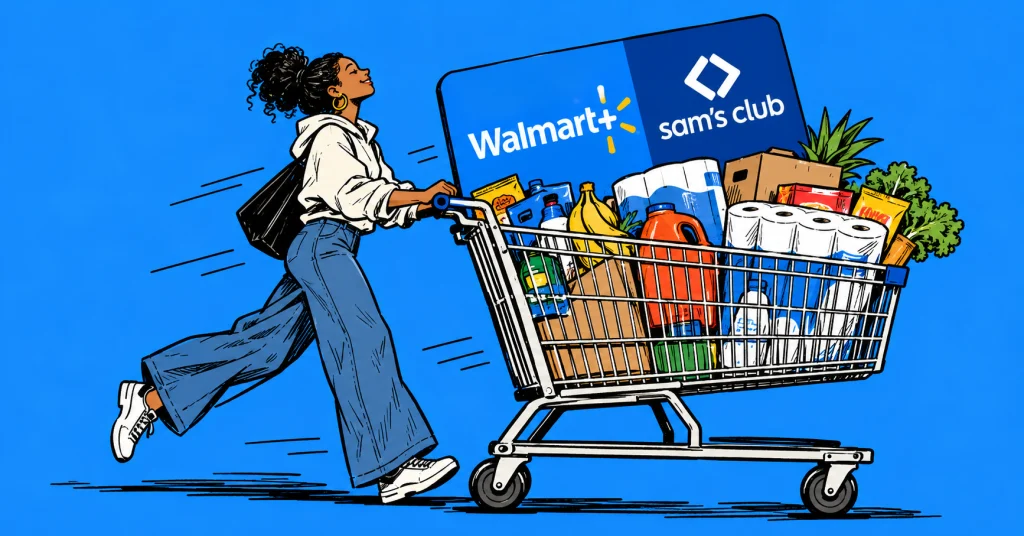
Walmart is combining its delivery service and warehouse club benefits into one annual subscription, offering households a cheaper way to shop across both chains. For the retailer, the opportunity is even bigger: becoming the first place customers turn for nearly everything they buy.
A family planning its weekly shopping trip might buy groceries at Walmart, stock up on household supplies at Sam’s Club, fill the gas tank on the way home and order a forgotten item for delivery later that evening. Until now, getting the full benefits of both retailers meant paying for two separate memberships. Walmart is betting that bringing those services together under one annual fee will make customers less inclined to shop anywhere else.
On Tuesday, October 20, Walmart announced a combined Walmart+ and Sam’s Club Plus membership for $120 annually, nearly $100 less than purchasing the subscriptions separately. The package includes access to Sam’s Club warehouse pricing, eligible deliveries from both chains, fuel discounts, streaming benefits and rewards on qualifying purchases. Walmart President and CEO John Furner described the new offering as a way to give customers more value and more time back. The company is introducing it just as households head into the holiday shopping season with grocery, transportation and other everyday expenses weighing heavily on their budgets.
The savings are real for customers who already use both services. But the broader business strategy goes beyond reducing membership fees. Walmart is consolidating two shopping experiences into a single relationship, making it easier for customers to move between its stores, warehouses, delivery services and digital platforms. The more needs that relationship satisfies, the fewer reasons a household may have to consider another retailer.
One Membership, Several Ways to Keep Customers
Walmart+ ordinarily costs $98 annually, while Sam’s Club Plus costs $120. Together, the separate memberships total $218. The new $120 bundle reduces that combined cost by $98, or roughly 45%. Existing Walmart+ annual subscribers can switch for an additional $22 a year, while current Sam’s Club Plus members can activate Walmart+ without paying another membership fee. Customers enrolled in the basic Sam’s Club membership can upgrade for $60.
The bundle gives Walmart a way to connect two parts of household spending that often operate on different schedules. Sam’s Club serves shoppers buying larger quantities, sometimes for weeks at a time. Walmart handles more frequent purchases, smaller baskets and immediate household needs. The combined subscription encourages customers to use both formats rather than treating them as separate shopping decisions.
That matters because retail loyalty is increasingly about convenience as much as price. A household that already uses Walmart for grocery delivery may be more inclined to buy paper towels, cleaning products and bulk groceries from Sam’s Club once warehouse access is included. Conversely, a Sam’s Club shopper who previously ordered everyday items through another delivery platform now has a financial incentive to try Walmart+.
Neither behavior is guaranteed. Yet the membership creates opportunities for Walmart to capture purchases that might otherwise go to Amazon, Costco, Target, Kroger or another competitor. It also establishes a recurring financial relationship with customers before they make their next purchase.
The Competition Is No Longer Just About Grocery Prices
Walmart is entering a more aggressive phase of competition with Amazon Prime and Costco, two companies that have built substantial businesses around paid memberships. Amazon Prime costs $139 annually, while Costco’s Executive membership is $130. Walmart’s new offering brings warehouse access, retail delivery and streaming benefits together at a lower annual price than either of those premium memberships.
The timing is important. Reuters reported that Walmart is entering the holiday season after softer consumer spending, including weaker average spending per visit. Like other major retailers, Walmart has reduced prices on thousands of products to attract shoppers who have become more selective about where their money goes. Memberships offer another avenue for building recurring revenue and encouraging repeat purchases, even when customers are reluctant to increase their overall spending.
There is a competitive advantage in reducing the number of decisions customers must make. Someone who has already paid for warehouse access, grocery delivery and streaming through one company has more reasons to begin each shopping trip within that company’s ecosystem. Over time, convenience can become habit, and habit can become a powerful form of customer retention.
The $120 Price Tag Does Not Tell the Whole Story
For consumers, the value depends on how frequently they use the benefits and whether the subscription changes their spending. Walmart’s advertised free scheduled delivery comes with qualifying order minimums: $35 for Walmart and $50 for Sam’s Club. Streaming access is limited to an eligible ad-supported Peacock or Paramount+ plan, while the advertised 2% Sam’s Cash applies only to qualifying purchases and is capped at $750 annually.
There is also an upfront affordability consideration. Walmart describes the $120 subscription as equivalent to $10 monthly, but the company does not offer a monthly payment option or free trial for the combined membership. For a household struggling to cover groceries or utilities, paying $120 at once may be more difficult than the marketing suggests, even when the annual savings are substantial.
That creates an important contrast in the company’s strategy. Walmart is positioning the membership as a response to economic pressure, but maximizing its value requires customers to spend enough with the retailer to justify the annual fee. A household that already uses both subscriptions could realize an immediate reduction in membership expenses. Someone joining solely because the bundle appears inexpensive may discover that the savings depend on shopping patterns they do not currently have.
Walmart Wants to Become the Default, Not Just the Discount
The company’s decision to offer the combined membership to U.S. Walmart and Sam’s Club field associates adds another dimension to the launch. It expands access among employees while introducing more potential users to services the company wants customers to adopt. Walmart has also said the costs associated with the new program are not expected to materially affect its current fiscal-quarter or full-year guidance.
For shoppers, the immediate proposition is straightforward: two memberships at a substantially lower combined price. For Walmart, the strategic opportunity is more consequential. The company is bringing warehouse shopping, everyday grocery purchases, delivery, fuel savings and entertainment into one subscription, competing for a larger share of how households organize their spending.
The success of that strategy will not be measured solely by how many people subscribe. It will depend on whether those members begin shopping more frequently across Walmart’s businesses and whether the company can retain them when the annual fee comes due again. The membership may save households money, but its greatest long-term value to Walmart could be making the retailer part of so many everyday decisions that shopping elsewhere becomes the less convenient option.