
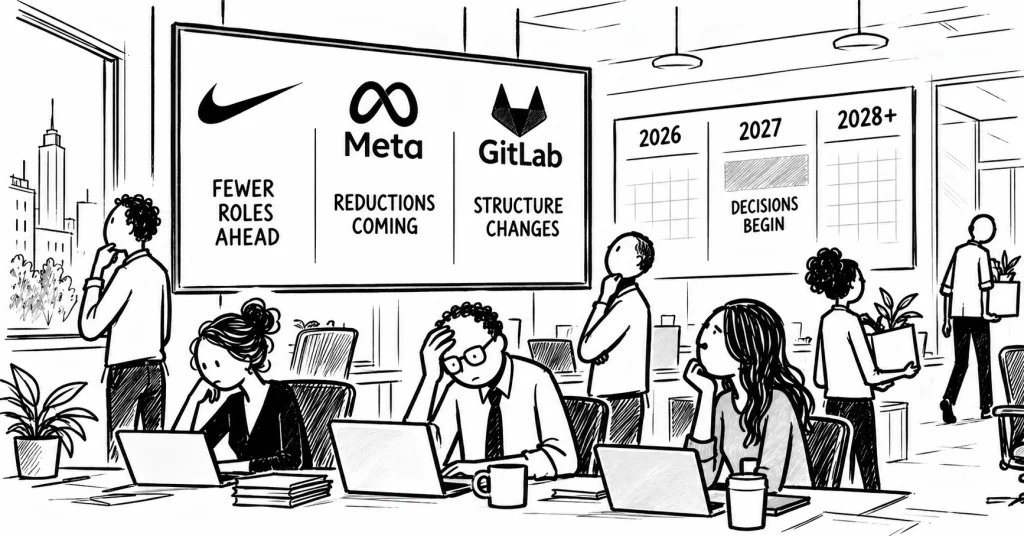
Nike, Meta and GitLab have announced reductions before identifying affected employees. The gap gives companies time to reorganize while workers decide how much uncertainty they can afford.
Nike told employees on October 1 that it would need fewer roles, with decisions about affected positions beginning in 2027 and beyond. The company has yet to determine the number of jobs or specific locations involved, according to CEO Elliott Hill’s employee memo. Business Insider reporters Sarah E. Needleman and Tim Paradis reported October 6 that Meta and GitLab also announced future reductions before identifying everyone affected. The examples show companies separating two decisions employees usually experience together: learning that jobs will disappear and learning whether theirs is among them. During that interval, the paycheck continues while confidence in its future weakens.
Nike’s announcement places the cuts inside a broader operating change involving supply-chain modernization, three geographic divisions and a new campus in Bengaluru, India. Hill says affected employees will receive timelines and support as decisions are made, with required local consultation taking place before proposals are finalized. Those changes involve decisions about where work happens and which capabilities receive investment. The company can explain its direction before completing that process. Employees, however, have to make their own decisions immediately—whether to pursue another job, postpone a purchase or keep investing in a career whose position in the new structure is unresolved.
The Company Gets Time. Workers Carry the Uncertainty.
Advance announcements spread the effects of a reduction beyond the people eventually dismissed. A worker who might otherwise feel secure now has reason to consider leaving, even if management ultimately intends to retain them. That changes the practical bargaining position: the employer controls the timetable and selection process, while employees must assess their prospects with incomplete information. Our reading is that some transition risk moves onto the workforce before a single individual receives a dismissal notice. People begin spending time preparing for unemployment without knowing whether that preparation will prove necessary.
Voluntary departures can also change the cost and composition of a restructuring. Employment attorney Kevin Zwetschtold Needleman and Paradis that early warnings could encourage employees to quit, potentially reducing severance expenses and involuntary layoffs. He presented that as a possible incentive, rather than an established motive at these companies. The trade-off is that employers can lose people they wanted to keep. Workers with attractive outside options may leave first, while those with fewer alternatives remain through the uncertainty. Management can control which roles it plans to eliminate; it has less control over who decides to walk away.
More Notice Helps When It Includes Useful Information
Phased announcements have precedent. In Meta’s March 14, 2023 restructuring update, Mark Zuckerberg outlined approximately 10,000 job reductions, with technology-group layoffs expected in late April and business-group reductions in late May. That schedule offered a clearer window than an announcement extending into an unspecified future year. Even a defined timetable leaves workers awaiting individual decisions, but it establishes when answers should arrive. The amount of notice and the usefulness of that notice are separate measures of how much preparation employees can realistically undertake.
Specificity can turn a warning into something workers can act on. Sarah Rodehorst, CEO of Onwards HR, told Business Insider that identifying departments, locations or roles at risk helps employees assess their situation. Outplacement executive Laura Labovich said a month or two can provide a useful head start on a job search, particularly when employers support interview time. Those practices make preparation compatible with continued employment. Without them, workers face competing demands: demonstrate commitment to the current job while quietly searching for the next one, using personal time to manage a transition the company initiated.
If advance announcements become more common, retaining employees through a restructuring will require more than promising eventual clarity. Companies that provide dates, explain affected areas and support transitions may preserve trust while decisions proceed. Companies that leave the warning open-ended could accelerate departures and weaken the teams expected to execute the turnaround. The next employment cost may appear before the final layoff count—in the people who leave, the plans workers postpone and the confidence employers must rebuild.