
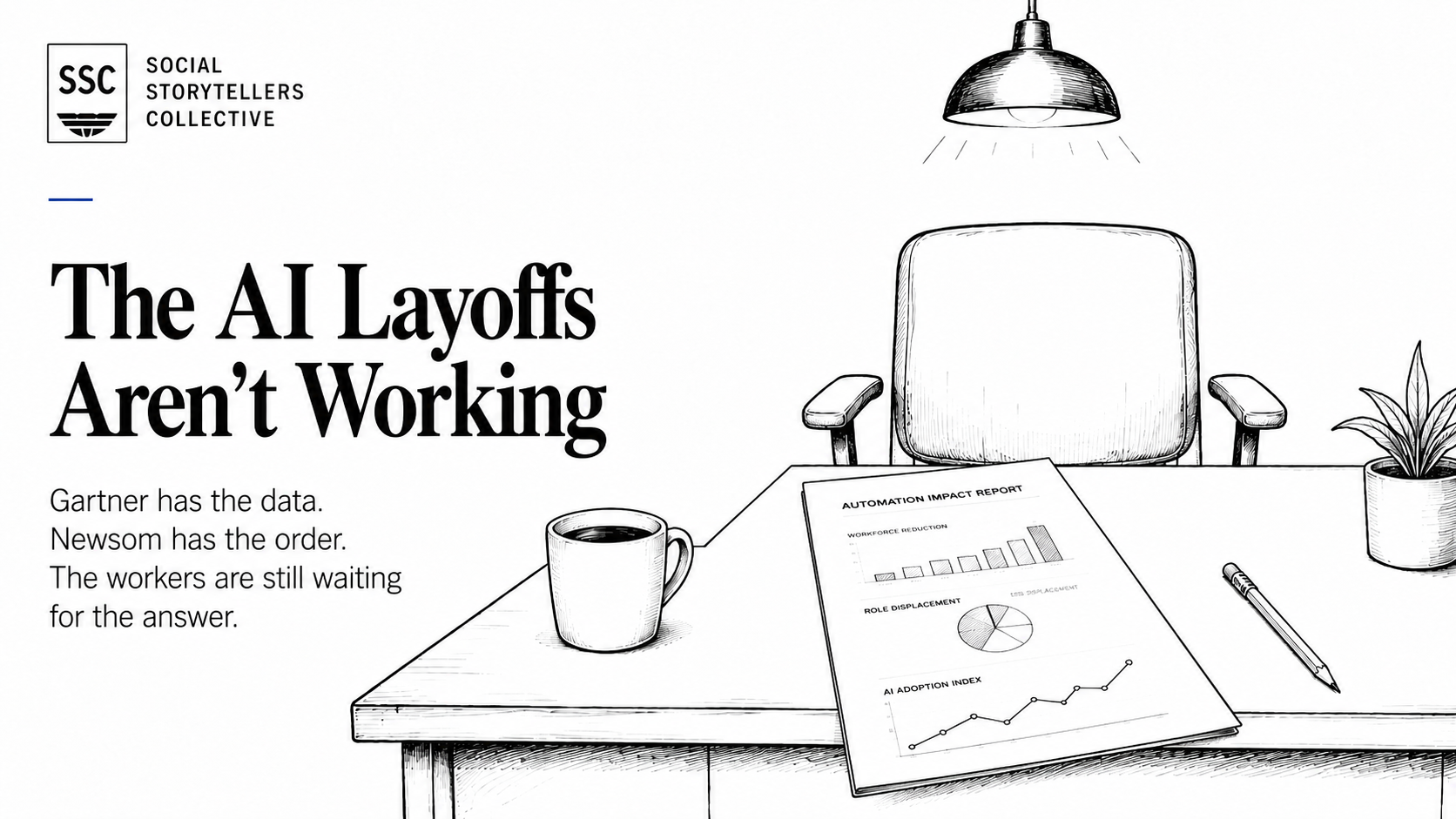
There is a number buried inside a Gartner study published earlier this month that should be in every earnings call, every board presentation, and every memo that uses the word “transformation” to describe what is about to happen to someone’s job.
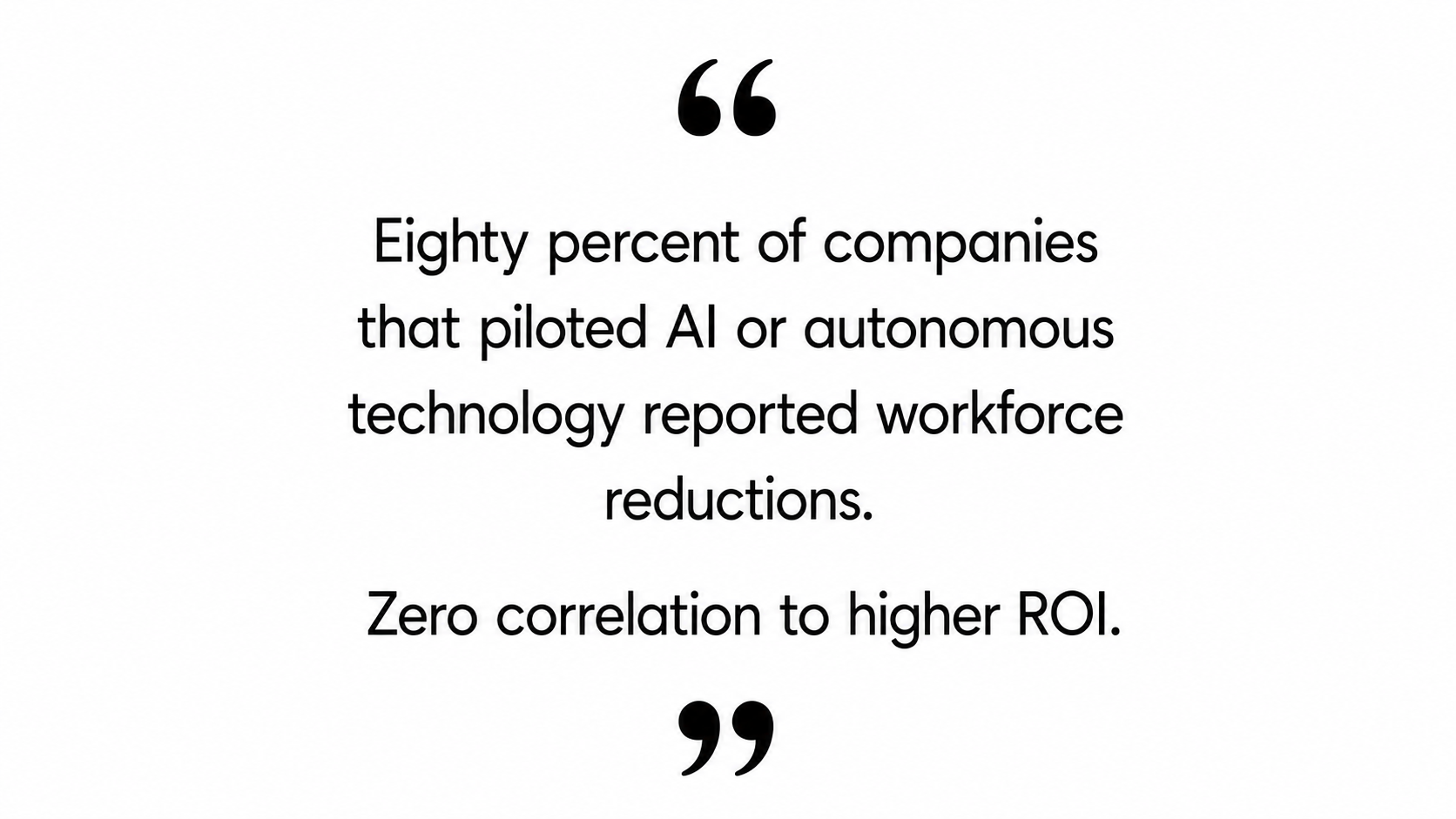
Eighty percent of companies that piloted AI or autonomous technology reported workforce reductions. Zero correlation to higher ROI.
Read that again slowly. The companies cutting people in the name of AI were not the companies generating returns from AI. The Gartner survey covered 350 global executives at firms with at least $1 billion in annual revenue — not startups making bets, but established institutions making decisions that affect tens of thousands of workers. And the data says the bet is not paying off the way the memos said it would.
“Chasing value only through headcount reduction is likely to lead most organizations down a path of limited returns,” said Helen Poitevin, VP analyst at Gartner and one of the study’s key researchers. “That’s not where the value is. That’s not where the productivity gains are going to be.”
The companies reporting the highest returns were doing something different. They were using AI to make workers more productive — what Gartner calls “people amplification.” Not replacing the person. Extending what the person could do. The distinction is not subtle, and it is not new. What is new is that there is now data, at scale, from organizations large enough that the results can’t be explained away as outliers, showing that the companies running the replacement playbook are not winning.
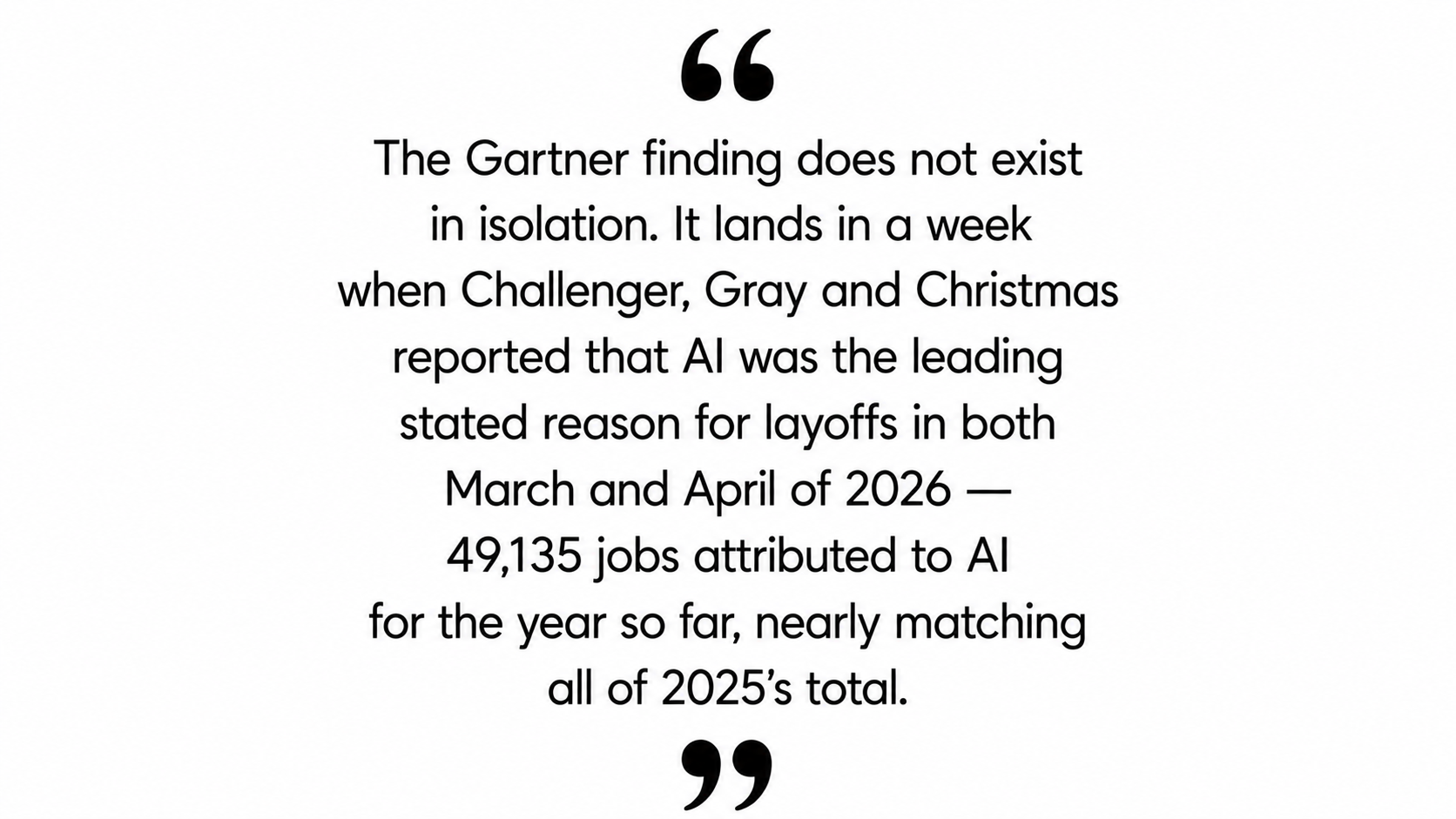
The Gartner finding does not exist in isolation. It lands in a week when Challenger, Gray and Christmas reported that AI was the leading stated reason for layoffs in both March and April of 2026 — 49,135 jobs attributed to AI for the year so far, nearly matching all of 2025’s total. It lands the same week Meta completed the layoffs of 8,000 workers, Cloudflare cut 1,100 after reporting internal AI usage jumped 600% in three months, and PayPal announced it would eliminate 20% of its workforce over the next two to three years, with the CEO citing AI adoption and automation in the same sentence.
The question the Gartner data raises about all of those announcements is not whether they happened. It is whether the companies making them are being honest about why.
Sam Altman said it directly in February: “I don’t know what the exact percentage is, but there’s some AI washing where people are blaming AI for layoffs that they would otherwise do.” Gartner’s own framing was more measured but pointed to the same conclusion — many of these cuts appear to be “a kind of one-time exercise,” Poitevin said, not the structural reset the press releases implied. Companies are testing the waters. Reducing headcount. Waiting to see if the returns arrive.
The workers who absorbed that exercise don’t get a do-over when the ROI doesn’t show up in the next earnings report.
SSC has been covering the pressure building inside the American workforce all year. The HSBC Ascend programme and the “performance culture” vocabulary spreading across Nestlé, 3M, Unilever, and Novo Nordisk. The Walmart restructuring that is engineering stress for its own corporate employees while capturing the financial stress of its customers. The credential deflation documented across The Degree Economy series — an MBA fire sale happening at the precise moment the jobs the degree was supposed to unlock are disappearing.
The Gartner number threads through all of it. The companies calling it performance culture, transformation, restructuring, right-sizing — they are, in many cases, running the same playbook Gartner just showed doesn’t produce the returns they promised their boards. The workers absorbing the cost of that playbook are doing so in a moment when the savings rate is 3.6%, consumer debt has crossed $1.2 trillion, and the cost of ordinary life has permanently reset upward. There is no cushion. The experiment is being run on people who cannot afford for it to fail — and who will not be in the room when the post-mortem happens.
On May 21 — one day after Meta’s layoffs began at 4AM Singapore time, two days after the California Senate passed the No Robo Bosses Act — Governor Gavin Newsom signed an executive order directing state agencies to study how to mitigate job losses from AI.
The order is wide-ranging. It calls for state agencies to explore severance policies, subsidized employment, job training investments, stock compensation structures, cooperative business ownership for workers, and a review of how unions are currently negotiating around AI. It directs California to assess the impact of AI on its labor market. It is, as policy documents go, serious in its scope.
What it is not is enforceable protection. Not yet.
The No Robo Bosses Act — Senate Bill 947 — would prevent companies from using an AI or automated system as the sole reason a person is fired or disciplined. It passed the California Senate the day before Newsom signed his executive order. It is a direct, structural response to the dynamic the Gartner study documented: companies cutting people based on AI-driven decisions before those systems are generating verified returns. Newsom vetoed a nearly identical bill last fall.
He now has it on his desk again.
The political context around that decision is not invisible. In February, AFL-CIO president Liz Shuler, members of the California Labor Federation, and labor leaders across Democratic primary states pledged to pull support from a Newsom 2028 presidential campaign if he did not take concrete steps to protect workers from AI displacement. The executive order issued May 21 is the concrete step. Whether it is sufficient is the question labor is now asking — and the question the Gartner data makes considerably sharper.
The governor who wants to run on protecting workers from AI has the clearest possible argument for signing the No Robo Bosses Act sitting in a Gartner study: the layoffs aren’t generating the returns the companies promised. The workers lost the jobs. The ROI never showed up. The system making the decision — the autonomous AI, the algorithmic performance review, the automated workforce reduction model — did not have access to that data when it recommended the cut. And under current California law, that recommendation is sufficient grounds for termination.
The No Robo Bosses Act would require a human in that loop. Not to prevent AI from being used. To require that a person — accountable, auditable, named — be part of the decision to fire someone. That is not an anti-technology position. It is a pro-accountability one. And Gartner’s own data suggests it would push companies toward the “people amplification” model that is actually producing returns, rather than the headcount reduction model that isn’t.
The gap between the Gartner study and the Newsom executive order is the same gap that runs through every workforce story SSC has covered this year. It is the gap between what the data says and what the decision-makers do with it. Between the research that shows the playbook isn’t working and the quarterly incentive to run it anyway. Between the executive order that calls for a study and the bill that would actually change the outcome for the worker at the end of the org chart.
Gartner is looking at the corporate interior. Newsom is looking at the political exterior. The workers are in the middle — in the space between a commissioned study and a decision already made, in the all-hands where the word “transformation” was used, in the performance review that arrives before anyone has run the post-mortem on whether the last round of cuts produced what the memo said it would.
The data exists. The argument is there. The bill is on the desk.
Watch what happens next.