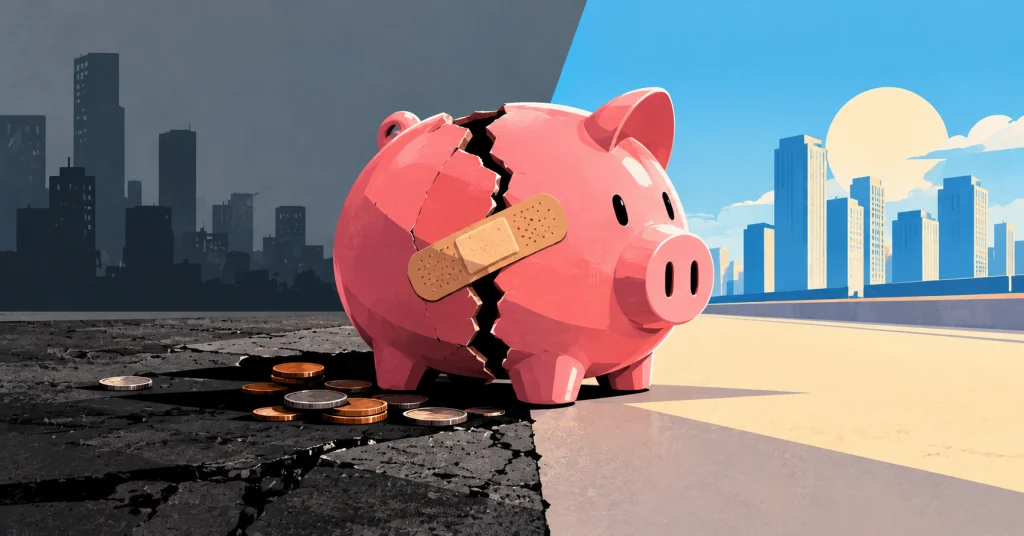
New Pew Research Center data shows how financial strain feels from the inside: stuck, angry and sometimes ashamed for those at the bottom, content and proud for those at the top. With the midterms days away, those feelings may matter as much as the numbers.
Earlier this month, SSC reported in Nearly Half of Americans Struggled to Afford at Least One Basic Necessity This Yearthat 44% of U.S. adults had trouble paying for medical care, transportation, housing or food in the past year. That finding, from a Pew Research Center survey conducted this summer, measured what people could and could not afford. The same research asked a harder question: how does it feel?
The answers show an economy that is experienced very differently depending on where you stand in it. And they help explain why so many Americans can be cutting back, falling behind and still believe they are doing better than most.
Hopeful at the Top, Stuck at the Bottom
Pew asked Americans how often they feel certain ways when they think about their personal finances. Overall, the picture is mixed. About 37% say they often feel hopeful and 36% often feel content. But 30% often feel stuck, 18% often feel angry and 13% often feel ashamed.
Those averages hide two very different emotional realities. Among upper-income adults, 58% often feel content, 53% feel hopeful and 45% feel proud. Only 12% often feel stuck, and just 3% feel ashamed.
Among lower-income adults, the most common feeling is not hope. It is being stuck. Forty-three percent say they often feel that way, compared with 30% who often feel hopeful and 24% who feel content. Twenty-eight percent often feel angry, and nearly a quarter, 23%, often feel ashamed when they think about their finances.
Shame is a striking word to find in an economic survey. It suggests that for many people, money trouble is not only a budget problem but a personal verdict, something to hide rather than something happening to millions of others at the same time.
“Doing Better Than Most”
One of the survey’s most revealing findings is about comparison. Asked how they are doing at meeting basic expenses, 58% of Americans say they are doing better than most people. That includes 85% of upper-income adults and 63% of middle-income adults.
Even among lower-income adults, the group most likely to be struggling, 35% say they are doing better than most Americans, 44% say about the same, and only 19% say they are worse off.
There are reasons people underestimate where they stand. Financial strain is often private. People see friends’ vacations and dinners, not their overdue bills, payday loans or trips to the food pantry. Pew found that among people who struggled to afford a basic necessity, half had borrowed money from friends or family and nearly a third had taken out a payday or short-term loan. Those are not things most people post about.
That silence shows up in everyday social life. As SSC explored this week in When Your Friends Pick Drake’s Hollywood and You Can’t Afford to Go, a dinner invitation can quietly turn into a financial calculation that no one else in the group chat sees. Pew found that 70% of Americans cut back on extras like eating out, streaming and entertainment in the past year. Many of them may assume they are the only ones. So we want to know: when your friends pick a restaurant that’s outside your budget, what do you usually do? Take the SSC Daily Poll and see how other readers answered.
Worry That Doesn’t Clock Out
The anxiety extends past this month’s bills. Thirty-seven percent of Americans worry every day or almost every day about saving for retirement, and about a third worry that often about health care costs and debt. Looking ahead, 41% say they are not too or not at all confident they will have enough income in the future to live the life they want, nearly double the 22% who are very confident.
For lower-income adults, daily worry is the norm across nearly every category. About half worry every day or almost every day about paying their bills (49%) and saving for retirement (48%). More than four in 10 worry that often about health care (43%), debt (42%), affording enough food (41%) and paying rent or a mortgage (39%).
Who Carries the Strain
The burden is not spread evenly. Pew found that financial challenges are more common among women, Black and Hispanic adults, young adults and people without a four-year degree, groups that are also more likely to have lower incomes. Sixty-five percent of Black adults and 60% of Hispanic adults had trouble affording at least one basic necessity in the past year, compared with 36% of white adults. Among adults under 30, the figure was 60%.
Those gaps line up with other strains SSC has tracked this week. In The Public-Sector Ladder Is Shrinking, and Black Women Are Falling First, we reported that unemployment among Black women rose sharply in September as job cuts reached the sectors where they are concentrated. When income is already tight, losing a job does not just reduce spending. It pushes households into the borrowing and worry that Pew documents.
Same Economy, Different Lenses
Feelings about money also split by party, though less than one might expect, and not only because of income. Republicans and Republican-leaning independents are more likely than Democrats and Democratic leaners to say they have enough income to live the life they want (46% vs. 35%), were able to save in the past year (51% vs. 43%), can pay all their bills in full (78% vs. 69%) and have three months of emergency savings (51% vs. 45%). Pew notes that income gaps between the two coalitions are modest. Republicans are also more positive about the national economy, though those ratings have slipped among Republicans since January.
That matters with the November 3 midterms days away. As SSC reported in The Economy Is Growing. So Why Does It Feel Like It Isn’t?, the official data puts the economy somewhere between the administration’s optimistic claims and voters’ gloomy mood. The University of Michigan’s latest survey, covered in Americans Are Still Spending. They Are Not Feeling Better About the Economy., found consumer sentiment stuck near historic lows. And as egg prices have fallen, SSC noted in Egg Prices Have Fallen 64% From Their Peak. The “Grocery Election” Isn’t Over. that cheaper eggs have not erased voters’ frustration with the overall cost of living.
Pew’s emotional data adds a layer those numbers cannot capture. Voters do not walk into the booth with a spreadsheet. They walk in with a feeling: hopeful or stuck, proud or ashamed, content or angry. For a large share of lower-income Americans, the dominant feeling is that they are working hard and not getting anywhere.
The Feelings Behind the Figures
The survey shows a country where most people believe they are getting by better than their neighbors, while millions are quietly borrowing, skipping, worrying and, in some cases, feeling ashamed. Both things can be true at once, because financial hardship is so often hidden.
That may be the most useful takeaway. The struggle Pew measured is common, not a personal failing. When nearly half of Americans have trouble affording a basic necessity, the person who feels stuck is not alone. They are simply not seeing everyone else who feels the same way.