
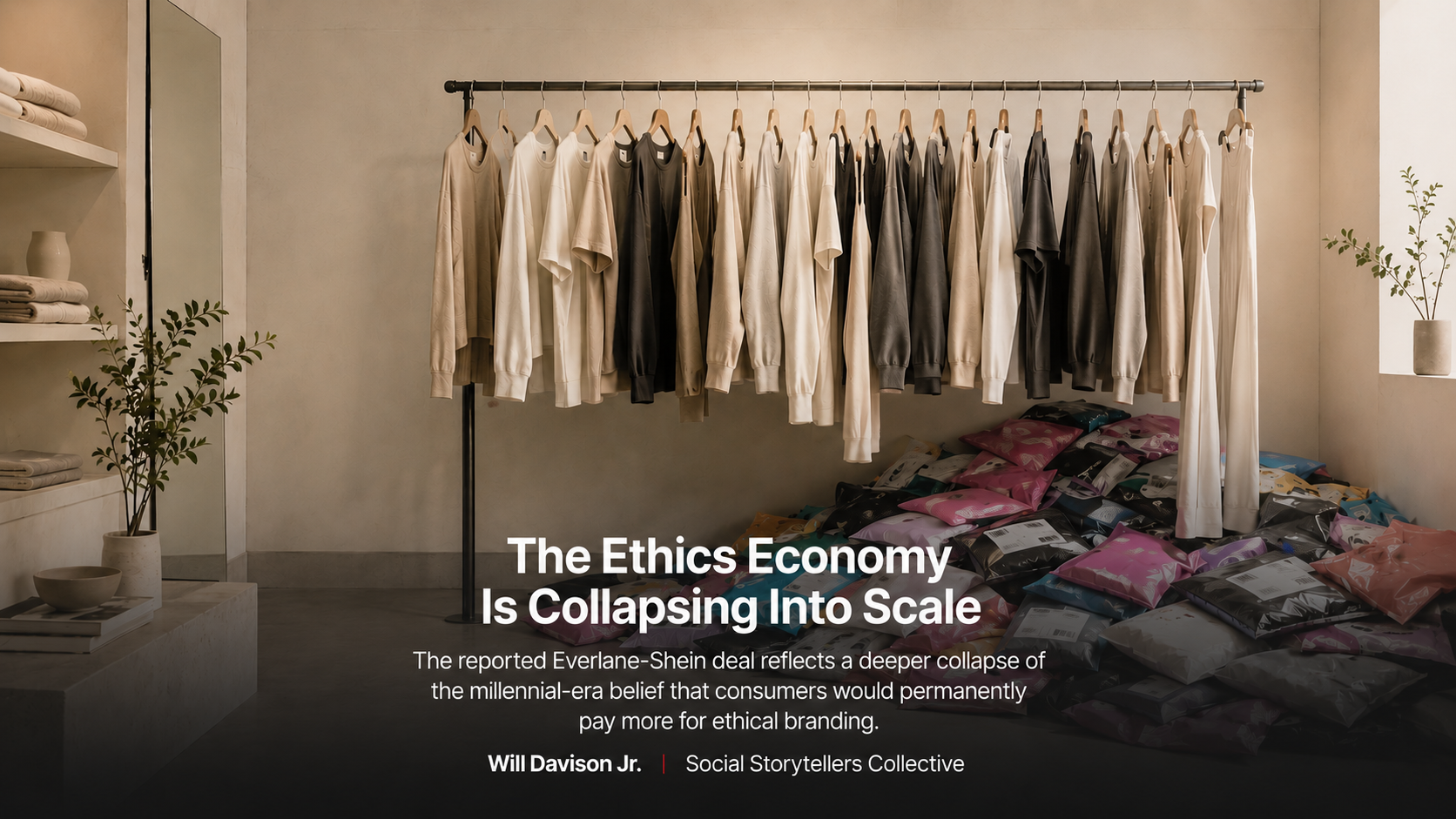
Everlane was supposed to be the answer to fast fashion. Transparent pricing. Responsible sourcing. A direct line between the factory and the consumer that cut out the markups and the mythology that made traditional retail possible. When it launched in 2011, it was one of the first brands to publish the true cost of every product it sold — what the materials cost, what the labor cost, what the markup was, and why. The pitch was simple: you don’t have to choose between looking good and doing good. We’ve already done the math for you.
The reported sale of Everlane to Shein for approximately $100 million is the receipt.
Shein — the ultra-fast fashion platform whose production cycles, labor practices, and environmental footprint represent the near-total inversion of everything Everlane marketed itself as — is reportedly acquiring one of the defining ethical fashion brands of the last fifteen years. If the deal closes, it will mark one of the starkest brand reversals in recent retail history. Not a quiet shutdown. Not a slow fade. A sale to the opposition.
The Everlane story does not begin with Shein. It begins with a market condition that no longer exists.
Everlane flourished in an environment built on specific assumptions: that a growing cohort of college-educated, urban, professionally mobile consumers would consistently prioritize ethics over price; that direct-to-consumer retail would continue disrupting traditional markup structures; that ESG-aligned branding would function as a durable competitive advantage rather than a temporary one. Those assumptions were not unreasonable in 2015 or 2018 or even 2021. They were wrong by 2024.
What changed was not consumer values. What changed was consumer financial flexibility. Inflation reshaped purchasing behavior across every income bracket. White-collar layoffs spread through the professional class that had been Everlane’s core customer. Housing costs rose. Student loan payments resumed. Discretionary spending contracted — and when it did, the premium attached to ethical purchasing was among the first things people stopped paying. Consumers still say they care about sustainability. Purchasing behavior across much of retail still heavily favors convenience, affordability, and scale.
That gap between stated values and actual purchasing behavior is not hypocrisy. It is arithmetic. And Everlane was caught inside it.
The reported Shein acquisition is striking not just as a business outcome but as a symbol. Shein has faced sustained criticism over labor conditions in its supply chain, environmental impact from its production volume, and the broader cultural role it plays in accelerating disposable fashion consumption at a global scale. These are not minor footnotes. They are the core of what Everlane spent fifteen years positioning itself against.
For Shein, the acquisition logic is straightforward. Everlane’s brand equity, customer data, and positioning in the premium ethical fashion space represent assets that scale players can absorb and redeploy. The mission doesn’t have to survive the acquisition. The customer list does.
For Everlane, the reported deal reflects what happens when a brand built on values runs out of the financial runway needed to defend them. Principles are easier to maintain when the balance sheet cooperates. When it doesn’t, the choices narrow quickly.
Everlane is not alone. Allbirds — the wool sneaker company that once reached a $4 billion valuation on a nearly identical consumer proposition — is closing stores and restructuring operations after years of declining revenue. Beautycounter, the clean beauty brand built on ingredient transparency and advocacy, shut down in 2024 before relaunching under new ownership. The pattern across all three is consistent: brands that bet on ethical consumption as a standalone business model are discovering that the bet had a time limit attached to it.
The deeper shift is structural. The ethical consumer economy is not disappearing. It is stratifying. Sustainable, mission-driven consumption is drifting upward toward households wealthy enough to treat it as fixed spending — a category where the purchase decision is never really about price. For everyone else, the calculus has changed. And the brands caught in the middle — too expensive for the price-sensitive consumer, not prestigious enough for the luxury buyer — are finding there is less and less room to stand.
Meanwhile the scale players keep winning. Companies with the largest supply chains and lowest prices continue absorbing market share regardless of their practices — in some cases, precisely because their practices allow them to undercut on price. In that environment, ethical positioning stops functioning as a competitive advantage and starts becoming a liability. The brands with the best values story and the thinnest margins are the most exposed.
The reported Everlane-Shein deal is not just a retail story. It is a values story — about what the millennial consumer economy actually was, and what it is becoming.
For a decade and a half, a cohort of consumers believed that purchasing decisions were a form of moral participation. That buying the right brand was a way of being the right kind of person. That the market would eventually reward companies that told the truth about their supply chains and charged accordingly. Everlane was one of the clearest expressions of that belief.
The belief was not wrong. The market condition that sustained it did not last.
What comes next is a retail landscape increasingly defined not by who has the best values story but by who has the most resilient infrastructure. Scale wins. The ethics economy, in its current form, is collapsing into it — one acquisition at a time.
This piece is part of SSC’s ongoing coverage of the ethical consumer economy and the structural forces reshaping brand identity in a post-boom retail environment.