
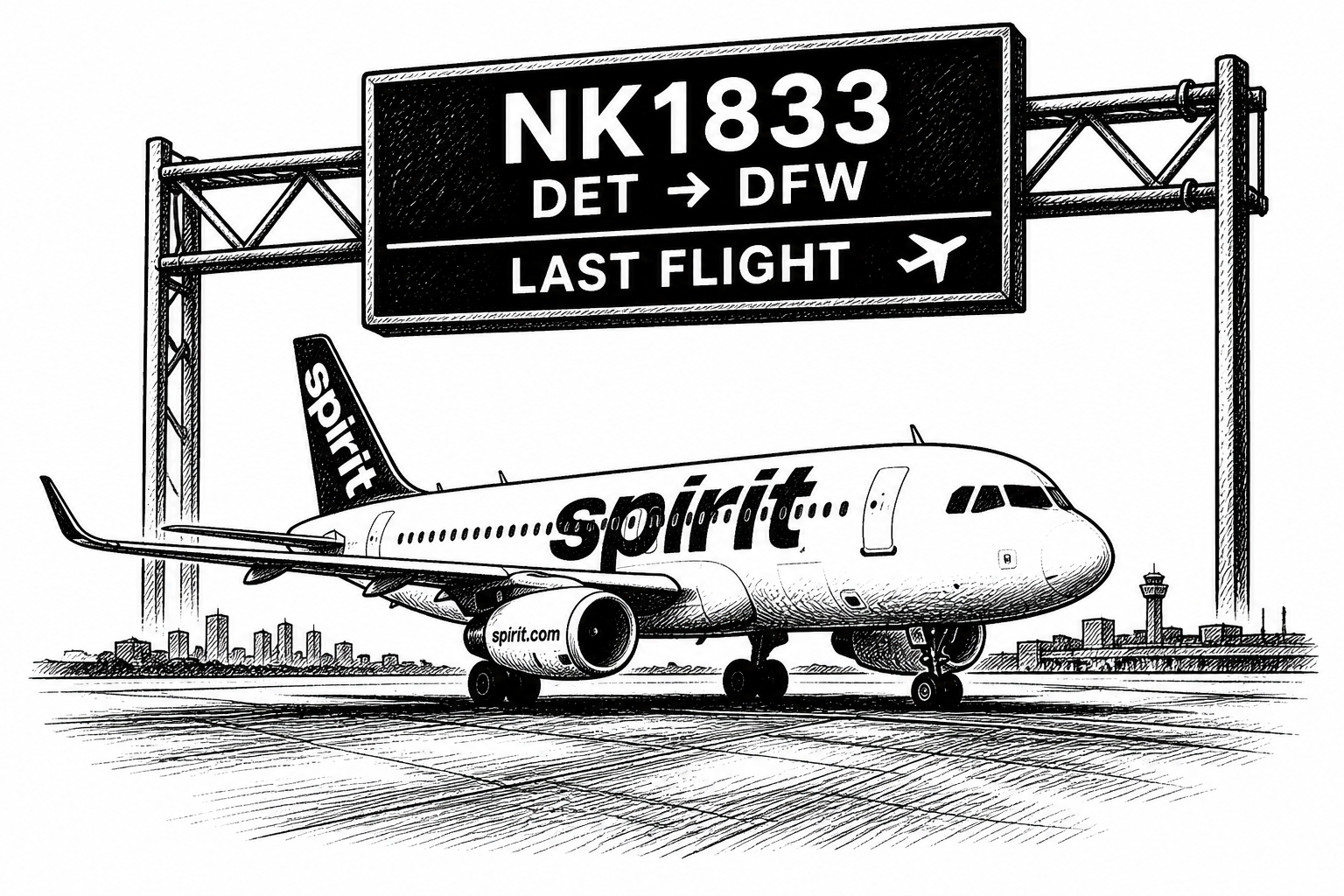
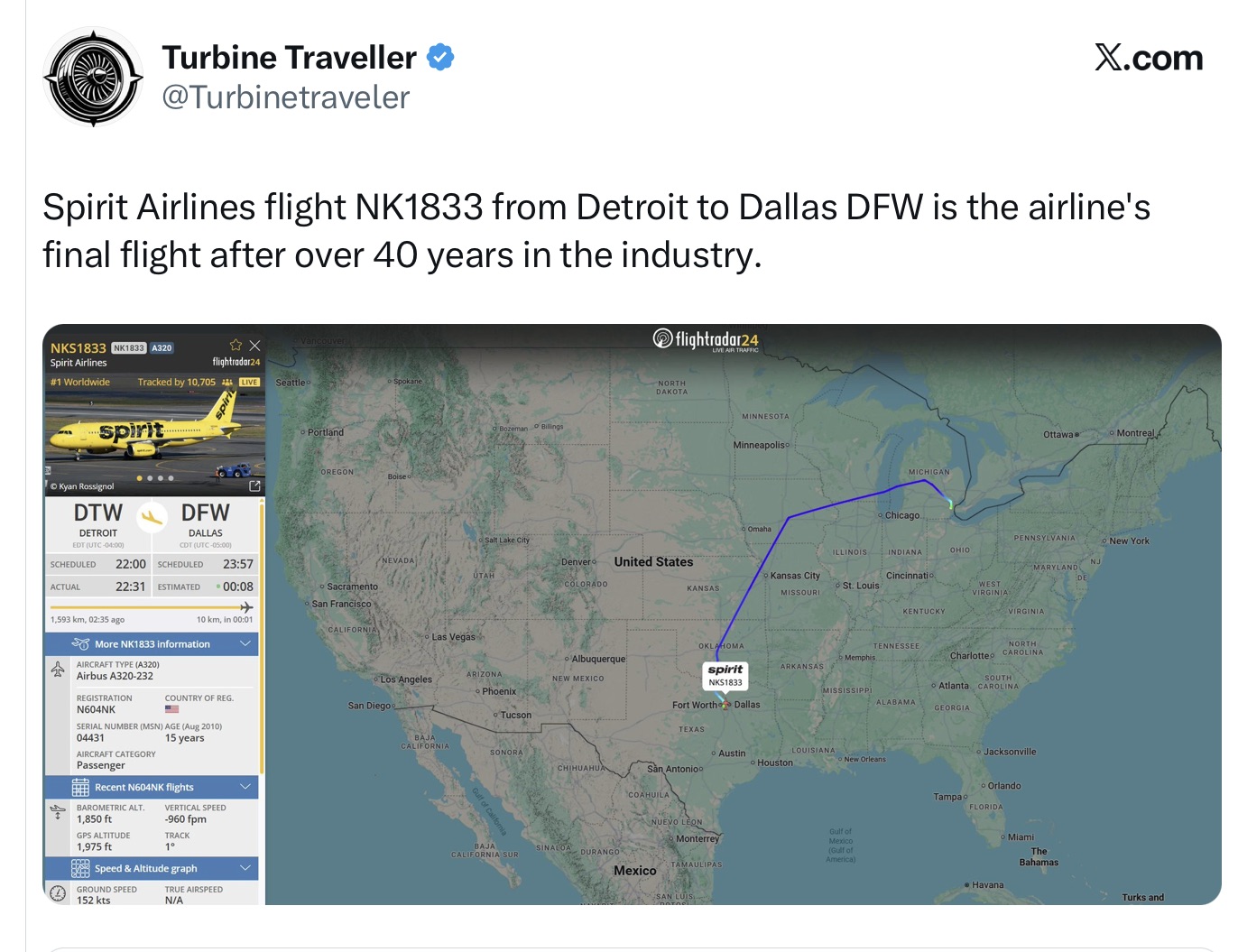
The final movement is almost quiet. Flight NK1833 departs Detroit, traces a familiar path south, and lands at Dallas–Fort Worth. No spectacle. No ceremony built into the system itself. Just another arrival — except this one carries a different kind of weight. After more than four decades in operation, this is Spirit Airlines’ last flight.
What makes that moment notable isn’t just the end of an airline. It’s the end of a specific kind of access that moved through the system so consistently it became invisible. Spirit’s ultra-low-cost model turned airfare into something closer to a commodity — stripped down, unbundled, and built around the idea that price alone could expand who gets to travel. That philosophy showed up in how people used it. Not aspirational trips planned months in advance, but opportunistic movement — weekend travel, last-minute visits, routes chosen because they were available rather than ideal. Spirit didn’t just serve demand. It shaped behavior.
I flew Spirit exactly once — and only by necessity. I missed my flight back to Miami from Cuba on another carrier and booked a Spirit flight on the spot for $100. The seat didn’t recline. They upsold me on Pringles and gummy bears somewhere over the Gulf. And it was, overall, a perfectly fine experience. I didn’t become a regular. I’m a United loyalist — sky miles accumulate slowly and I’m not giving them up. But that $100 flight existed when I needed it, and it got me home. That’s the version of access Spirit represented for millions of travelers who weren’t loyalists, weren’t collecting miles, and weren’t planning ahead. They just needed to move.
NK1833 becomes the final expression of that system in motion. The aircraft itself — a standard Airbus A320 — doesn’t signal anything unusual. The route isn’t symbolic in the way a final transatlantic crossing might be. But that’s the point. The end of this model doesn’t arrive with spectacle. It arrives the same way it operated: efficiently, quietly, and at scale until it no longer could.
The pressures that grounded Spirit weren’t tied to a single failure. They were structural. Rising operating costs, tighter margins, shifting consumer expectations, and a competitive landscape where larger carriers absorbed pieces of the ultra-low-cost playbook without committing fully to it. The model didn’t disappear overnight. It was gradually made harder to sustain — squeezed from multiple directions until the accumulation became impossible to absorb. What NK1833 marks is less an abrupt ending and more the moment where that accumulation becomes visible.
The implications move beyond aviation. When a system built around the lowest possible entry point disappears, access doesn’t vanish — but it becomes conditional. Fewer consistently cheap seats. More variability. More reliance on timing, flexibility, and trade-offs that not everyone can absorb. The flight lands. The system continues. But the layer that made movement broadly accessible at the lowest margin has thinned in ways that won’t be immediately obvious and won’t be replaced by the market on its own terms.
The pricing effect extends beyond Spirit’s own routes. Ultra-low-cost carriers don’t just compete — they set a ceiling. When Spirit operated a market, other airlines had to respond. Fares on overlapping routes were suppressed not because legacy carriers wanted to offer lower prices, but because Spirit’s presence made higher pricing difficult to sustain. That dynamic operated quietly and consistently across hundreds of markets for decades. Now that the constraint is gone, the recalibration begins. Not through a single dramatic price increase that would draw immediate attention, but through the gradual disappearance of the lowest fare options — fewer sale seats, less aggressive promotional pricing, reduced pressure on carriers that no longer have to match a competitor operating at Spirit’s cost structure. The traveler most affected won’t see a headline telling them airfare went up. They’ll just notice, over time, that the price they used to find is no longer there when they look for it.
NK1833 is just a route on a map. What it represents is a boundary — between a version of air travel that expanded access through price, and one that is now quietly redefining who that access still works for.