
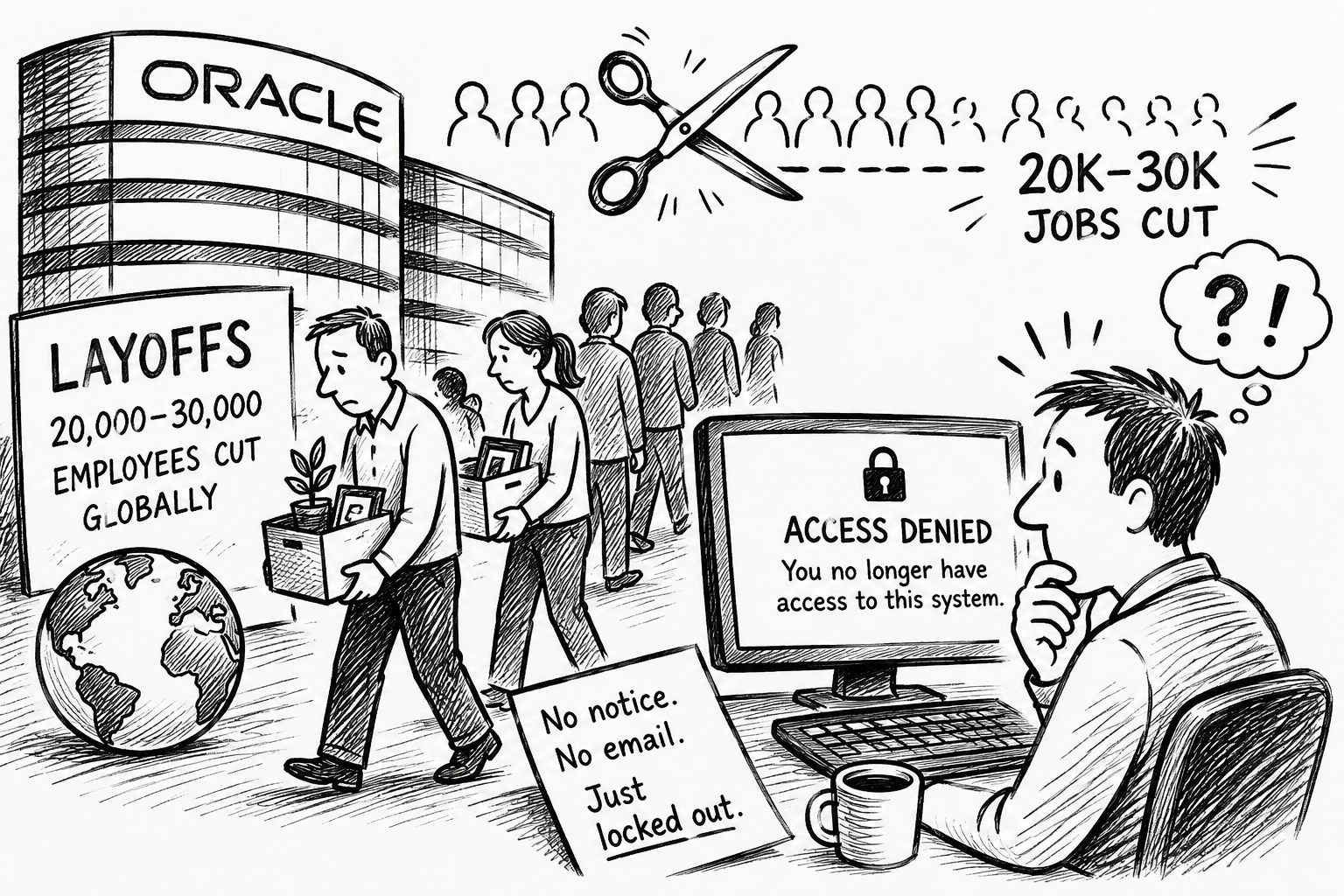
Reporting from TechCrunch, corroborated by multiple outlets, confirmed what many inside the tech industry had already suspected was coming. Oracle Corporation carried out one of its largest recent workforce reductions, cutting between 20,000 and 30,000 workers globally by most estimates. The pace was deliberate and the execution was blunt — some employees learned they had been terminated when they lost access to internal systems, before any formal notice arrived.
What happened next is where the story gets instructive. Workers didn’t simply accept the terms. Several laid-off employees told TechCrunch they attempted to negotiate — pushing for stronger severance, acceleration of unvested stock grants, and clearer answers on WARN Act protections. Oracle declined across the board. The company offered severance tied to tenure and limited COBRA coverage. It did not move on restricted stock units. It did not extend notice periods. And it did not engage with workers as a group.
That last part is the one worth sitting with. The negotiations failed not because the workers asked for too much, but because they asked alone.
The Architecture of a One-Sided Deal
Tech compensation structures are designed to create loyalty through delay. Restricted stock units vest on schedules that typically run four years, with a one-year cliff. The math is intentional — the longer an employee stays, the more they stand to lose by leaving, and the more they stand to lose when terminated before a vesting date. One former Oracle employee cited in the TechCrunch reporting said they forfeited approximately $1 million in stock that was only months away from vesting. That is not an edge case. That is the structure working as designed, except in reverse.
The remote classification issue compounds the problem. Some workers discovered they had been categorized internally as remote employees even while working hybrid schedules near company offices. Federal WARN Act protections, which require employers to provide advance notice before certain mass layoffs, are often calculated based on employee concentration at a physical worksite. Workers dispersed across remote classifications are harder to count, harder to organize, and harder to protect under existing law. Whether that outcome is incidental or strategic, the effect is the same.
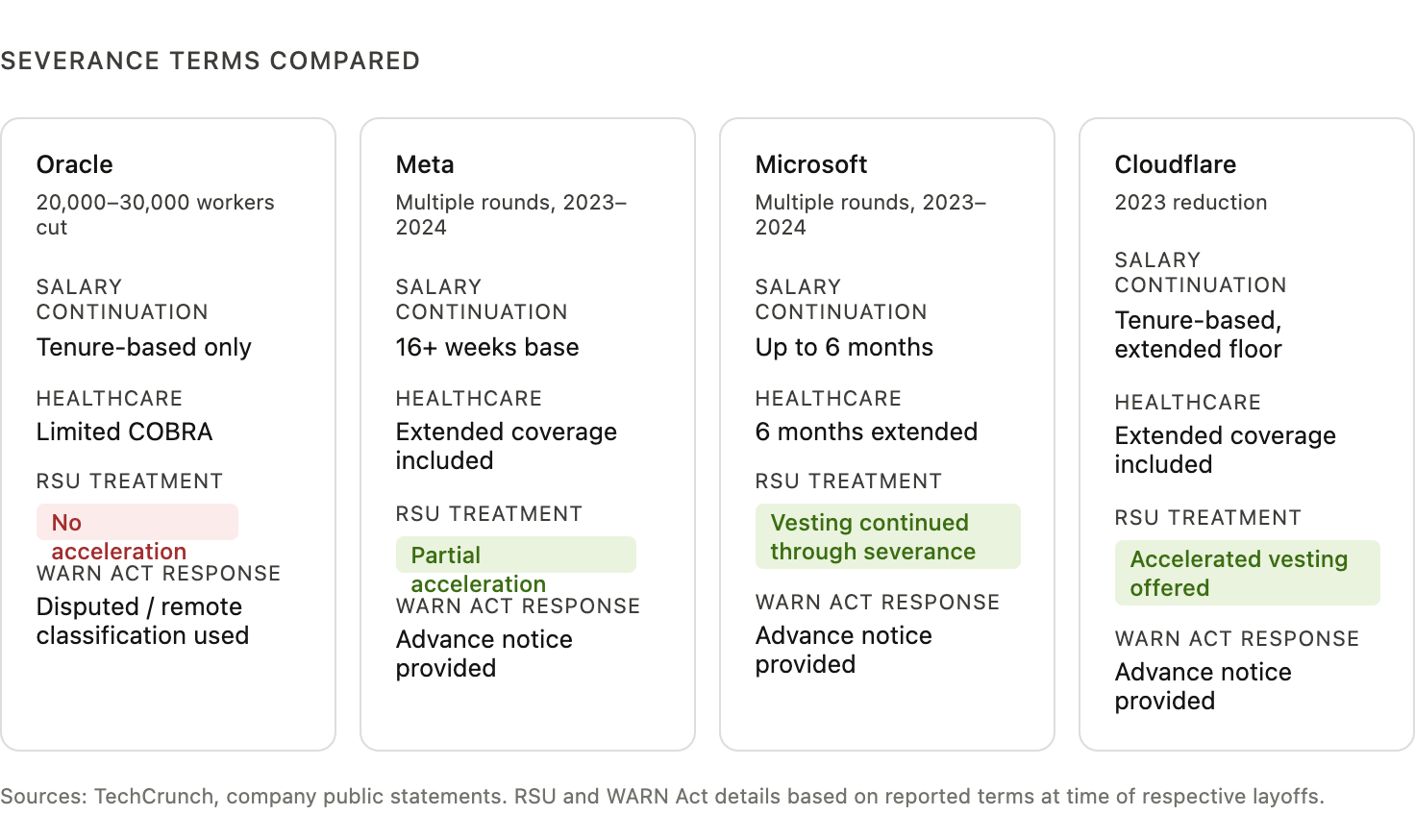
TechCrunch noted that other companies including Meta Platforms, Microsoft, and Cloudflare have offered more protective severance terms — longer salary continuation, expanded healthcare, or accelerated vesting provisions. The comparison matters not because those companies were especially generous, but because it establishes that Oracle made a choice. More protective terms exist. They were simply not offered here.
Why Individual Negotiation Was Always Going to Lose
When a company eliminates tens of thousands of positions in a compressed timeframe, the individual worker’s negotiating position is structurally weak from the start. The company has legal counsel, standardized agreements, and institutional experience executing these reductions. The worker has days to review documents, limited access to comparable data, and no coordinated counterpart on the other side of the table.
This is not a failure of individual effort or preparation. It is a structural mismatch. White-collar workers in tech have largely operated without unions, without formal collective bargaining agreements, and without the institutional infrastructure that exists in trades and other organized labor sectors. The implicit trade was that compensation — salary, equity, perks — made that infrastructure unnecessary. The Oracle layoffs, like the broader wave of tech reductions before them, reveal what happens when that trade is called in.
Collective action in white-collar environments does not require a union card to be effective, but it does require coordination. Workers at some companies have organized open letters, coordinated public statements, and used platforms like LinkedIn to surface shared experiences in ways that create reputational pressure. None of those tactics guarantee outcomes. But they shift the dynamic from individual supplicant to collective voice, and that shift changes what companies calculate when deciding how much resistance to absorb.
What Workers Can Actually Do
The time to understand your leverage is before a layoff, not after. A few realities worth knowing:
Your severance agreement is negotiable more often than companies suggest. Standardized offers are presented as fixed because most workers accept them without pushback. Asking for an extension to review the agreement, requesting clarification on RSU treatment, or pushing for additional weeks of salary continuation costs nothing to attempt. Employment attorneys who specialize in severance review often work on contingency or flat-fee arrangements and can identify provisions worth challenging.
WARN Act protections are worth understanding before you need them. The federal WARN Act requires employers with 100 or more employees to provide 60 days advance notice before covered mass layoffs. State-level WARN laws in California, New York, and New Jersey, among others, offer broader protections and lower thresholds. Remote classification affects eligibility, which is precisely why understanding how your employer categorizes your work location matters long before a reduction happens.
RSU vesting windows are not automatically closed at termination. Some agreements include provisions for pro-rated vesting, continued vesting during severance periods, or accelerated vesting tied to specific termination conditions. Those provisions are rarely volunteered. They require direct inquiry and, in some cases, negotiation.
Connecting with former colleagues immediately after a layoff is not just emotional support — it is strategic. Shared information about severance offers, classification disputes, and WARN Act eligibility creates the factual baseline for any collective response. Workers who compare notes are harder to manage individually than workers who process the experience in isolation.
The Broader Shift
The Oracle situation is not an outlier. It is a data point in a pattern that has been building across the tech sector for several years. The compensation structures that defined the industry’s growth period — equity-heavy, deferred, tied to tenure — were always more protective of company interests than worker interests when termination entered the equation. The growth cycle obscured that reality. The contraction is clarifying it.
White-collar workers are not without leverage. But that leverage has to be built before it is needed, exercised collectively rather than individually, and grounded in an understanding of the legal and contractual terrain that most workers are never given a reason to learn until it is too late. Oracle’s former employees asked the right questions. The lesson is in how they had to ask them — one at a time, alone, against a company that had already decided the answer.