
Meta raised its capital expenditure forecast this week, doubling down on AI infrastructure even as markets reacted with caution and its stock declined. The surface tension — between investor expectations and long-term strategy — is the story most coverage is telling. Underneath it sits something more consequential: capital is moving aggressively toward systems that reduce reliance on human labor, even as those systems remain expensive, unproven at scale, and still evolving.
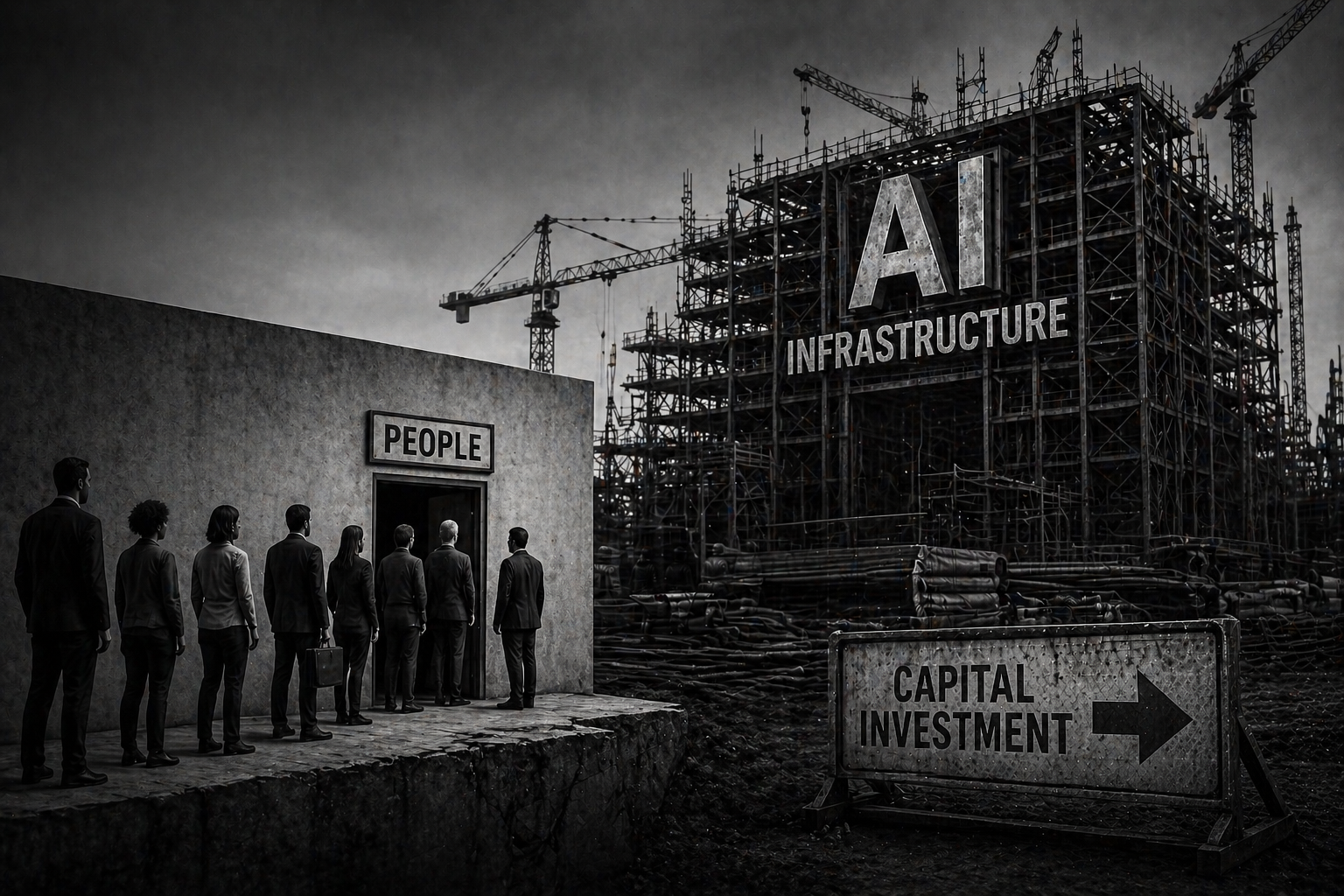
The pattern is no longer isolated. Across the tech sector, companies are pairing large-scale AI investment with workforce reductions, hiring freezes, and role restructuring. As SSC reported recently, Snap’s recent layoffs — affecting roughly 1,000 employees, or 16% of its workforce — fit the same logic, where efficiency is being pursued not through incremental improvement but through substitution. Labor is not being optimized. It is being reconsidered as a cost center relative to infrastructure that, once built, scales without proportional increases in headcount.
What makes this moment different from earlier automation cycles is where the impact is landing. The roles most exposed are not manual or repetitive in the traditional sense — they are cognitive and professional. Programmers, analysts, customer service agents, knowledge workers whose value was tied to specialized training and credentials. As AI systems handle a growing share of those tasks, the economic logic that justified those roles shifts. The question becomes less about whether the work can be done and more about who — or what — does it most efficiently.
The compression effect is already visible. Entry points into professional careers are narrowing as companies rely on tools that reduce the need for junior-level roles. Demand for highly specialized oversight and technical management is increasing — but for a smaller number of workers. Fewer pathways in, higher expectations for those who remain, and a growing gap between the value created by systems and the number of people required to operate them.
What Meta is signaling is not just confidence in AI but confidence in a different distribution of value — one where fewer people are needed to produce the same or greater output. That bet reshapes not just company balance sheets but the structure of work itself: who gets access to stable employment, how careers are built, and what skills retain long-term value. The investment is in the technology. The implication is in everything the technology is designed to replace.