
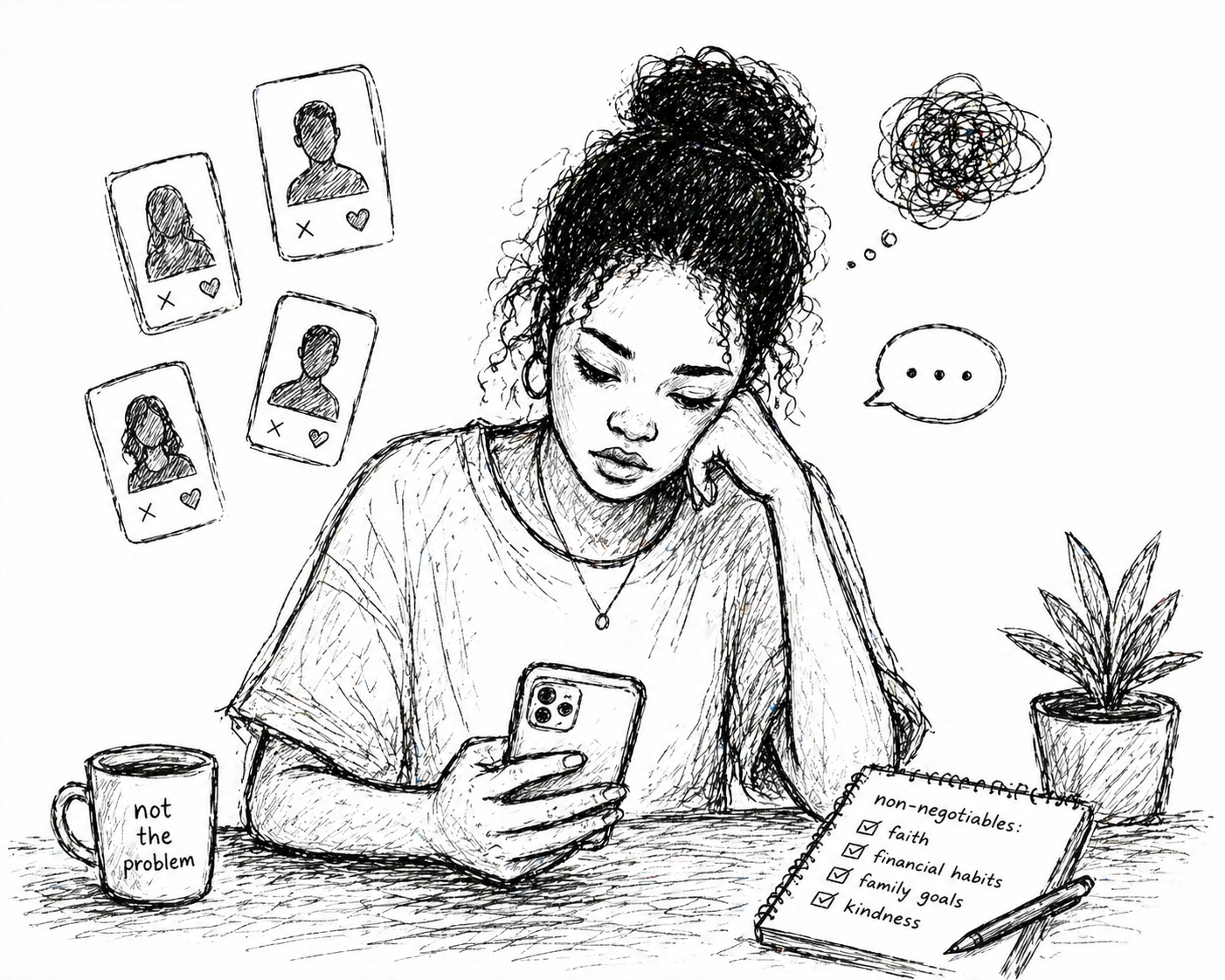
For a long time, I thought the problem was me.
It felt like everyone else had figured something out that I hadn’t—how to approach someone without overthinking it, how to read interest without second-guessing every signal, how to move from a conversation to something real without feeling like I was getting it wrong. Dating wasn’t just difficult. It felt like something I was supposed to already know how to do.
Most of us were told it would get easier with technology. That apps would remove the awkward parts. That compatibility would be easier to find. That intention would replace guesswork. But for many people, that hasn’t been the experience.
The story being told about young adults and dating is that we’ve checked out—that commitment feels too heavy, that independence has taken priority, that the structures previous generations built no longer appeal to us. The data tells a different story. Only about 30% of young adults are actively dating in 2026, but nearly half are raising nonnegotiables like faith, financial habits, and family goals within the first few dates—not because they’re rushing, but because they’re trying to be intentional with their time. The dating recession isn’t a rejection of connection. It’s a confidence crisis inside a system that was never designed to build the skills connection requires.
That lack of confidence shows up in small, quiet ways. It looks like opening an app and seeing dozens of profiles, but hesitating to message any of them because you’re not sure what to say that won’t be misread. It looks like typing something, deleting it, and closing the app altogether. It looks like matching with someone and letting the conversation stall because starting it feels heavier than it should.
The numbers reflect that reality. Only about one in three young adults feels confident approaching someone they’re interested in. Fewer than four in ten trust their own judgment when choosing a partner. Only about one in three feels comfortable discussing their feelings with someone they’re dating. Those aren’t the numbers of a generation that doesn’t want relationships. They’re the numbers of a generation that wants them and doesn’t feel equipped to pursue them.
There used to be spaces where this felt easier—or at least more natural. Conversations that weren’t labeled as anything. Interactions that didn’t carry the weight of outcome. You learned by doing, not by optimizing. The hallway conversation, the awkward school dance, the neighborhood interaction that required nothing and risked little—those moments weren’t about romance. They were practice. They built the muscle memory for approaching, reading, and responding to people in real time.
As those environments faded, the practice disappeared with them. What replaced them was a system optimized for matching—one that assumes the skills required to connect are already there, just waiting for the right algorithm to activate them. But matching isn’t the same as connecting. And without the underlying confidence, even the best match can stall before it begins.
Researchers studying dating patterns in 2026 have described a growing disconnect between how people are currently dating and how they want to be dating—more people using apps while finding them emotionally exhausting, more people wanting intentional connection while lacking the confidence to initiate it. That gap isn’t a personality issue. It’s a structural mismatch between what the system delivers and what people inside it actually need.
The dating recession won’t be solved by better algorithms or more intentional app design. It will be resolved when the environments that build relational confidence are rebuilt—in communities, in schools, in shared physical spaces where interaction doesn’t have to lead anywhere to still matter.
The challenge isn’t that people don’t want connection. It’s that many of us were never given the chance to build the confidence it requires.
So we’re left trying to figure it out in environments that expect fluency without ever teaching it. That doesn’t mean the desire isn’t there. It means the starting point feels harder to find than it should.