Early voting is running ahead of the 2022 midterm pace in several states, while new polling finds Americans motivated by economic pressure, political dissatisfaction and control of Congress. But high early turnout doesn’t necessarily tell us who will win—or how many people will ultimately vote.
With more than a week remaining before Election Day, millions of Americans have already finished voting. They’ve stood in line outside county election offices, visited early voting centers during lunch breaks and returned mail ballots from kitchen tables. By October 25, approximately 26.8 million ballots had been cast nationwide, according to an early-voting tracker drawing from state election offices. The University of Florida Election Lab’s data, reproduced by a separate election tracker, showed approximately 26.7 million. The totals are continuing to change as election officials report additional ballots, but the significance is already apparent: Americans are participating in the 2026 midterms well before November 3, and several states are reporting activity above their pace during the last congressional midterm election.
The numbers have prompted a question that goes beyond turnout statistics. Why are so many Americans voting now, and what is driving their interest in an election that traditionally receives less attention than a presidential contest? The answers are more complicated than a single political message or national mood. Dissatisfaction with the economy, President Donald Trump’s second administration, concerns about national policy and increasingly organized campaign operations are all contributing to the atmosphere. For some voters, casting a ballot is an expression of opposition to the direction of the country. For others, it is a way to defend policies they support or influence who controls Congress. And for many, early voting is simply the most practical way to participate.
The Numbers Are Getting Attention for a Reason
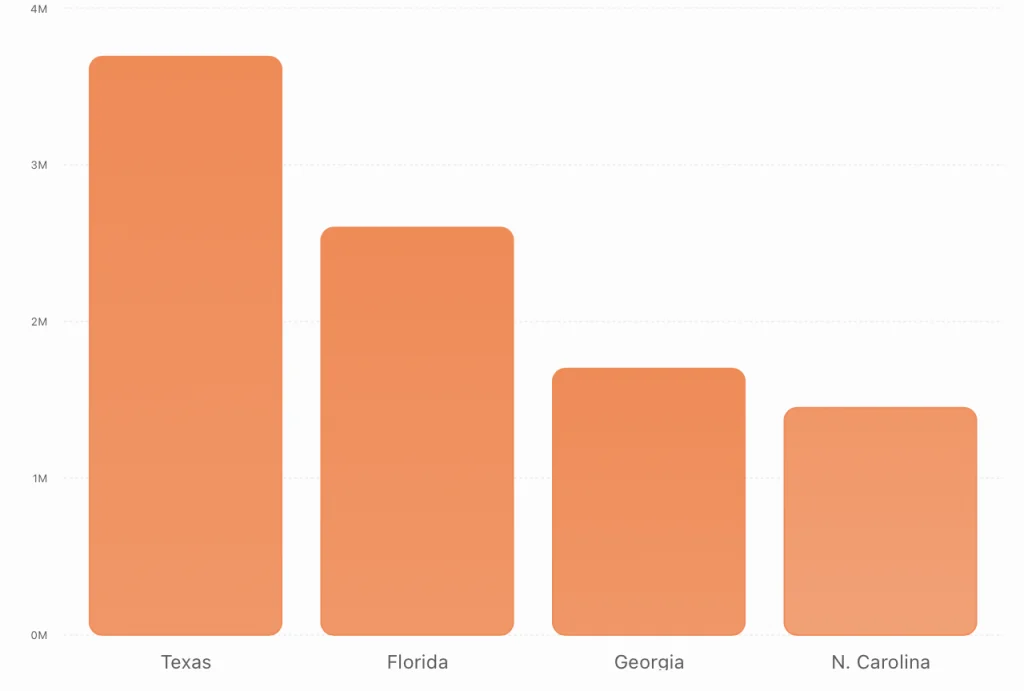
Early voting has accelerated in states that could help determine control of Congress. Texas, Florida, Georgia and North Carolina are among those reporting substantial participation, with millions of ballots already submitted. As of October 24, figures based on the University of Florida Election Lab showed approximately 3.69 million ballots cast in Texas, 2.60 million in Florida, 1.70 million in Georgia and 1.45 million in North Carolina. By October 25, another tracker reported more than 4.1 million ballots in Texas alone. These totals demonstrate the scale of participation, although differences in reporting schedules and voting rules complicate direct comparisons among states.
Some of the most significant activity is occurring in states with competitive congressional races, where campaigns have invested heavily in voter outreach and organization. An October 20 analysis by Axios found that Georgia and Virginia had already recorded early vote totals equivalent to roughly one-quarter of their entire 2022 midterm turnout. North Carolina was running 37% ahead of its corresponding 2022 pace as of October 18, while Dallas County reported a record opening day for in-person early voting. These comparisons suggest unusually strong participation in particular places, even though states begin early voting on different dates and use different reporting systems.
But there is an important distinction between voting earlier and voting more. Someone who casts a ballot in October may be someone who would otherwise have voted on November 3. A large early-voting total does not necessarily mean that overall participation will reach a record. Charles Stewart, a political science professor at MIT, explained in an October 23 NPR interview that the increase reflects a combination of voter enthusiasm and intensive campaign spending to encourage supporters to participate ahead of Election Day. Early voting data reveals when ballots are being cast, but not necessarily how many additional people will participate in the election.
Reported early ballots in four states
University of Florida Election Lab-based figures as of October 24, 2026
An Election Shaped by Dissatisfaction
To understand the urgency, it helps to look beyond the voting centers and examine how Americans are feeling about the country. An October 8 Pew Research Center survey found widespread dissatisfaction with national conditions and growing concern about the economy. The survey of 5,062 adults, including 3,917 registered voters, was conducted between September 28 and October 4. It found that 84% of registered voters considered the economy very important to their vote, including large majorities of both Democratic and Republican supporters. Americans expressed concern about prices, particularly energy costs, as well as the broader economic and political environment.
That economic dissatisfaction exists alongside sharply different political interpretations of who is responsible and what should change. Democratic candidates have emphasized the cost of living, the administration’s policies and the need for congressional oversight. Republicans have defended their economic and governing priorities while seeking to maintain control of Congress. Voters may agree that prices are too high or that economic conditions deserve attention without agreeing on which candidates are best positioned to address those concerns. The common thread is not a unified political preference but the importance many Americans place on the decisions being made in Washington.
Pew’s survey also found that 63% of registered voters considered Trump a factor in their congressional vote. Forty-four percent said they viewed their vote as opposition to the president, compared with 19% who described it as support for him. His approval rating stood at 30% in the survey. Those findings indicate that the president’s standing is shaping how many Americans approach elections that do not include him on the ballot. But the reasons voters participate still extend beyond their views of any one political figure, particularly when individual congressional contests involve local priorities, candidate records and issues specific to their states or districts.
Democrats Are Showing Greater Motivation, but Republicans Are Voting, Too
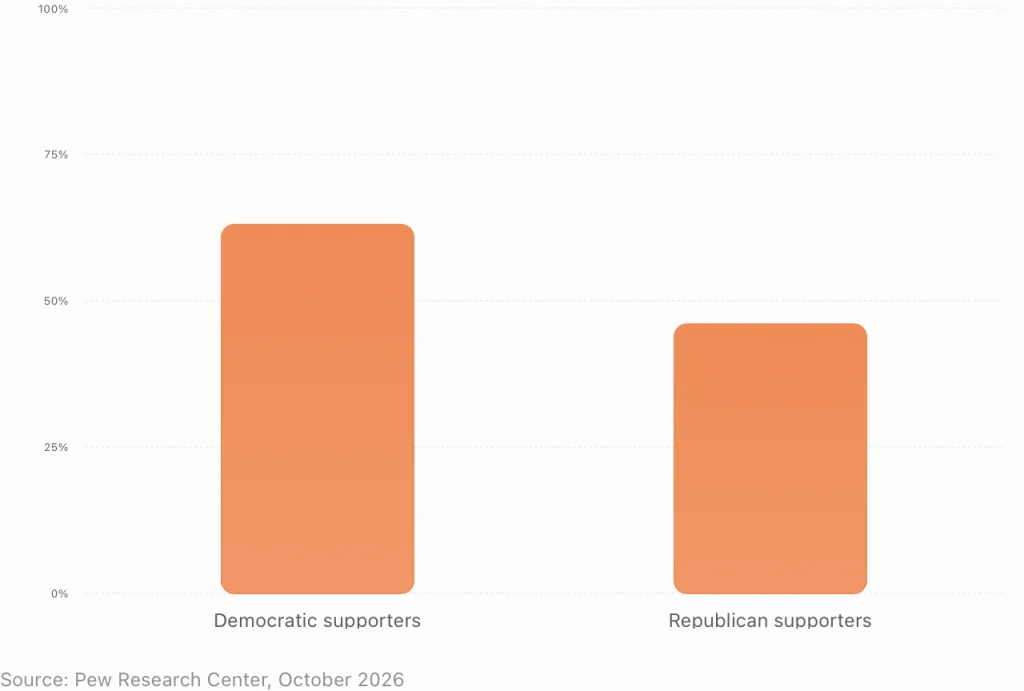
One of the clearest differences in the polling involves the intensity of voters’ motivation. Pew found that 63% of registered voters supporting Democratic House candidates said they were extremely motivated to vote, compared with 46% of Republican supporters. That 17-point gap contrasts with October 2022, when the two groups reported nearly identical levels of extreme motivation. Democratic supporters were also more likely to say that control of Congress mattered greatly and that they had devoted substantial thought to the upcoming election.
That difference is consistent with patterns identified in early-voting analyses. ABC News reported October 22 that registered Democrats and voters statistically modeled as Democratic supporters accounted for a higher share of early voting in most states than they had at a comparable point in 2024. The shift was especially evident in some competitive states, although the analysis cautioned that voter registration and modeled partisanship do not reveal which candidate someone actually selected. Republicans also have historically relied more heavily on Election Day voting, meaning their participation may be less visible in early returns.
The difference in motivation also raises questions about how Americans respond when their preferred party holds power. Midterm elections have frequently given voters an opportunity to register dissatisfaction with the sitting president’s administration. Political engagement can intensify when people believe the direction of government is moving away from their preferences, while supporters of the governing party may feel differently about the immediate stakes. That pattern helps explain why political opposition is often an important source of midterm participation, although it does not establish that every early voter is motivated by dissatisfaction.
Voters who say they are extremely motivated to vote
Percentage of registered voters, by preferred House candidate
Campaigns Are Changing How Americans Vote
The rise in early voting is not solely a spontaneous expression of political interest. Campaigns increasingly treat the early-voting period as an essential part of their organizing strategy, rather than waiting until Election Day to mobilize supporters. Political organizations invest in door-to-door canvassing, text messages, advertising and direct voter contact designed to encourage people who already intend to participate to cast their ballots sooner. For campaigns, an early ballot represents a voter who no longer needs to be persuaded to make time to visit the polls.
That organizational effort can make the early-voting numbers look unusually dramatic. A campaign that successfully moves a large share of its supporters from Election Day to October may produce impressive advance turnout without necessarily increasing its final vote total. MIT’s Stewart emphasized that extensive campaign spending and direct outreach are contributing to this year’s activity. He also identified states such as Maine and Iowa, which have attracted greater political attention during this election cycle, as examples of how campaign competition can influence early participation.
Practical considerations matter as well. Early voting allows people to plan around work shifts, childcare responsibilities, transportation schedules and other obligations. A person who cannot confidently predict their availability on November 3 may prefer to cast a ballot when an opportunity arises. The growing familiarity of early voting has also changed expectations around elections. For many voters, Election Day is no longer the only day that matters; it is the final day of a longer voting period.
What 26 Million Ballots Cannot Tell Us
It may be tempting to look at the number of early ballots and conclude that Americans are preparing for a historic election. That is possible, but the evidence is not yet sufficient to establish what final turnout will look like. In the 2022 midterms, nearly 122 million Americans voted, according to data discussed by NPR. The approximately 26.8 million early ballots recorded by October 25, 2026, represent a substantial portion of that figure, with more than a week of voting remaining. Yet differences in early-voting access, reporting practices, campaign strategy and voter behavior make it difficult to draw a simple national comparison.
Nor can early voting establish which party will benefit. Some states report voters’ party registration, while others do not register voters by party at all. In states without party registration data, analysts may use statistical models based on voter histories and demographics to estimate partisan composition. Those models can help describe participation patterns, but they cannot identify actual ballot selections. Independents may support either party, registered Democrats may vote for Republicans, and registered Republicans may vote for Democrats. The final results will depend on the ballots cast throughout the entire voting period and counted under each state’s election procedures.
What the early numbers do establish is that the 2026 midterms are attracting substantial attention well ahead of November 3. Voters are encountering a political environment defined by concerns about household costs, disagreements over federal policy, questions about the country’s direction and competing arguments about which party should control Congress. The intensity of those concerns differs across partisan groups, but the election has become a focal point for Americans seeking a say in the government’s next two years.
The Measure Comes on November 3
There are still eight days between the October 26 publication of this story and Election Day. Millions more Americans will have opportunities to vote, and campaigns will continue working to reach those who have not yet participated. The early-voting surge is an important development because it shows that political engagement is already translating into completed ballots. It is also a reminder that participation depends on access, organization and the practical ability to make voting fit into everyday life.
For now, the most revealing question may not be whether 26 million Americans are unusually enthusiastic. It is why so many see enough at stake to cast their ballots before the election’s final day. Some want a change in direction. Others want continuity. Many are responding to economic concerns or political decisions that have made national issues feel immediate and personal. Those motivations do not point toward a single conclusion, but they help explain why voting centers are busy while the campaigns are still underway.
The final turnout figures will tell us how many Americans participated. The election results will determine which candidates won. Understanding what brought voters to the polls in the first place will require listening to the people behind those millions of ballots.