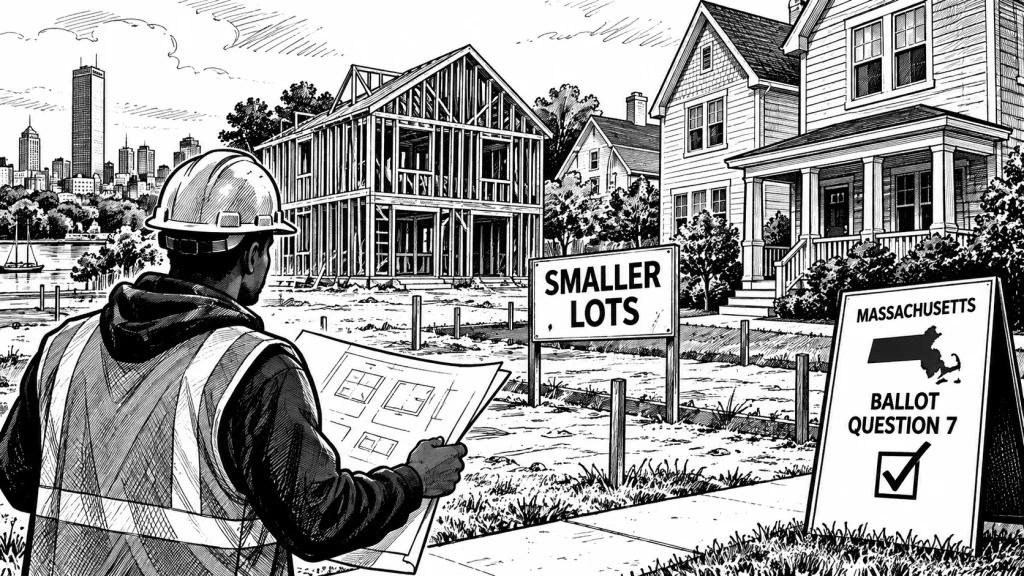
Voters will decide whether to allow single-family homes on smaller parcels of land. The proposal could expand housing construction, but changing zoning rules does not guarantee affordable prices.
Massachusetts voters will decide on November 3 whether to make it easier to build single-family homes on smaller pieces of land, a change supporters believe could help address the state’s housing shortage. Ballot Question 7 would allow qualifying homes to be constructed on residential lots of at least 5,000 square feet, even in communities where local zoning currently requires substantially larger properties. According to Zeninjor Enwemeka’s reporting for WBUR, some Massachusetts communities require an acre or more for a single-family home, limiting how many houses can be built on available land. The proposal would apply to qualifying lots with public water and sewer service and at least 50 feet of street frontage. Boston itself would be exempt because it operates under separate zoning rules.
Minimum lot-size requirements influence housing prices long before construction begins. When a town requires every new house to sit on a large parcel, developers need more land for each property, reducing the number of homes that can be built in a neighborhood. Smaller lots could allow builders to divide eligible land into additional home sites, potentially reducing the land cost attached to each house. Supporters argue that the change would create more opportunities for first-time buyers, young families and older residents seeking smaller properties. Opponents and municipal officials have raised concerns about local control, infrastructure demands and whether developers would actually build less expensive homes. Under the proposal, municipalities would retain authority over matters including building height, setbacks and parking requirements.
The affordability argument depends on what happens after zoning restrictions are loosened. Developers generally build homes they believe buyers will purchase at profitable prices, and expensive land can still produce expensive houses even when lot sizes shrink. Construction costs, mortgage rates, local demand and financing conditions also influence the final price. A smaller parcel may lower one development expense without bringing a finished home within reach of a teacher, service worker or young family. The proposal would expand where certain homes could legally be built, but it would not establish maximum sale prices or require builders to serve households below a particular income level. Allowing more construction creates an opportunity for affordability; it does not determine who can afford the homes that follow.
Massachusetts needs additional housing, and restrictive zoning can prevent new supply from reaching communities where people want to live. Question 7 would shift some authority over minimum lot sizes from municipalities to statewide rules, limiting the ability of individual towns to exclude smaller homes through land requirements alone. If approved, the change could open additional sites for development, although construction would still depend on infrastructure, financing and market demand. The longer-term test would be whether new homes reach buyers who have been priced out of ownership. Without attention to construction costs and household purchasing power, Massachusetts could succeed in making more land available for housing while leaving starter homes financially inaccessible to the people who need them.