
Part of The Access Shift — an ongoing series examining how access is being quietly reshaped across American life.
The growth of legal sports betting in the United States is often framed through revenue. According to data cited in a recent Good Morning America investigation, online sportsbooks have generated at least $3.7 billion in tax revenue, with states like New York pulling in hundreds of millions from mobile betting alone. The numbers are presented as proof of success — a regulated industry, a new stream of public funding, a modernized version of something that has always existed.
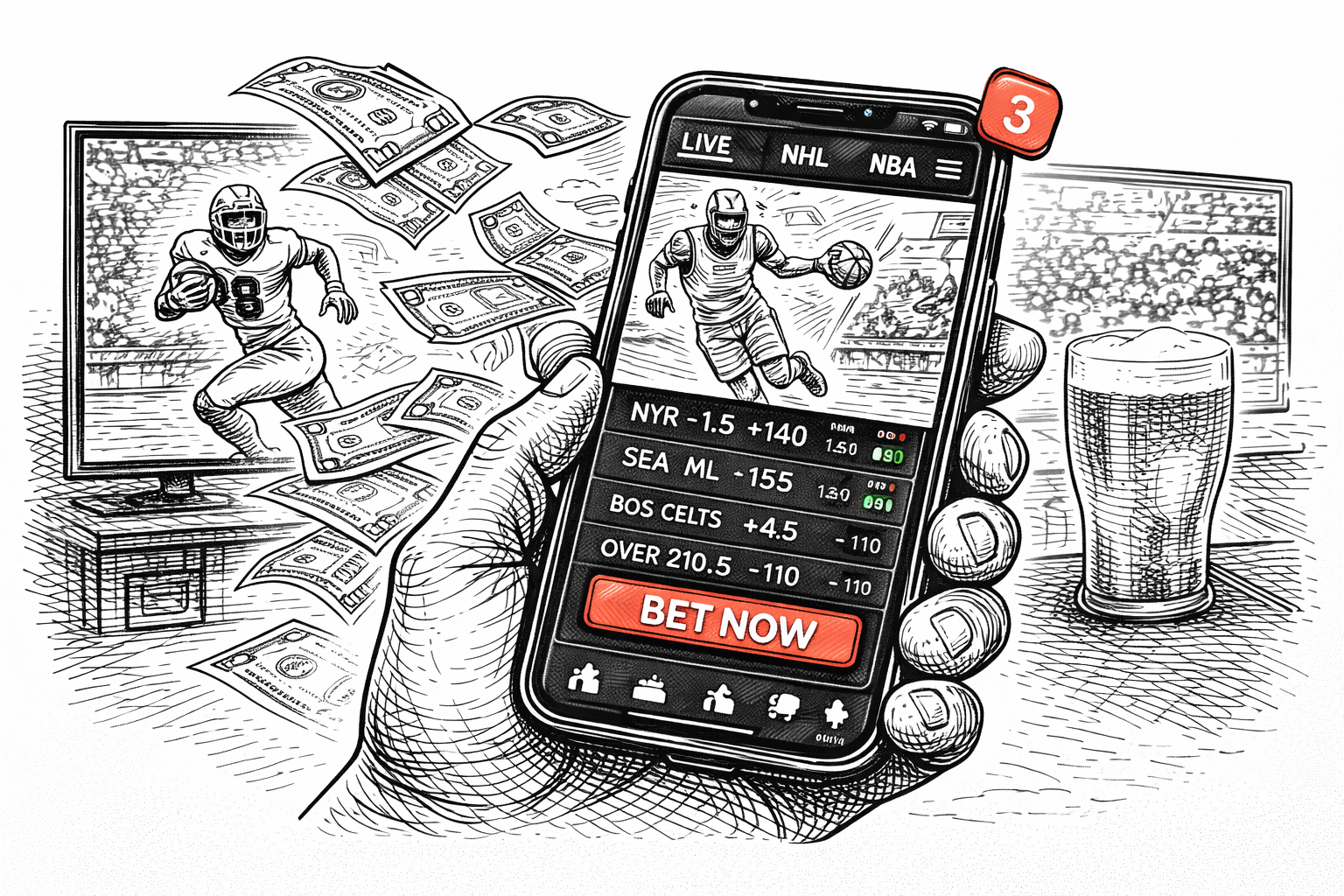
But revenue is only part of the story. The more significant shift is structural. Sports betting has not just expanded — it has changed form. What once required physical presence, cash transactions, and deliberate effort now lives inside a device people carry at all times. The distance between watching a game and wagering on it has collapsed into a single screen.
The industry points to safeguards. Platforms like FanDuel, DraftKings, and BetMGM require identity verification, including Social Security information, to confirm age and prevent fraud. On paper, this creates friction — signaling control, regulation, and oversight, a system designed to ensure that access is limited to those legally allowed to participate.
But that friction is temporary. It exists at the threshold, not within the experience. Once inside, the design shifts entirely. Interfaces are built for speed: one-tap deposits, live odds updating in real time, parlay builders that encourage stacking outcomes into higher-risk bets, and constant prompts framed as opportunities. The same system that requires personal identification to enter is structured to make placing a bet feel immediate, continuous, and low-effort once you’re there.
That distinction matters because it reveals what has actually changed. Access is no longer defined by whether something is legal or available. It is defined by how easily it integrates into everyday behavior. Sports betting now sits alongside texting, scrolling, and streaming — not as a separate activity, but as an extension of the same digital environment. The barrier is not physical anymore. It is behavioral. As What Doesn’t Make It Into the Cart examined, the decisions that appear most personal are often the ones most shaped by systems designed to make a particular choice feel effortless — and another feel out of reach.
The concern around teens and gambling is not just about rule-breaking or enforcement gaps. It is about proximity. When a system is designed to be ever-present, exposure becomes difficult to avoid. Even for those who cannot legally participate, the language, the visuals, and the rhythms of betting culture become part of how sports are experienced. The line between watching and wagering becomes less distinct over time.
This is where the tension becomes unavoidable. States benefit from the revenue. Platforms operate within legal frameworks. Safeguards exist and can be pointed to as evidence of responsibility. At the same time, the experience itself is engineered for engagement — not restraint. Regulation governs entry. Design governs behavior. Those are not the same thing, and the gap between them is where the real risk lives.
The result is a system that appears controlled at the surface while functioning with a different set of incentives underneath. It is not simply that more people can gamble — it is that gambling has been repositioned as something that fits seamlessly into the flow of everyday life. As When the Economy Slows, Some Communities Feel It First documented, the communities with the least financial cushion absorb the earliest effects of any system under pressure — and systems engineered for frictionless engagement are most dangerous precisely where the margin for error is smallest. The bet is already in your pocket. The question is who designed it to be there — and who pays when it doesn’t land.
The Access Shift
The gradual redefinition of who systems are designed to serve.
Across sectors—from public infrastructure to healthcare to everyday spaces—access is no longer assumed. As costs rise and systems face increasing pressure, services once built for broad reach are becoming more selective, more conditional, and less universal. The Access Shift explores how these changes are unfolding in real time—and what they reveal about who is included, who is left out, and how the structure of everyday life is quietly being reshaped.