
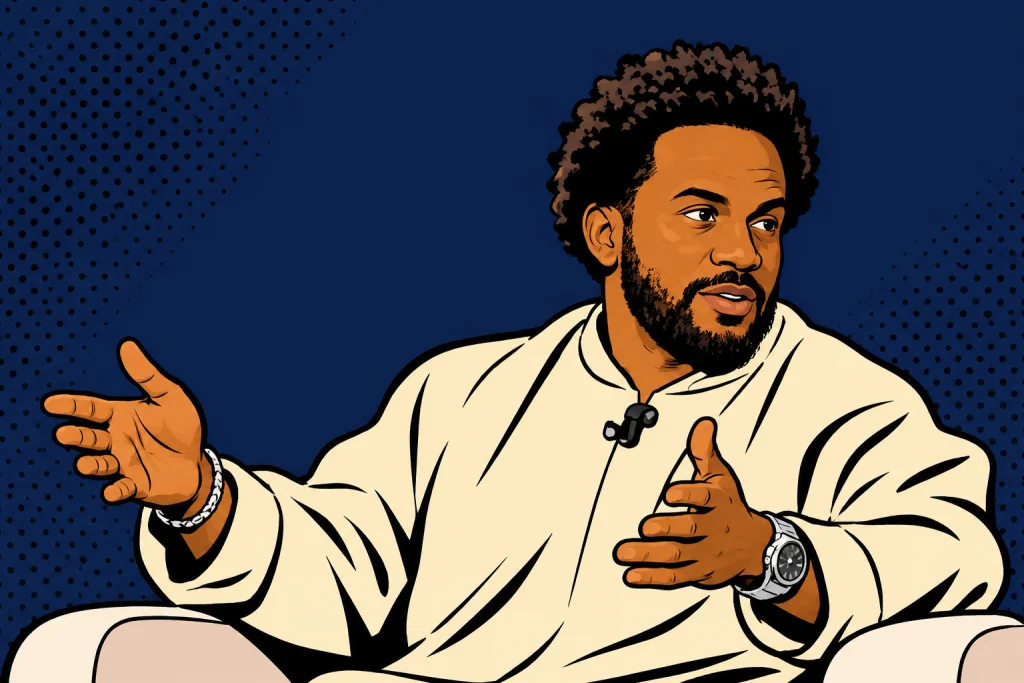
Everette Taylor’s climb from a library computer to the CEO’s office shows that executive talent isn’t scarce. Access to the people who teach the CEO playbook is.
By the Social Storytellers Collective News Desk | November 11, 2026 | 3 min read
Everette Taylor started in marketing because his mother caught him making money in ways he shouldn’t have and made him get a real job at 14. He told the WSJ Leadership Institute’s Katie Deighton about it in a new CMO Today series on marketing chiefs who became CEOs. That first job was at Eastern National, a nonprofit. A few years later he was laid off as his family’s finances fell apart, and he was homeless during his senior year of high school. He spent that year at the local library, where he found the tech industry. He got into Virginia Tech, dropped out after his first year, started and sold an events company, and moved to California once he learned the buyer had flipped it for more money. In 2022, at 32, the former Artsy marketing chief was named CEO of Kickstarter.
How a growth marketer became a CEO
- He asked for the job out loud. Early in his time as Artsy’s CMO, Taylor told then-CEO Mike Steib he wanted Steib’s job. Steib didn’t brush it off.
- The CEO taught him the job. Steib added 15 minutes to their weekly 30-minute one-on-ones to walk Taylor through how a CEO thinks, starting with how to read a P&L. Taylor said that by the time he got to Kickstarter, he felt ready on day one.
- He got noticed by chance. A woman he met at a gallery show turned out to write for the Financial Times, and her profile of him reached a Kickstarter board member. That led to a months-long search in which Taylor called himself an unorthodox candidate.
- The title changed how people saw him. Taylor said people now treat him completely differently since “the M got switched out for the E.” His point was that he had the same drive and creativity before. Someone just had to give him the chance.
Taylor’s story is often told as personal grit, and it is, but the more useful lesson is how his path worked. CMOs rarely become CEOs, and Black executives rarely become CEOs in tech. That isn’t because the ability is missing. Financial fluency, the skill boards check for first, is usually learned in private, from a sitting CEO who decides to teach it. Steib’s extra 15 minutes a week moved that knowledge from the CEO’s office to a young marketer who otherwise would have had to learn it on his own and prove it with no proof. The Financial Times profile did the rest by putting him in front of a board that wasn’t searching for someone like him.
Taylor told Deighton that brands stuck repeating the same moves should take a chance on someone like him, and that’s a recruiting pitch boards should take seriously. Expect more boards to pick CEOs from marketing as companies compete on brand and community as much as on product. Expect the executives who make that jump to have something in common: a sitting CEO who taught them the financial side early. Talent like Taylor’s is spread widely. The rare part is a CEO willing to spend 15 minutes a week teaching it.