
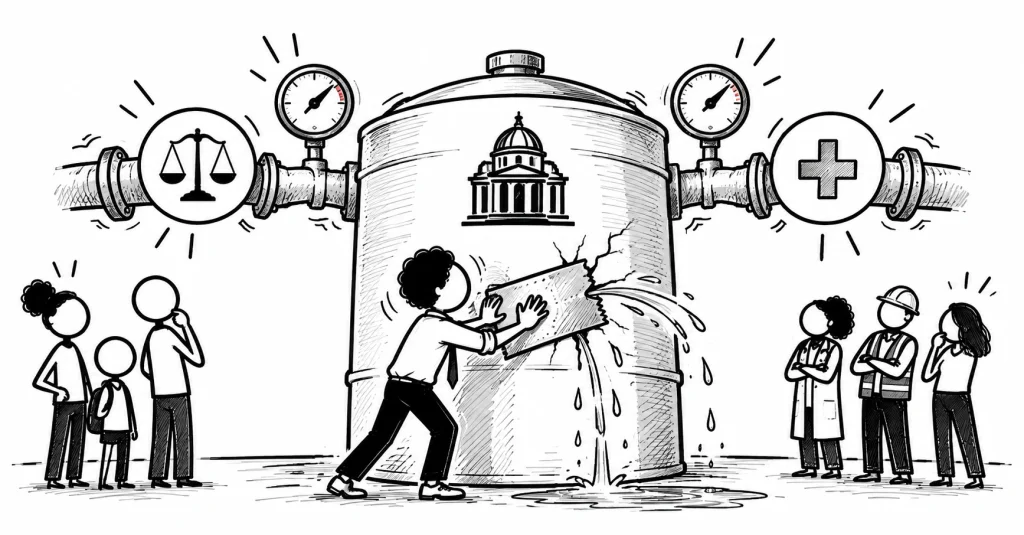
A $9.69 billion proposal avoids new taxes and layoffs for now, while the sources of the shortfall show why one balanced year offers limited reassurance.
Cook County proposed a $9.69 billion budget for fiscal 2027 after confronting a preliminary $550.7 million gap, according to its October 8 executive-budget announcement. Board President Toni Preckwinkle says the recommendation avoids layoffs, tax increases, and cuts to essential services. Those are important immediate commitments for residents and employees, but the recommendation still requires the county’s budget process. Closing a projected gap is evidence that officials found a financing plan for the coming year; it is not evidence that the pressures producing the gap have ceased to exist.
The county separates two significant sources of pressure: a court-ordered restriction affecting $258 million in tax revenue, and an expected $138 million impact on the hospital system from federal changes. Those explanations should not be collapsed into a claim that one federal law caused both. The county says its gap would have been substantially smaller without those effects. WTTW’s reporting by Heather Cherone describes the challenge across the general and health funds. The different sources underline why a budget’s headline balance needs to be read alongside the assumptions about revenue, legal authority, and healthcare funding behind it.
A Balanced Year Can Contain Unresolved Risk
Governments can close gaps through several kinds of decisions, and those decisions have different consequences for later years. A recurring reduction in spending changes the baseline; a temporary source of money helps for as long as it remains available. Investment income can help a budget without providing the same certainty as a dependable revenue stream. The analytical task is to identify which solutions recur and which must be replaced. Otherwise, a successful annual budget can be read as a lasting repair when it is actually a bridge to another round of difficult choices under similar or worsening conditions.
The Center Square’s October 8 account describes vacancy management, spending reductions, investment gains, and $18 million in reserves among the measures officials used. These tools do not all mean the same thing for residents. An unfilled position may avoid a layoff while still requiring an assessment of workload and service capacity. Using reserves can protect a service today while reducing flexibility later. Neither consequence should be assumed automatically in this case, but both show why the quality of a budget solution depends on more than whether its totals add up.
Healthcare Makes the Consequences Less Abstract
A hospital-system funding gap is especially important because the need for care does not adjust neatly to an annual appropriation. Residents may still need treatment when reimbursement assumptions change, and providers must continue to coordinate staff, facilities, and payment. The county’s estimated federal impact should be evaluated as an official projection rather than a tally of services already lost. The next evidence should connect that projection with actual revenue and operating conditions. A claim that essential services are protected becomes more persuasive when residents can see stable access, manageable waiting times, and adequate staffing throughout the budget year.
The same discipline applies to the promise of no new taxes. That commitment answers one immediate question about how the proposal is financed, while leaving open whether future budgets will require different choices. FOX 32’s October 8 coverage highlights officials’ warning about a tougher period ahead. Residents deserve a clear account of the conditions that could change the outlook. That means separating enacted funding, expected receipts, legal restrictions, and forecasts, then explaining which assumptions are most vulnerable rather than treating every dollar in the plan as equally secure.
Follow the Solution Into the Next Year
Cook County’s proposal offers near-term relief from measures residents and workers might otherwise have faced. The next test is whether the approach preserves both service capacity and room to respond when outside conditions change. The county should be judged on execution as well as its announced balance: the revenue it actually receives, the staffing it maintains, and the expenses deferred into later years. Fiscal stability becomes more credible when officials show the durability of the solution. A budget that closes today’s gap is a useful start; a public explanation of how it avoids rebuilding that gap is the stronger assurance.