South Africa’s Comrades Marathon Shows Wellness Outside the Luxury Frame
More than 20,000 runners took on the world’s largest ultramarathon, revealing a form of endurance culture built on grief, class, race, memory, and shared public ritual.
The Guardian’s Rachel Savage reported from Durban and Pietermaritzburg that more than 20,000 runners stood outside Durban city hall on June 14 for the 2026 Comrades Marathon, the world’s oldest and largest ultramarathon. Photographed by James Oatway, the story followed a race that began in 1921 with 34 white male runners, only 16 of whom finished, and has since become one of South Africa’s most recognizable civic rituals.
The mechanism is collective endurance. Wellness here is not sold as optimization, luxury recovery, or personal branding. It operates as a public test of meaning, where people carry grief, illness, class pressure, memory, faith, discipline, and national identity across the same road.
That makes Comrades different from the dominant wellness economy. Much of modern fitness culture is built around access: expensive gyms, recovery tools, supplements, wearables, coaching, boutique races, and status-coded forms of self-improvement. Comrades still requires resources, training time, shoes, travel, and a body capable of enduring the distance. But its cultural power comes from how many different kinds of people enter the same ritual and are judged by the same cutoff clock.
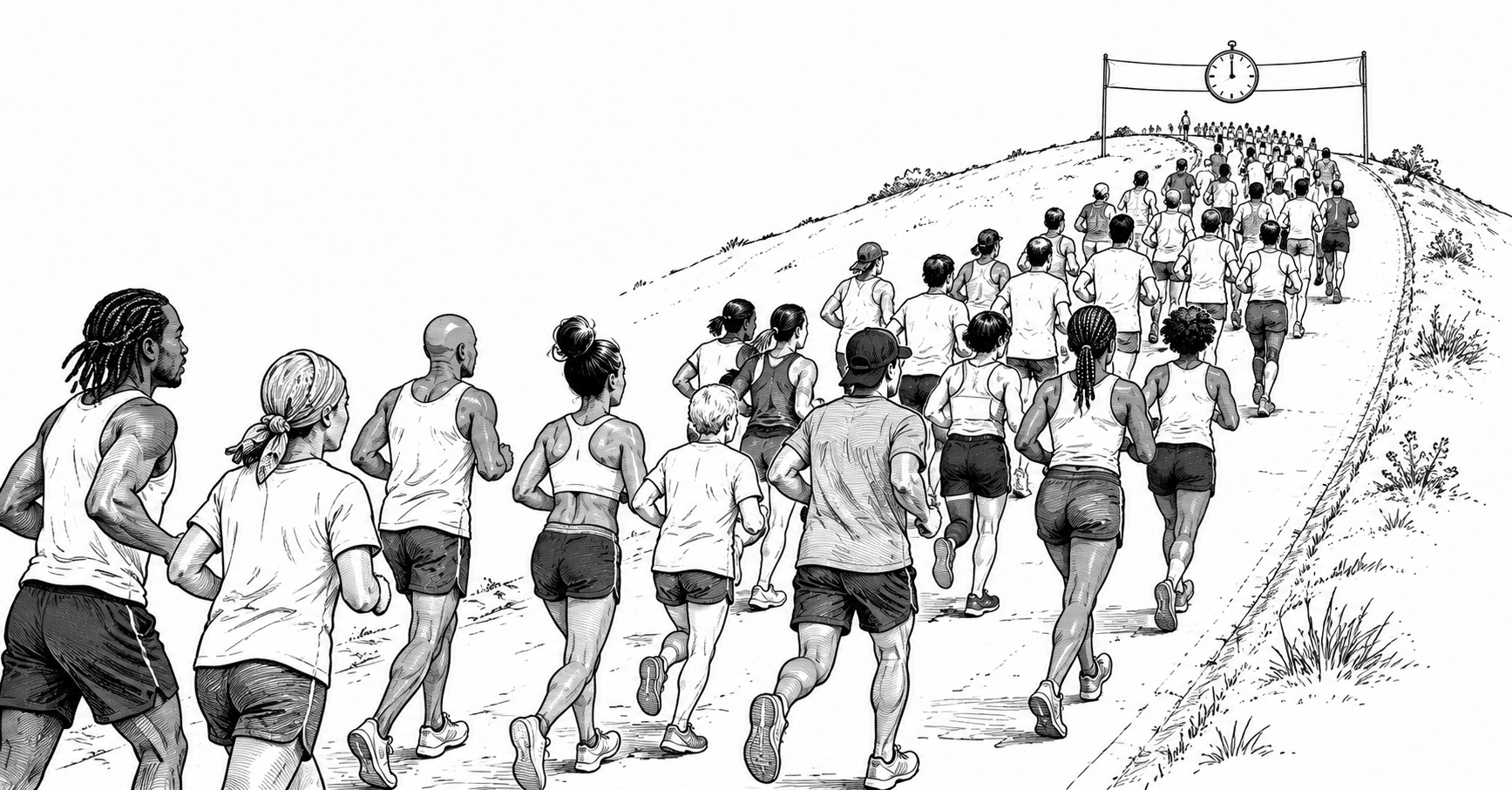
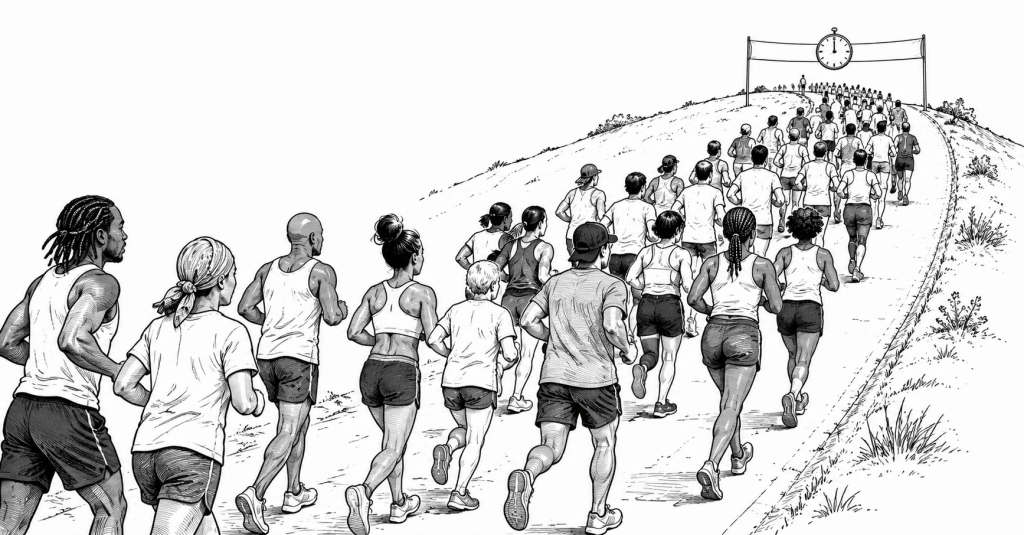
Savage reported that the race averages just under 55 miles, changing direction annually between Durban and Pietermaritzburg. The 2026 event was an “up run,” climbing toward Pietermaritzburg with a 12-hour cutoff. Runners came from clubs across the country, with security guards, shop workers, bankers, celebrities, and local running groups moving through the same course.
The racial history matters because the event did not begin as an inclusive national story. The first Comrades was all white and all male. The race later became part of South African television culture, and by the 1980s, scenes of Black and white runners sharing the road carried social meaning in a country still governed by apartheid. Savage reported that South Africans were captivated by runners such as Hoseah Tjale and Sam Tshabalala, the first Black man to win Comrades in 1989.
The current race cannot erase inequality. It briefly reorganizes how people experience it. South Africa’s racial and economic divisions do not disappear because thousands of runners share a course. But for one day, the structure creates a different rule: the road does not care about status once the clock starts. That does not make the ritual equal. It makes the inequality visible against a common standard.
That is why the personal stories carry weight. Savage followed William Seleka, who began running in March 2025 while dealing with depression after the end of his marriage. He joined Run Alex, a club in Johannesburg’s Alexandra township, and within months went from never having run farther than 10 kilometers to finishing a 50-kilometer ultramarathon. At Comrades, he crossed the line in 10:30:49, thinking of his younger sister, whose kidneys failed in 2018.
The finish line showed how the system works. Around a third of Comrades runners finish in the final hour, according to reporting cited by The Guardian. This year, about 91% of runners finished, and the final 12-hour pacing group crossed at 11:56:34, carrying dozens of runners home just before the cutoff.
Power moved from the individualized wellness market to a shared civic standard. The body remains personal, but the meaning is collective. The race turns private pain into public movement and gives people a structure for surviving something hard in view of others.
As wellness keeps moving toward optimization, Comrades points in the opposite direction. The future of fitness culture may split between people buying tools to perfect the self and communities building rituals that help people keep going when perfection is not the point.