
Part of Social Storytellers Collective’s ongoing coverage of culture, identity, and the stories communities carry forward.
In February, during a Senate Foreign Relations Committee confirmation hearing, Sen. Chris Murphy asked Trump nominee Jeremy Carl a straightforward question: define white culture. Tell me the values being erased. Carl — who had written an entire book arguing that anti-white racism is the most pervasive form of discrimination in America today — struggled to answer. He pointed to church worship styles, food, and music. He suggested that a Spanish-language Super Bowl halftime performance was evidence of cultural erasure. The definition never held, and neither did his nomination — Republican Sen. John Curtis ultimately joined all Democrats in opposing him. But the hearing left something behind worth examining: if white culture cannot be defined without borrowing from specific ethnic identities — Irish, Italian, Anglo-Protestant — what exactly is being threatened?
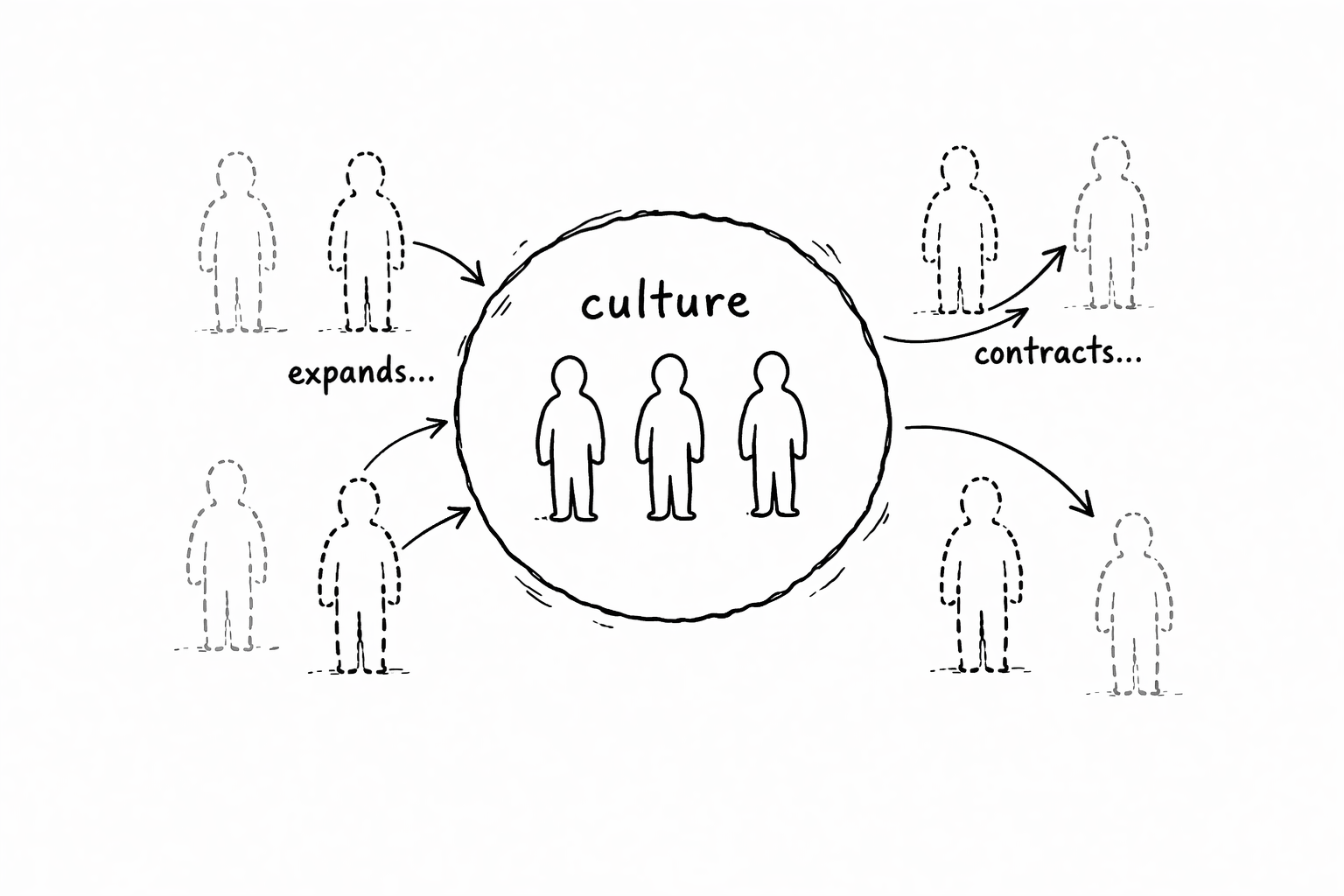
The historical record complicates the erasure argument considerably. The boundaries of whiteness have never been fixed. Irish and Italian immigrants were once explicitly excluded from the category before being absorbed into it. What appears stable in the present is almost always the product of earlier redefinition. A category that has expanded and contracted along economic and political lines throughout American history is a poor candidate for the kind of fixed, threatened identity Carl was describing. Remove specific ethnic identities and there is no common cuisine, no shared ritual calendar, no shared kinship system binding the group together. The identity is positional, not cultural.
That distinction matters — and it becomes even sharper when set against what Black Americans have been building for centuries. Black American culture did not emerge from shared skin color alone. It was forged through law, forced displacement, and generations of collective navigation of a system designed to exclude. As Will Davison explored in Why the Foundational Black American Conversation Matters, scholars describe this as ethnogenesis — the formation of a new cultural group through historical circumstance. Hip-hop, jazz, R&B, civic invention, linguistic innovation — all of it emerged from that rupture. When something becomes global, its origins tend to disappear. That doesn’t mean the origins aren’t there. And at the very moment the FBA conversation is asking Black Americans to name their history with more precision and care, the dominant political conversation is asking the country to treat demographic anxiety as cultural loss. Those are not equivalent claims.
What makes this moment worth tracking isn’t the nominee — it’s the pattern. Cultural identity tends to be treated as fixed when it feels secure, and as threatened when it begins to shift. The framing of erasure says less about the culture in question than about the speaker’s relationship to power. It’s a dynamic we’ve explored in Why Even Ordinary Moments Now Invite Extraordinary Analysis — how interpretation gets applied unevenly, and who gets to simply exist in a moment without having to justify it.
The hearing raised a question larger than any nominee. If American ideals belong to a race, they are not democratic. If they are democratic, they cannot belong to a race. That tension is not new. But it is becoming harder to avoid naming directly — especially when the communities who built so much of this country’s culture from the ground up are still being asked to prove their belonging.
Why This Matters
The debate over “white culture” is ultimately less about culture than about authority — specifically, who gets to define it. Cultural identity is not just something people have; it is something people claim, contest, and shape. The tension is not simply about preservation. It is about control over meaning — who holds it, and whether that control is acknowledged or assumed.