
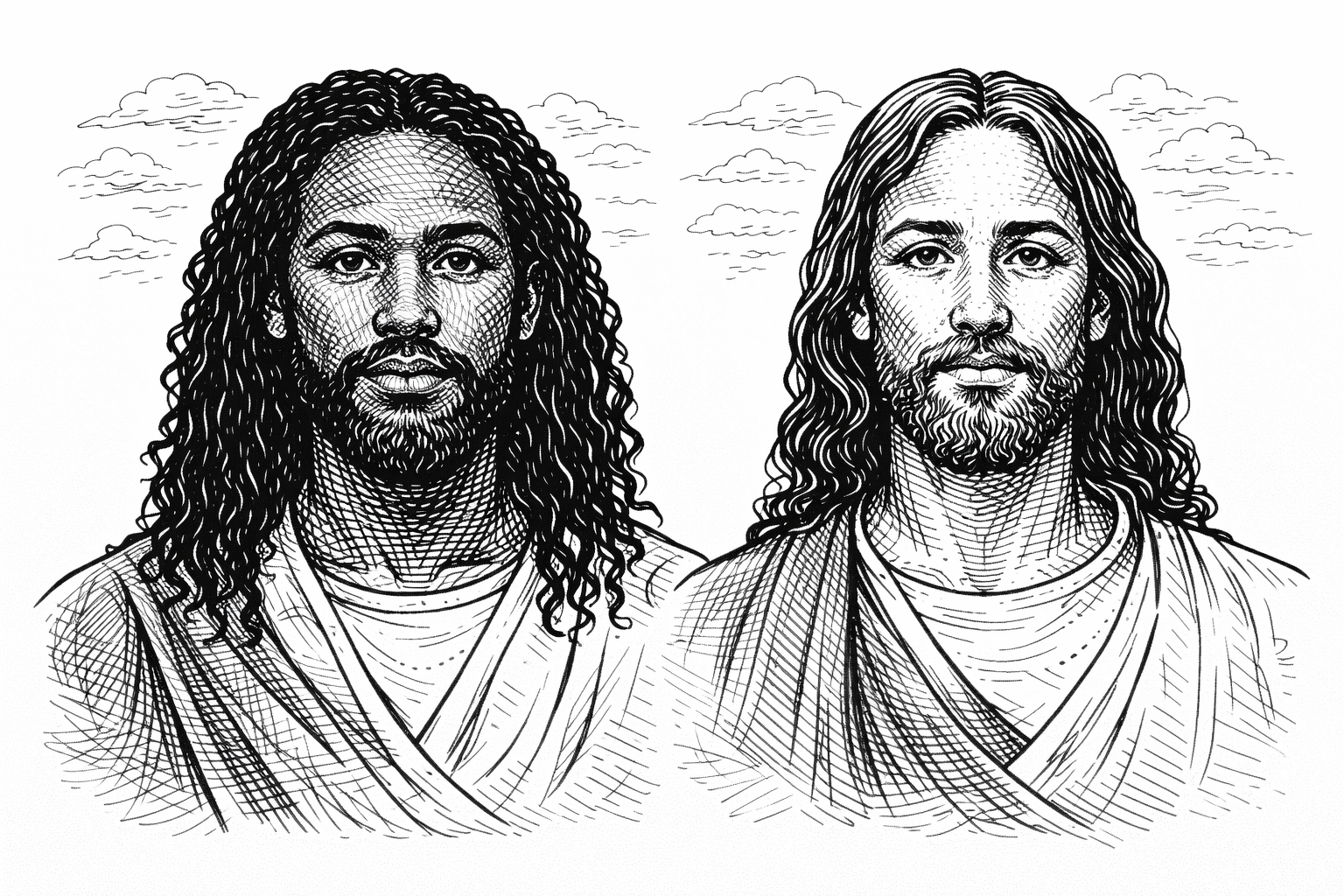
Part of Culture in Motion — an ongoing series examining who defines culture, how it’s interpreted, and how both are reshaped over time.
There is a difference between reclaiming identity and having identity explained back to you.
A recent clip circulating on X shows a white priest asserting that Jesus was Black. The statement itself is not new — questions about the historical and cultural identity of Jesus have existed for centuries, shaped by geography, theology, and interpretation. But the reaction to this moment is not just about accuracy. It is about authorship. Who is allowed to define identity — and under what conditions — matters as much as the claim itself.
Part of the argument draws from the Book of Revelation, where the resurrected Jesus is described with hair like wool and feet like fine brass, as if burned in a furnace. The language is visual but not precise. Burnished bronze is not a bright metallic gold — it is darker, deeper, altered by heat, closer to a rich brown than a reflective shine. The passage evokes color and intensity, but it does not map cleanly onto modern racial categories. That gap is where interpretation begins.
For some, the description functions as a corrective — an attempt to move away from centuries of Eurocentric imagery toward something more geographically and historically grounded. In that reading, the claim challenges a dominant visual tradition that has long shaped how Jesus is seen. For others, the discomfort is immediate. Not because the passage is unfamiliar, but because of who is presenting it. When identity is reframed by someone outside the community most directly impacted by that history, it can feel less like recognition and more like re-entry — a narrative that has been historically imposed, now being revised again from the outside.
That tension is visible in the responses. The conversation does not settle into agreement or disagreement. It fragments. Some engage the text. Others move into broader debates about Black identity, diaspora, and belonging. Still others reject the premise entirely. What begins as a theological interpretation becomes something else — a reflection of how often identity is defined, challenged, and redistributed in public spaces without the consent of the communities most affected.
This is where the moment becomes cultural rather than purely religious. The issue is not only what is being said. It is how frequently Black identity in particular is interpreted, translated, or reframed by external voices — and how even interpretations that appear corrective exist within a longer pattern of narrative control. The history of misrepresentation does not disappear simply because the message changes direction. As FLO, Dave, and Kwn — The U.K. R&B and Rap Takeover Is No Longer a Trend examined this week, Black Americans have never fully built the protective borders around their identity and culture that other diaspora communities maintain — and that openness has consistently created space for others to step in and define the terms.
Platforms like X intensify that dynamic. The clip circulates without context, the passage is reduced to a few phrases, and responses are immediate. Agreement, skepticism, frustration, and hostility appear side by side. The structure favors reaction over resolution, visibility over depth. In that environment, the meaning of the original claim becomes secondary. What remains is the experience of watching identity be debated in real time — again, in public, again without a shared framework for how those conversations should unfold, and again by people who will move on to the next debate long before the community at the center of it has.
Why this matters
The question is not simply whether a description is symbolic or literal. It is who is positioned to interpret it—and how that interpretation is received when it enters a space shaped by a long history of external definition. When identity is repeatedly explained from the outside, even moments that appear to challenge dominant narratives can carry a familiar weight. Not because they are identical to what came before, but because they emerge from the same dynamic: identity being defined in public, often without the consent of those who live it.