

Financial disparities between Black and white Americans remain one of the most persistent features of the U.S. economy. Across income, wealth, credit, and retirement, the gaps are not only large—they are moving, in some cases widening, and consistently reinforcing one another. A recent analysis by LendingTree, supported by data from the U.S. Census Bureau and the Federal Reserve, shows that these disparities are not isolated—they form a connected system that compounds over time.
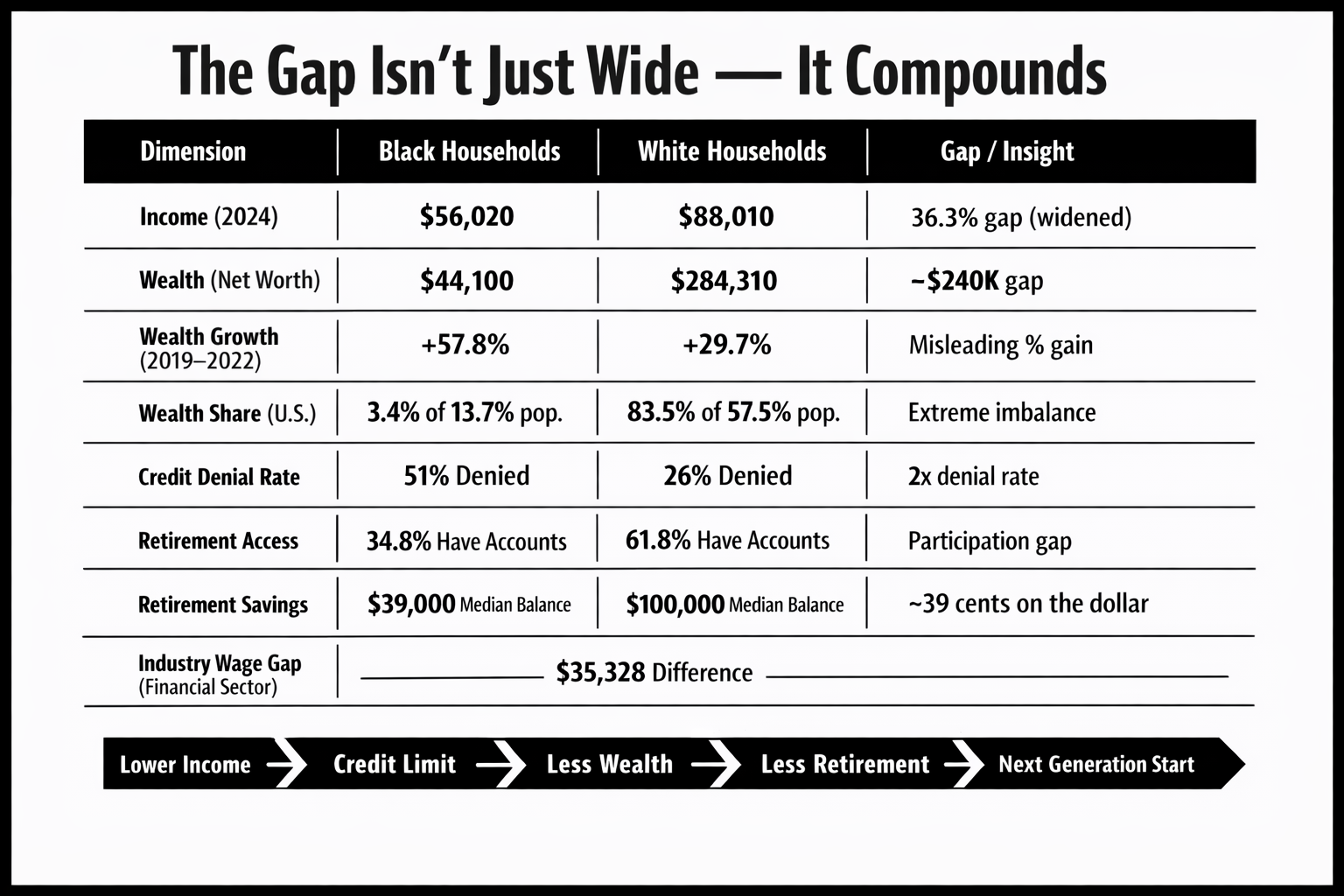
The income data makes that clear immediately. According to U.S. Census Bureau data, Black household income has remained relatively flat while white household income has continued to rise, pushing the gap above 36%. That divergence is not incidental. It reflects how economic growth is distributed—and who is positioned to benefit from it. Income is the entry point into the financial system, and when it lags, every downstream outcome reflects it.
From there, the disparities begin to compound. Lower income limits savings and increases reliance on credit, but access to credit is uneven. LendingTree reports that 51% of Black applicants were denied credit or approved for less than requested, compared to 26% of white applicants. The Federal Reserve has consistently found similar patterns in its Survey of Household Economics and Decisionmaking (SHED), where Black households report higher rates of financial fragility and credit constraints. What appears to be individual financial behavior is, in reality, structurally conditioned access.
The wealth data shows how those conditions accumulate over time. Federal Reserve data from the Survey of Consumer Finances shows that median Black household wealth remains a fraction of white household wealth—even in periods of growth. LendingTree’s analysis reflects this same pattern, with Black median net worth at $44,100 compared to $284,310 for white households. Percentage gains can suggest progress, but the underlying dollar gap continues to widen. Wealth does not just grow—it compounds, and so do the disparities tied to it.
That dynamic carries into retirement, where both access and outcomes diverge. Federal Reserve data shows that Black households are significantly less likely to have retirement accounts and, when they do, hold lower balances. LendingTree reports participation rates of 34.8% for Black households compared to 61.8% for white households, with a substantial gap in median savings. Over time, this translates into unequal levels of long-term financial security and greater reliance on systems like Social Security, which are not designed to close wealth gaps.
Taken together, the data shows more than disparity—it shows continuity. Each category feeds the next: income shapes credit, credit shapes wealth, wealth shapes retirement, and all of it determines the starting point for the next generation. The system does not reset between stages. As the Federal Reserve and Census data make clear, it carries forward.
The gap isn’t just wide. It compounds.