
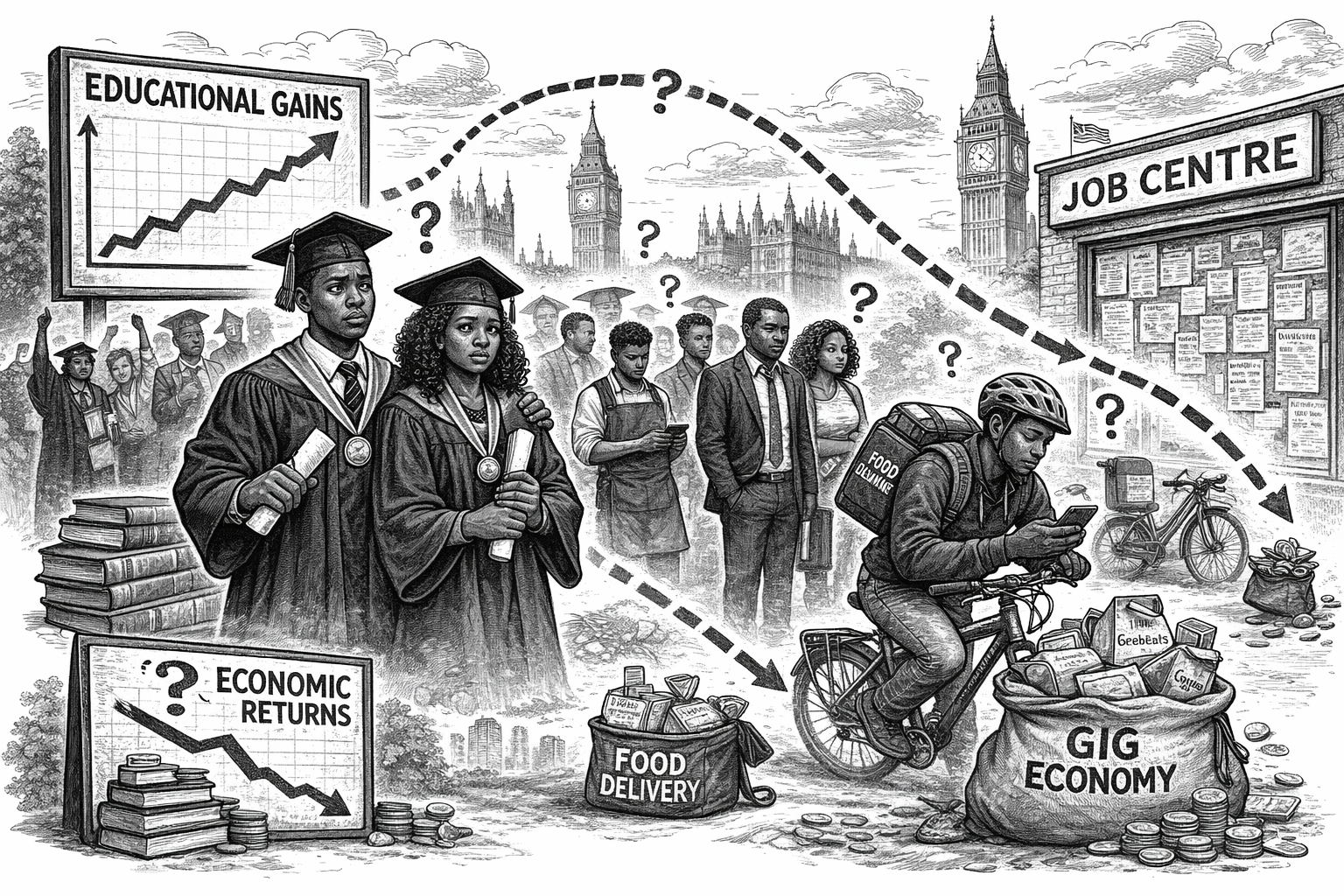
The conventional story about racial inequality and education runs in one direction: close the educational gap and the economic gap will follow. A February 2026 report from the Joseph Rowntree Foundation complicates that story directly, and the complication is significant. Black African pupils have improved their academic attainment during the 2019-2024 period and now outperform their White British peers. Although ethnic minority young people have achieved significant educational progress that should, in theory, reduce poverty, they are more likely to experience a lack of economic return for education qualifications and improvement of skills. The lowest financial returns to education are observed among Bangladeshi, Pakistani, and Black African Muslim women.
The data describes a system where credentials are being earned and not converting. Almost a quarter of ethnic minorities working in the gig economy say it is their main source of income, compared to 19% of those with a White ethnic background. Despite its relevance, ethnicity is still relatively absent from critical debates on the gig economy and its societal consequences, including risk of poverty. The gig economy statistic is the SSC entry point — it is the UK version of what SSC has documented in the US labor market: Black workers concentrated in the sectors with the least protection, the least stability, and the least ability to convert economic activity into wealth.
The reason credentials aren’t converting is the same on both sides of the Atlantic. The persistent disadvantage experienced by members of some ethnic minorities in the UK labor market, despite relevant qualifications or experience, is deeply rooted in a complex interplay of historical and systemic factors. Discrimination in hiring, informal network effects in professional advancement, and the credentialing inflation that pushes goalposts further from communities that just cleared the previous one — these are not British problems or American problems. They are structural problems that travel.