
Part of The Access Shift — an ongoing series examining how access is being quietly reshaped across American life. New stories publish every Wednesday at 12:00pm CDT.
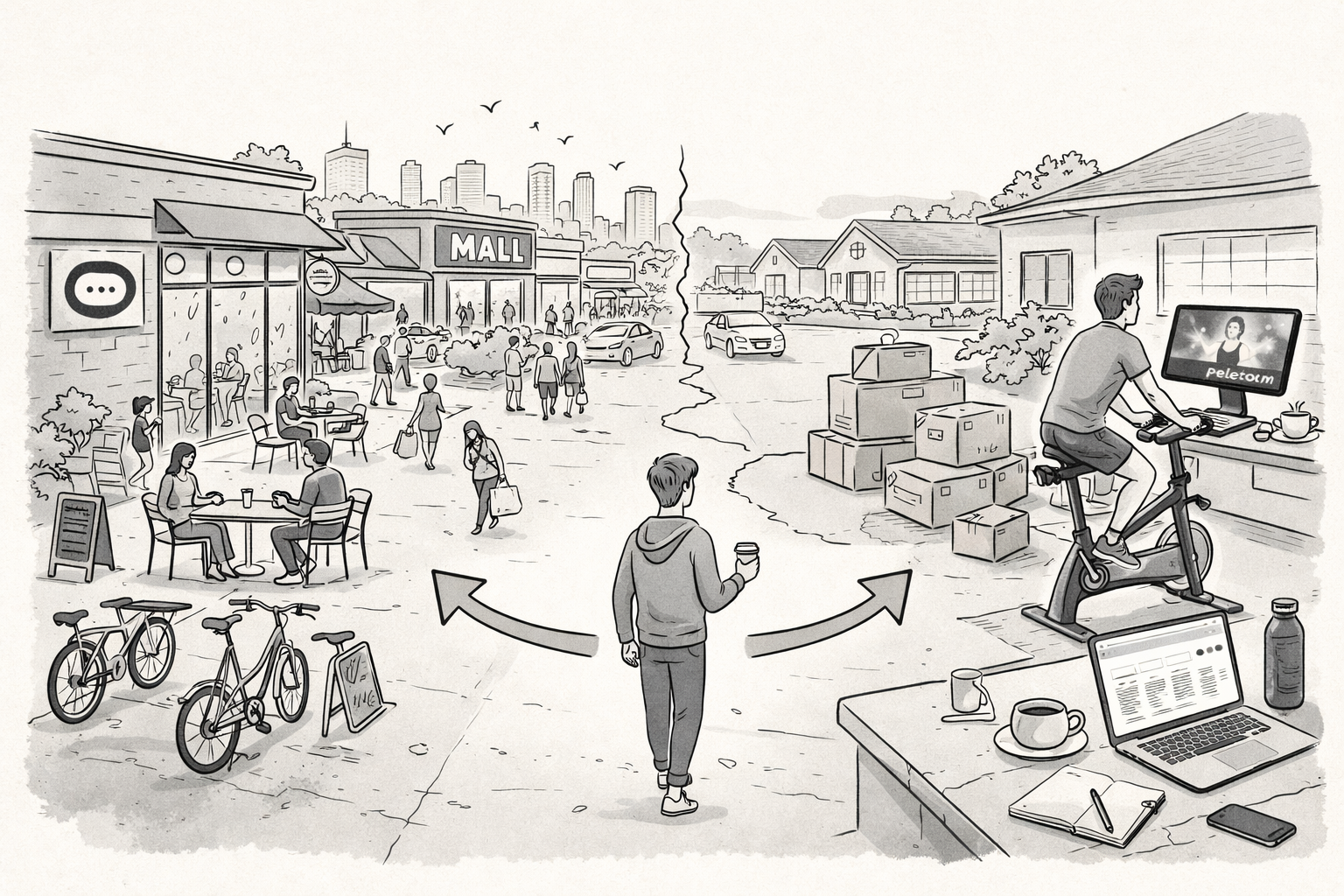
The machine on your counter makes a better espresso than most cafés. Your bike goes nowhere and still logs the miles. The package arrives before you’ve decided you needed it. Individually, these feel like upgrades. Collectively, they are quietly dismantling something older and harder to name.
The U.S. Surgeon General has reported that roughly half of American adults experience measurable loneliness, and long-term survey data shows people are spending less time socializing in person than they did a decade ago. Unlike most pandemic-era disruptions, this one didn’t fully reverse when the restrictions lifted. Remote work stayed. Home workouts stayed. The daily reasons to leave stayed gone.
I notice it in my own calculations. Do I ride to the cycling studio or just open the app? Do I go to the café to write, or make the espresso here? Do I drive to the store or let the algorithm deliver it by noon? None of these decisions feels significant on its own. But the math keeps coming out the same way, and each time it does, something small is skipped — a walk, a counter conversation, a face I didn’t expect to see. What gets skipped, at scale, is the third space.
Third spaces — the cafés, barbershops, plazas, parks, and malls that sit outside home and work — have always done something that online connection cannot fully replicate. They put people in proximity to difference. Not the curated, algorithmic difference of a feed, but the unscripted kind: a stranger’s opinion, a neighborhood you didn’t know, a conversation you didn’t plan. As Why Even Ordinary Moments Now Invite Extraordinary Analysis explored, digital proximity has replaced that unscripted encounter with something more managed — where even a glance gets analyzed and meaning is assigned before context arrives. That friction is not a flaw. It is, in many ways, the point. As convenience removes it, it also removes the exposure. People still connect — but increasingly in spaces designed around shared identity and preference, where the range of encounter narrows. The research on what that narrowing does to social trust and civic cohesion is not encouraging.
Third spaces haven’t vanished. But they are no longer embedded in daily life the way they once were — no longer the default, no longer the path of least resistance. The home has become too efficient, too complete, too easy to stay inside. And when the design of everyday life makes public space optional, the people with the most resources opt out first — and the spaces left behind reflect that absence. As When the Economy Slows, Some Communities Feel It First makes clear, the communities with the least financial cushion don’t get to opt out — they absorb what’s left when others do.
Convenience is not the enemy. But it is not neutral either. And what we trade away in the name of efficiency — the unplanned encounter, the shared room, the willingness to be briefly among strangers — may be worth more than we’ve been told to account for.
The Access Shift
The gradual redefinition of who systems are designed to serve.
Across sectors—from public infrastructure to healthcare to everyday spaces—access is no longer assumed. As costs rise and systems face increasing pressure, services once built for broad reach are becoming more selective, more conditional, and less universal. The Access Shift explores how these changes are unfolding in real time—and what they reveal about who is included, who is left out, and how the structure of everyday life is quietly being reshaped.