
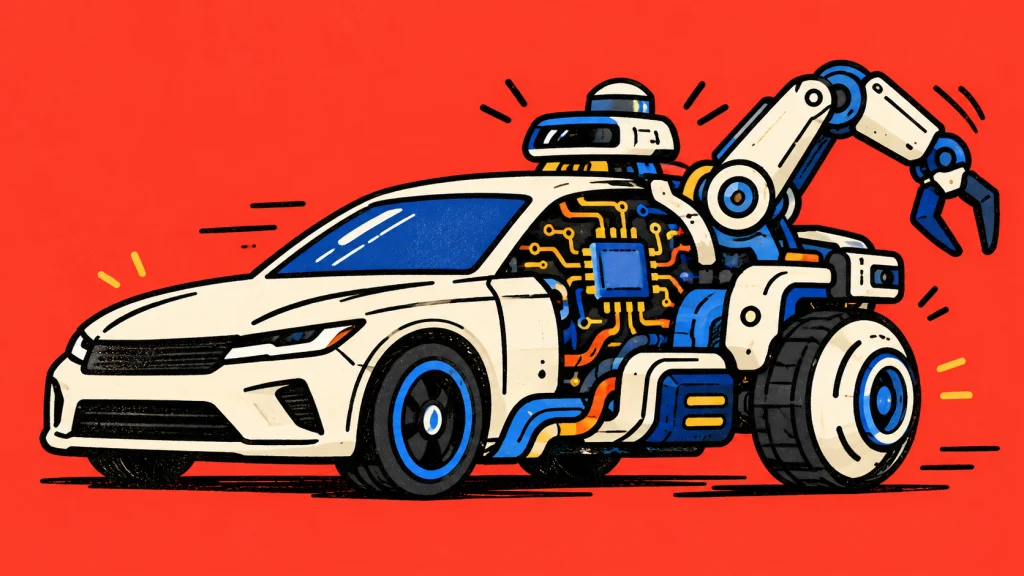
Toyota, Nissan and other manufacturers are moving into robotics, mobility and AI after China overtook Japan as the world’s largest vehicle exporter.
Japanese automakers are expanding into robotics, artificial intelligence and new forms of mobility as competition from China changes the industry that helped define Japan’s postwar economy. Trista Kurniawan of the South China Morning Post reported Tuesday that Toyota, Nissan and other companies used this week’s Japan Mobility Show Bizweek to highlight collaborations with technology firms and products extending beyond traditional passenger vehicles.
The shift follows a major reversal in industrial leadership. China overtook Japan as the world’s largest vehicle exporter in 2023, and Chinese automakers have continued expanding aggressively abroad. Industry projections now suggest Chinese overseas vehicle sales could exceed 12 million units in 2026, up 44% from last year.
Japan is responding by redefining what an automobile company can sell.
For decades, Japanese manufacturers held power through engineering quality, manufacturing discipline, global dealer networks and reliable internal-combustion vehicles. Those strengths created some of the world’s most recognizable brands and made automobiles central to Japanese exports.
Electric vehicles changed several of the competitive advantages underneath that system.
Battery technology became more important. Software became a larger part of the product. Chinese manufacturers developed huge domestic scale while moving quickly into electric vehicles and lower-cost production. Companies such as BYD then took that capacity abroad.
Japanese manufacturers cannot assume that the capabilities that protected their position in gasoline-powered cars will produce the same result in the next generation of transportation.
Expanding into robotics and mobility devices allows them to reuse assets they still possess: precision engineering, manufacturing expertise, sensors, supply chains and experience building machines that operate safely around people.
The transition also spreads risk. A company dependent almost entirely on conventional car sales is more exposed if Chinese competitors gain global market share or if consumers move more rapidly toward software-heavy electric vehicles. Robotics, autonomous systems and specialized mobility products offer additional sources of revenue.
Japan’s demographic pressures make some of those adjacent technologies especially relevant. An aging population and worker shortages create domestic demand for machines that can assist with transportation, logistics and physical tasks. Technology developed for vehicles can increasingly be applied to products designed to move people or goods in other ways.
Industrial identity is harder to diversify than a product line, however.
Japan built enormous supplier networks, employment systems and regional economies around automotive manufacturing. A move toward robotics and AI can benefit major manufacturers without guaranteeing that every supplier or worker tied to conventional vehicle production moves with them.
Technological change therefore redistributes power inside the industry as well. Software companies, battery makers and AI developers gain influence over products that were once dominated by mechanical engineering. Automakers increasingly need partnerships with companies whose expertise sits outside traditional vehicle manufacturing.
China’s rise has accelerated that change because Japanese firms no longer have the luxury of treating these technologies as distant experiments. Chinese companies are competing internationally now, and weakening domestic demand gives them additional incentive to push overseas.
Japan’s carmakers still possess global brands, manufacturing capacity and decades of engineering knowledge. Their challenge is converting those advantages before the definition of the industry moves beyond them.
The companies displaying robots and mobility systems this week are not abandoning cars. They are preparing for an economy in which the most valuable transportation companies may no longer be defined solely by how many cars they sell.
If China continues gaining share in conventional vehicle exports while software and AI become more important to mobility, Japanese manufacturers will have to compete for leadership in categories that do not yet have the same entrenched hierarchy. Japan’s next industrial advantage may depend on whether its car companies can stop thinking of themselves primarily as car companies before the market makes that decision for them.