
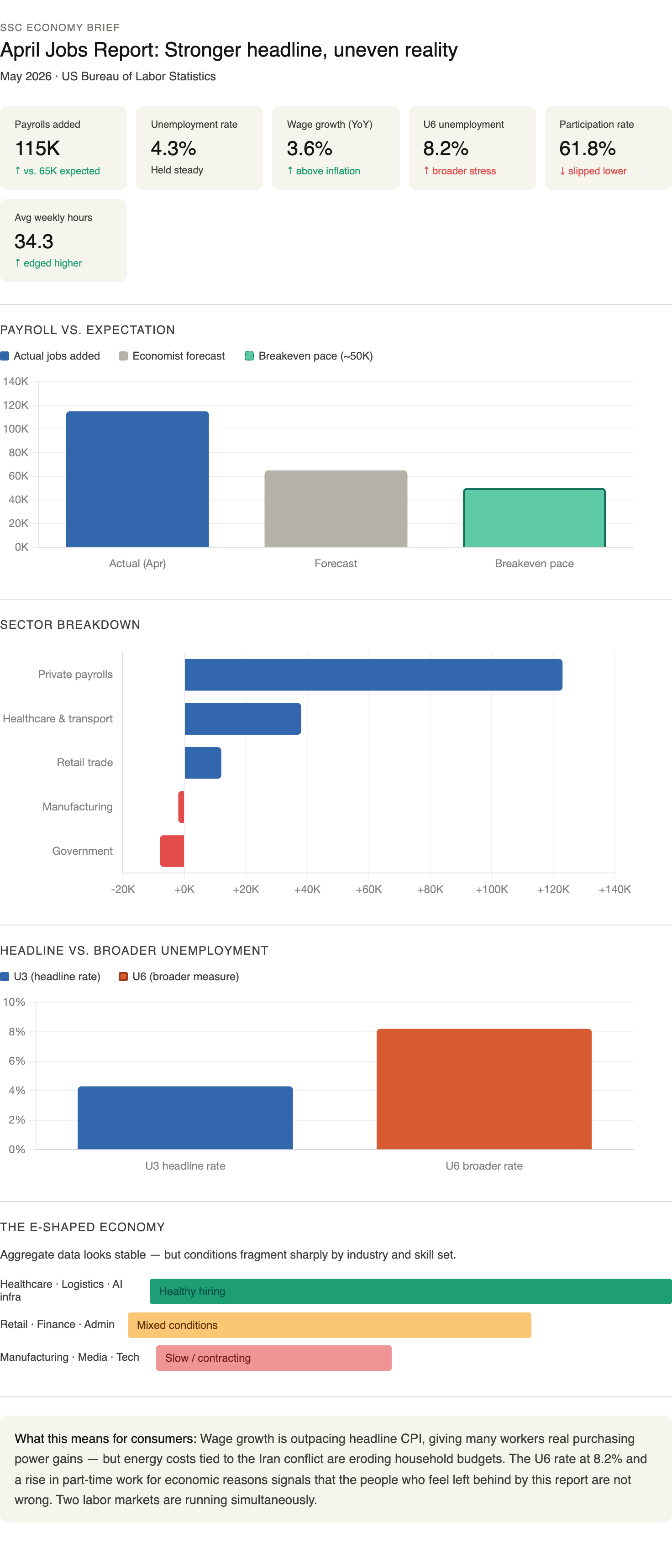
The April jobs report landed better than almost anyone expected. The US economy added 115,000 jobs last month — nearly double the 65,000 economists had forecast. The unemployment rate held steady at 4.3%. Wage growth is outpacing inflation. On paper, this is a labor market that is stabilizing, maybe even strengthening.
And yet something doesn’t add up. Consumer confidence remains fragile. Hiring timelines are stretching. White-collar professionals are cycling through job searches that would have taken weeks two years ago and now take months. People are not imagining this. They are reading a different report than the one being celebrated.
Both things are true. That’s exactly the problem.
What the headline says
According to Havas Edge, which tracks labor market data for its implications on consumer behavior, April’s numbers represented a genuine beat. Private payrolls rose 123,000. Average hourly earnings climbed 3.6% year over year, running ahead of headline CPI and delivering real wage gains for workers still holding steady employment. Average weekly hours edged higher to 34.3 — a signal that employers are squeezing more from existing staff rather than pulling back on hours.
Federal Reserve Chair Jerome Powell has noted that the economy likely needs fewer monthly job additions than it once did to maintain stable unemployment, as labor force growth has slowed. Some economists now put the so-called “breakeven” pace as low as 50,000 jobs per month. By that measure, 115,000 isn’t just a beat — it’s more than double what’s needed to hold the line.
At the headline level, this is a labor market that held.
What the headline doesn’t say
Beneath that number, the April report reads differently.
Manufacturing shed 2,000 more jobs. Government employment fell by 8,000 — a figure that will likely compound in coming months as federal workforce reductions continue to filter through state and local systems. The labor force participation rate slipped to 61.8%. The number of people working part time because they couldn’t find full-time work increased sharply. And the U6 unemployment rate — the broader measure that captures discouraged workers and those stuck in involuntary part-time arrangements — rose to 8.2%.
That’s nearly twice the headline figure. It is not a footnote. It is a more complete picture of where the labor market stress is actually concentrated.
The cumulative two-month revision also reduced prior job growth by 16,000 positions — a quiet acknowledgment that momentum has been softer than the top-line numbers suggested at the time.
The AI variable no one wants to name
Running alongside both reports is a data point that reframes the entire conversation — one SSC reported on this week. According to outplacement firm Challenger, Gray & Christmas, employers announced 83,387 job cuts in April, and AI was the single most cited reason for the second consecutive month, accounting for 21,490 cuts, or 26% of the total. Year-to-date, AI has been cited in nearly 50,000 planned cuts — a share that was 13% through March and is now 16%. The acceleration is measurable.
As SSC reported in The AI Layoff Machine Is Running, the budget that once paid for a human role is increasingly being redirected toward AI infrastructure — and companies are saying so publicly, in their own layoff filings. The money has moved. Tech companies led all sectors with 33,361 cuts in April alone. But the AI rationale is spreading beyond Silicon Valley into pharma, chemical manufacturing, and industrial goods — sectors that historically absorbed automation pressures more slowly.
That distinction matters. The shift is not always visible as a layoff. Sometimes it looks like a hiring freeze. Sometimes it looks like a role that gets restructured rather than refilled. Sometimes it looks like a job search that used to take six weeks now taking six months. The official unemployment rate doesn’t capture any of that. The Challenger data starts to.
The economy is not broken. It is bifurcated.
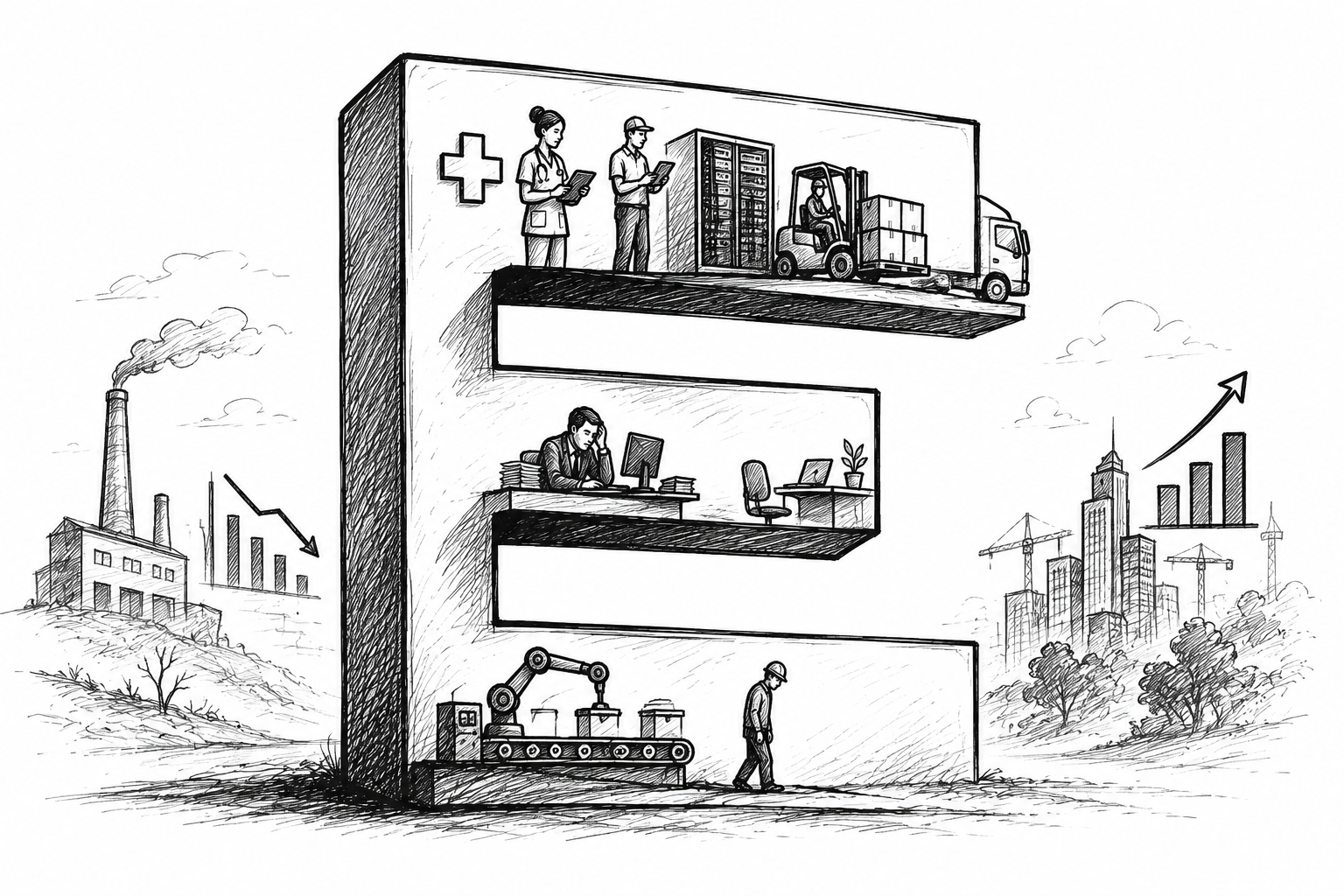
This is what Havas Edge describes as an E-shaped economy: aggregate data that looks stable at the top while conditions fragment sharply along industry, income, and skill lines.
A worker in healthcare, logistics, warehousing, or AI infrastructure is living in one labor market. Hiring in those sectors remains relatively healthy. Employers are competing for qualified candidates. Wages are moving.
A worker in manufacturing, recruiting, media, technology, or traditional white-collar professional services is living in a different labor market entirely. Hiring has slowed. Layoffs have clustered. Replacing a lost job is taking longer and often paying less when it comes. The experience of job searching has structurally changed in a way that aggregate unemployment data simply does not capture.
These are not contradictory realities. They exist simultaneously, inside the same monthly report, in the same economy, right now.
Why it matters beyond the numbers
Labor market data is a lagging indicator of economic confidence. Havas Edge tracks hiring conditions precisely because perceived job security shapes consumer behavior long before it shows up in broader economic data. When workers feel uncertain — even workers who are currently employed — they pull back on discretionary spending, delay major purchases, and increase savings as a hedge. That behavioral shift ripples through the economy whether or not unemployment technically rises.
The April report beat its forecast. The Challenger data told a more complicated story the same week. Together they describe a labor market where the headline is real, the anxiety underneath it is also real, and the two can coexist indefinitely — until they can’t.
The consumers who feel cautious right now are not misreading the data. They are reading the part of it that the headline number was never designed to capture.
Sources: Havas Edge labor market analysis, May 2026. US Bureau of Labor Statistics, April 2026 Employment Situation Summary. Challenger, Gray & Christmas April 2026 Job Cuts Report, via SSC — The AI Layoff Machine Is Running.