
Spotify is introducing a “Verified by Spotify” badge — a green checkmark designed to distinguish human artists from AI-generated ones. The feature will appear on artist profiles and in search results, signaling that a creator has been reviewed and meets the platform’s criteria for authenticity. On the surface, it reads like a simple labeling tool. In practice, it is a response to something much larger: the platform no longer has a clear boundary between what is human and what is synthetic.
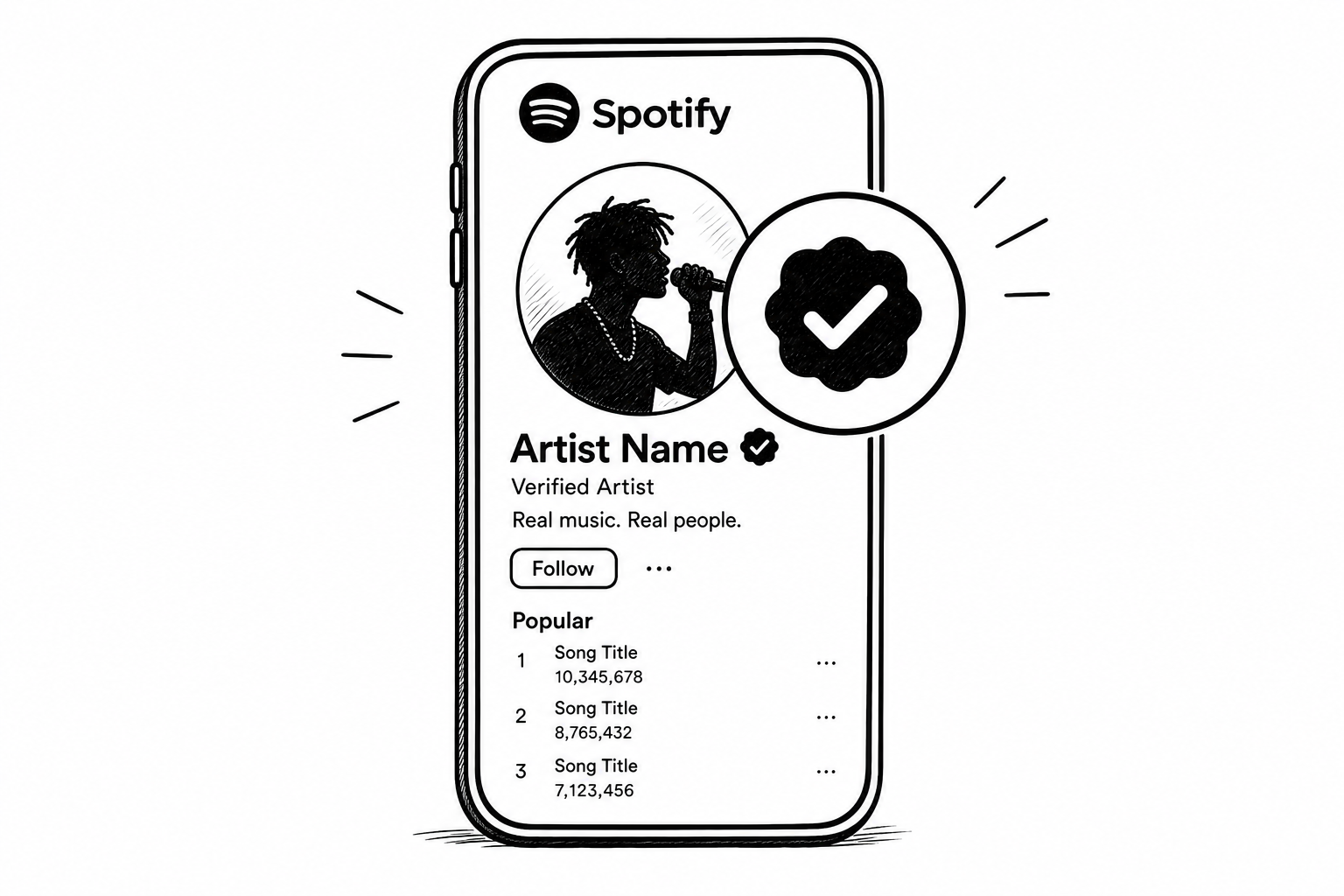
AI-generated music has scaled quickly — flooding streaming services with content that can mimic genres, voices, and production styles at volume. Spotify has already removed tens of millions of tracks tied to spam and AI misuse, but the underlying problem isn’t just moderation. It’s classification. The checkmark is an attempt to rebuild that classification layer from the inside out.
What Spotify is actually doing is shifting the burden of clarity from the system to the signal. Instead of fully identifying and labeling AI-generated content, it is marking what it considers real and leaving everything else unmarked. That distinction matters. It means authenticity becomes something that has to be earned, verified, and maintained — rather than assumed. The platform is not solving the AI problem. It is drawing a line around what it can confidently stand behind and calling that line authenticity.
The criteria reinforce that shift in ways worth examining. Verification is not just about identity — it’s tied to activity. Consistent listener engagement, social presence, touring, merchandise. Being real, within Spotify’s system, is not just about being human. It’s about being legible within the platform’s ecosystem. That introduces a significant tension. Smaller or emerging artists who haven’t yet built that infrastructure may appear unverified — not because they are AI, but because they don’t meet the system’s thresholds. At the same time, AI-generated content that is distributed effectively enough could begin to resemble legitimacy through scale alone. The signal is meant to clarify authenticity, but it is still shaped by the same dynamics that determine visibility across the platform to begin with.
This is where the feature moves beyond product and into structure. Spotify is not just labeling artists. It is redefining what counts as an artist within its system. Profiles that primarily represent AI-generated personas are not eligible for verification at launch, but the platform has already acknowledged that the definition of authenticity is evolving — which is another way of saying the line it is drawing today may not hold.
That evolution is the real story. The line between human and AI is not fixed. Many human artists already use AI tools in production, songwriting, and distribution. The distinction Spotify is drawing is less about process and more about origin and control — who is behind the work, and whether that presence can be verified across systems. It is a workable distinction for now. It is not a permanent one.
What the checkmark reveals is not just a new feature but a deeper instability. Streaming platforms were built on the assumption that identity and output were connected — that a name represented a person, and a catalog represented their work. AI breaks that assumption. It allows output to exist without a stable identity behind it, at scale, faster than any moderation system was designed to catch. Spotify’s response is to reintroduce identity as a signal. But signals only work if users trust them, and if the system applying them is consistent. If verification becomes tied too closely to scale or platform-native activity, it risks reinforcing the same dynamics it’s trying to correct.
The checkmark is less a solution than a first boundary — not between human and AI, but between what the platform can confidently stand behind and everything else it can no longer fully explain.