
Forty-nine million, two hundred thousand people. That is how many Black Americans were living in the United States in 2024, the highest number ever recorded — a population larger than the entire country of Spain, growing at a pace that has reshaped the demographic map of nearly every major region in the country.
The growth is real. The educational gains are real. The geographic momentum is real. But data has a way of flattening the people inside it, and the Pew Research Center’s latest portrait of Black America is no exception. Read carefully, it is less a story of arrival than one of uneven terrain — a community diversifying rapidly in composition, dispersing geographically into cities without the infrastructure to receive them, and producing educational gains that the labor market has not yet seen fit to fully compensate.
To look at this data honestly is to hold two things at once: a population that has grown by 36% since 2000, with rising degree attainment and a median age young enough to shape the next two decades of American life — and a population whose median household income, marriage patterns, and geographic displacement still bear the structural weight of decisions made long before any of these numbers were collected.
What follows is a closer read of what the data shows, what it suggests, and what it cannot say on its own.
The U.S. Black Population in 2024: What the Numbers Actually Mean
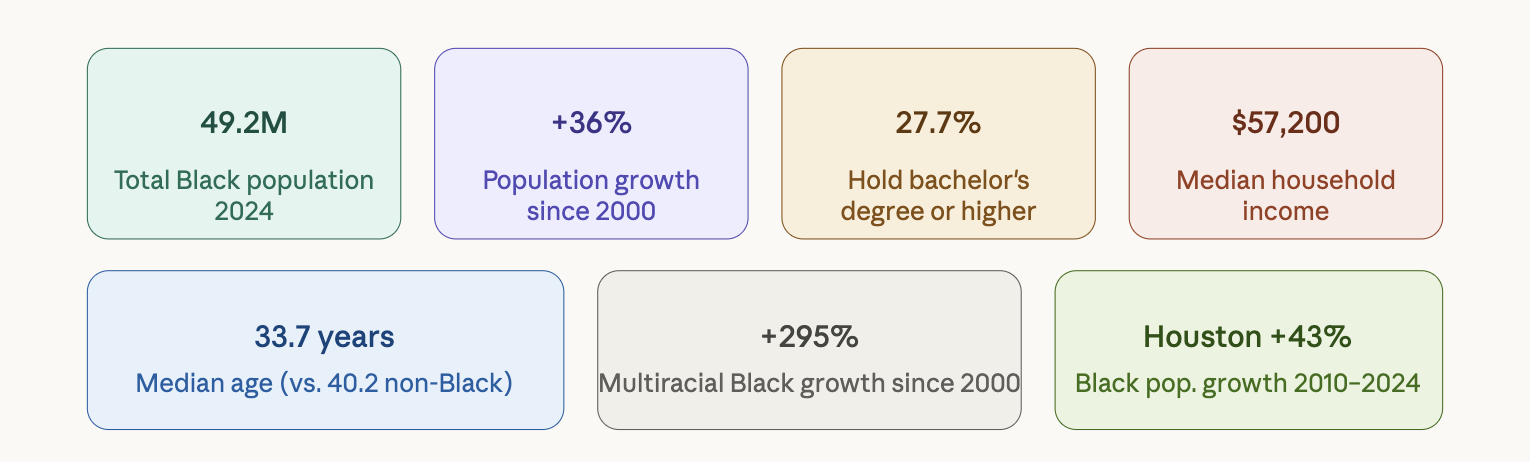
The Pew Research Center’s updated demographic portrait of Black America is more than a headcount — it’s a structural document. At 49.2 million people, the Black population has grown 36% since 2000, and the composition of that growth tells us a great deal about identity, migration, education, and the ongoing gaps that data points alone can’t close.
Who Is Being Counted — and Why That Matters
The 36% population growth headline obscures something important: the fastest-growing segments of the Black population are multiracial (up 295%) and Black Hispanic (up 232%). This isn’t just demographic bookkeeping. It reflects both a shift in how Americans self-identify — particularly younger generations — and the continued arrival of immigrants from Africa and the Caribbean. Any policy or advocacy work that treats “the Black population” as a monolithic category will increasingly miss the texture of who’s actually here. These are communities with different immigration statuses, different relationships to institutional racism, different cultural frameworks, and in many cases, different economic footholds.
The Geographic Story: Dispersion and the Sun Belt
The data confirms what’s been visible on the ground for over a decade — Black Americans are moving, and not just to traditional strongholds. The largest numerical gains are in Texas and Florida, while Illinois, Mississippi, and D.C. are losing Black residents. Houston’s Black population grew 43% between 2010 and 2024. Dallas grew 52%. Meanwhile, Chicago dropped 3%.
This matters because political power, institutional infrastructure, and cultural capital tend to be concentrated in legacy Black metros. When Black residents disperse into fast-growing metros without that infrastructure, they’re often entering communities where Black institutions, HBCU pipelines, and established civic organizations don’t yet have the same density. Growth without infrastructure is not the same as progress.
The Black population decline in D.C. is particularly worth noting. The nation’s capital — long one of the most significant hubs of Black political and cultural life — is actively losing Black residents as housing costs escalate. That’s not a footnote. That’s a displacement story.
Education: Real Gains, Persistent Gap
The education numbers are genuinely encouraging and deserve to be named as such. Black adults with a bachelor’s degree rose from 14.5% in 2000 to 27.7% in 2024. Black women drove much of that gain — 30.7% now hold a degree, nearly double the 2000 figure. These are real, structural changes in the educational profile of Black America.
But the framing matters. Gains within the Black community don’t automatically close gaps with other communities that have also been advancing during the same period. A rising tide lifts all boats — and boats that started higher are still higher. The more meaningful question isn’t “how much has Black educational attainment grown?” It’s “what has that attainment translated into in terms of income, wealth, and opportunity?” The $57,200 median household income answers that, quietly.
Income and the Marriage Penalty
Median household income at $57,200 tells part of the story. The internal variation is more revealing: multiracial Black households earn $67,000, Black Hispanic households $63,300, and single-race, non-Hispanic Black households $56,000. These gaps track closely with data about wealth accumulation, credit access, and intergenerational transfer — all of which are still severely constrained for foundational Black Americans specifically.
The marriage data adds a layer. Black adults are nearly twice as likely to have never married as non-Black adults (48% vs. 29%). Black women are significantly more likely to be divorced, separated, or widowed. The causes of these patterns are structural — mass incarceration, economic precarity, the long tail of policies that destabilized Black family formation — but the economic consequences compound. Single-income households don’t build generational wealth at the same rate. The intermarriage data (18% of married Black adults have a non-Black spouse) also quietly signals ongoing shifts in how Black households form and what that means for intra-community economic solidarity.
The Bottom Line: 49 Million People, Uneven Terrain
The overarching takeaway from this data isn’t a single headline. It’s a set of structural tensions that anyone working on Black community development, policy, communications, or media needs to sit with:
Growth is real — but it is uneven across subgroups, and the fastest-growing segments (multiracial, Hispanic, immigrant-origin) have different needs than foundational Black Americans who have carried the weight of this country’s racial architecture longest.
Education is rising — but income gains haven’t matched pace, and the educational achievement of Black women in particular remains inadequately compensated in the labor market.
Geography is shifting — and the communities gaining Black residents fastest are often the least prepared to serve them institutionally.
The median age of 33.7 means this is a young population. Half of Black America is under 34. What happens with housing, education, and economic policy in the next decade isn’t abstract — it lands directly on the cohort entering their peak earning and family-forming years right now.
The numbers don’t tell you what to do. But they tell you where to look.