
I was a kid when “It Takes Two” found me. I can still remember the music video. I played it over and over. I did not find it. It found me — the way that song always does. It was already playing somewhere before I arrived. It was already in the room. That is not a memory specific to me. That is the memory of an entire generation of people who grew up in the 1980s and 1990s and did not learn that song so much as absorb it.
Rob Base — born Robert Ginyard in Harlem, New York — died on May 22, 2026, surrounded by family, four days after his 59th birthday. He had been fighting cancer privately, on his own terms, the way he did most things. The announcement came through his social media. The internet responded the way it always does when someone from that generation leaves: with the song.
You already know it. You have always known it. “It Takes Two” is not a song you discover. It is a song you inherit. It arrives at the wedding reception before you get there. It is already playing at the block party when you pull up. It exists in the category of music that functions less like a record and more like a shared cultural reflex — the kind of song that, when the first two seconds come through the speaker, produces a physical response before the brain has time to process what is happening.
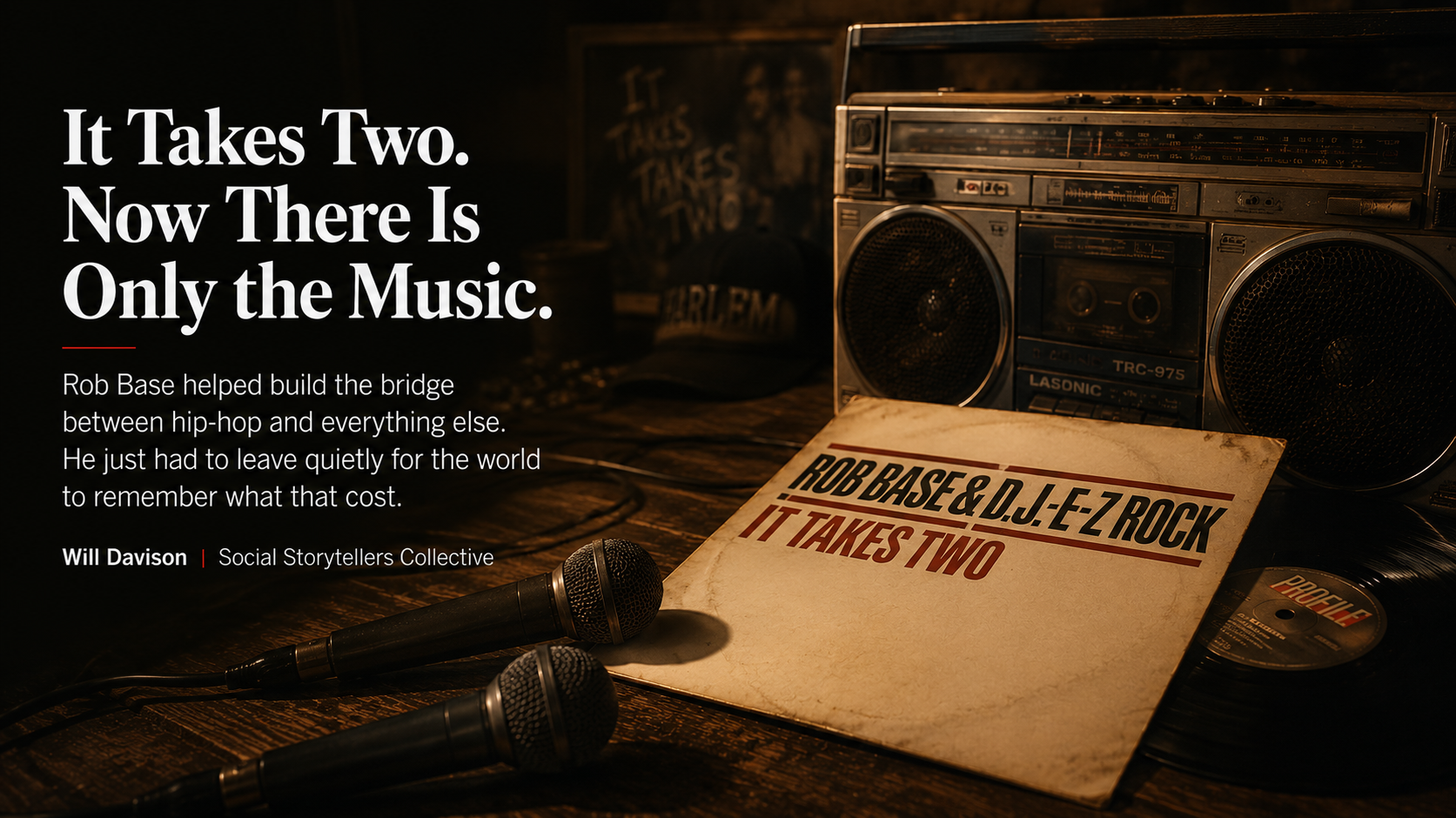
Rob Base and DJ E-Z Rock released “It Takes Two” in 1988 on Profile Records. It sampled Lyn Collins’ 1972 record “Think (About It)” — a James Brown production — and built on top of it something that didn’t sound like rap and didn’t sound like house and didn’t sound like pop but somehow reached all three audiences simultaneously. That was the point. They were not crossing over. They were building a bridge that the rest of hip-hop would spend the next decade walking across. The record went platinum. The album went platinum. The song outlived both of those designations by decades.
DJ E-Z Rock — Rodney “Skip” Bryce, the other half — died in 2014 from complications of diabetes. He was 46. Rob Base outlived his partner by twelve years, carrying the legacy of what they built together through every era the culture cycled through. He spoke about E-Z Rock after his death with the plainness of someone describing a person who had been with him since fourth grade. “He was a joker,” Base told Rolling Stone. “Everybody loved him.” Nine words. The whole relationship in nine words.
What Rob Base and E-Z Rock actually did was demonstrate — at a moment when hip-hop was still being dismissed as a genre rather than recognized as a cultural force — that the music could move any room, reach any crowd, and hold any floor. They did it without a major label, without the industry infrastructure that would later claim credit for hip-hop’s commercial expansion, and without waiting for permission from institutions that were still deciding whether the genre counted.
The song is 38 years old. It will be played this weekend at cookouts and block parties and wherever people gather who carry the particular memory of what summer sounded like when they were young. Rob Base will not be there. The music will not notice the difference. That is the only kind of permanence that actually holds.
Rest, Rob. E-Z Rock has been waiting.