
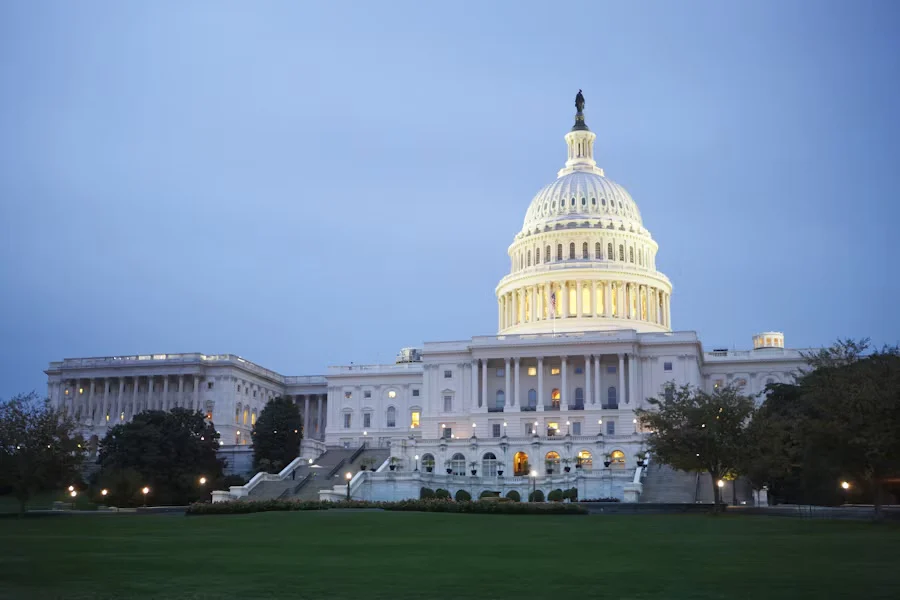
A new Pew survey shows most Americans approve of the incoming Democratic majority’s plans and give it a lopsided edge over Donald Trump on the issues. It also shows two-thirds of Americans worried the party will spend its power investigating instead of governing.
Policy · Analysis · 4 min read · Nov 20, 2026 ·
A 55% majority of Americans approve of Democratic congressional leaders’ policies and plans for the country after the party’s midterm sweep, according to a Pew Research Center survey of 10,247 adults conducted Nov. 9-15 and written by Steven Shepard, Andrew Daniller and Ted Van Green. Another 57% say they are excited (19%) or relieved (38%) that Democrats won control of Congress. Pew’s most striking number concerns the White House: 80% of Americans say Donald Trump will be unsuccessful getting his programs passed over the next two years, including 72% of Republicans and Republican-leaning independents.
Agenda-setting just changed addresses
That 80% figure describes a shift in who sets the agenda in Washington. After the 2018 midterms, 35% of Americans still expected Trump to get his programs through, and 33% said the same about Joe Biden after 2022. In both of those years the opposition flipped only the House. This time Democrats took both chambers, and the public has adjusted its expectations accordingly. More Americans want Democratic congressional leaders to take the lead in solving the nation’s problems (36%) than want Trump to (15%), while 47% want both to lead.
Congressional Democrats also hold double-digit advantages over Trump on every issue Pew tested. They lead by 18 points on the economy, 13 on immigration, 22 on the military conflict with Iran, 23 on trade and tariffs, 29 on ethics in government and 32 on healthcare. A majority can schedule votes, write spending bills and run committees, but anything it passes still needs a signature from a president who holds a veto. What the new majority can control on its own is the calendar, and the survey is mostly about what voters want on that calendar.
The base and the public want different first acts
The split shows up on investigations. More Americans call Democratic investigations into how government operated under the Trump administration the right thing to do (32%) than the wrong thing (19%), though about half say it’s too early to tell or haven’t heard of such plans. By more than two to one, though, the public worries Democrats will focus too much on investigating (67%) rather than too little (31%). Republicans hold that worry almost unanimously, 89% to 10%. Democrats split down the middle, 49% to 50%.
That Democratic split is the pressure point. Roughly seven in ten Democrats (72%) still want their leaders to stand up to Trump rather than work with him, although that share has come down from the 82% Pew measured in January. Republicans moved further. In January, 61% of Republicans wanted Trump to stand up to Democratic leaders; now 53%say he should work with them even if it disappoints his own voters. The Republican rank and file has moved toward deal-making faster than the Democratic base has. If Democratic leaders read their own voters’ appetite for confrontation as the national mood, they will be governing for half of their own party and a fraction of the country.
Approval for the plans, not the people
Pew also found that views of Hakeem Jeffries and Chuck Schumer are more negative than positive, even as a majority backs what their caucuses plan to do. Americans are rating an agenda, not the people who will carry it out, and agendas get graded on results. The 52% who expect congressional Democrats to succeed in their policy aims are a soft majority. They will judge the majority on prices, healthcare and the Iran conflict, the issues where the party’s advantage over Trump is widest.
The first months of the 120th Congress will decide whether that advantage holds. A majority that leads with legislation on costs and healthcare, and lets oversight run as a secondary track, will likely keep its approval near where it sits now. A majority that opens with a run of investigative hearings will hand Republicans the argument 67% of Americans are already primed to hear, and the 55% approval rating will slide well before the 2028 campaign begins.