
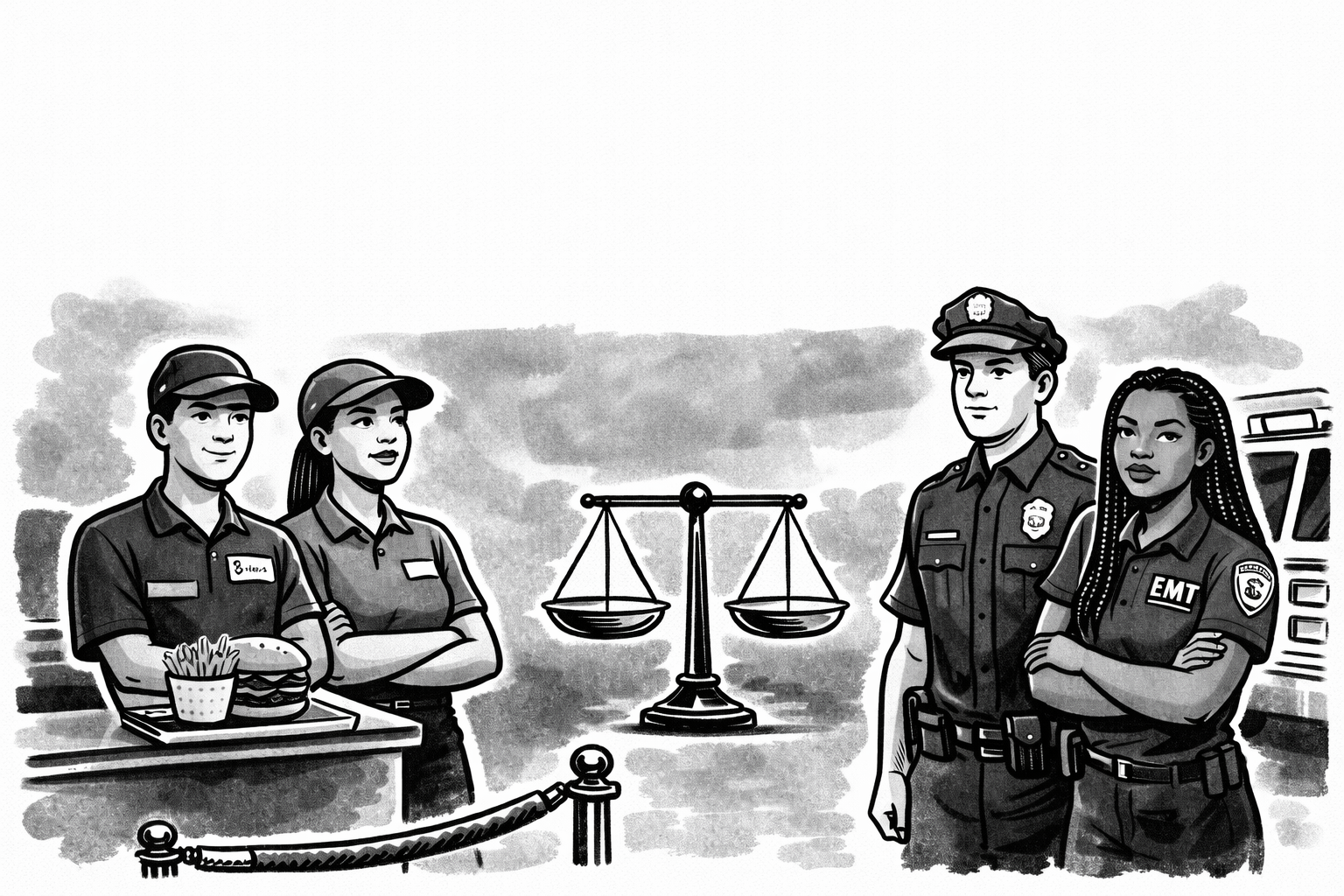
The claim that fast food workers in New York City are making $30 an hour isn’t accurate — at least not yet. What exists is a proposal that would push wages to that level over time, driven by one reality: the cost of living has outpaced what low-wage work can sustain. But the comparison took hold for a reason. When projected wages for fast food workers begin to approach or exceed the starting pay of rookie police officers and EMTs, it forces a different question — one less about accuracy and more about structure.
Because the gap isn’t where most people assume it is. Entry-level EMTs in New York have long been among the lowest-paid essential workers in the city, and early-career police salaries, broken down hourly, aren’t dramatically higher. That tension isn’t new. It has been building quietly for years. What’s changed is visibility. As the wage floor rises in response to economic pressure, it exposes how slowly public sector compensation has moved by comparison — and how long that gap was easy to ignore because the floor was low enough not to draw attention.
This isn’t a story about fast food workers being overpaid. It’s a story about what happens when one part of the labor market adjusts to reality while another remains anchored to a different one. As SSC has reported, the companies powering the economy have not always extended that power to the workers making it run — and the distance between productivity and compensation has widened steadily for the workers least positioned to negotiate the gap. The reaction to this comparison reveals a deeper discomfort: not that wages at the bottom might rise, but that rising wages make it harder to look away from how undervalued critical public roles have become. The outrage, for many, is less about fast food workers gaining ground and more about what that gain quietly exposes.
Why It Matters
Wage comparisons tend to generate heat without producing clarity. But this one is worth sitting with. The workers being compared — fast food employees, EMTs, entry-level officers — are not in competition with each other. They are all participants in a labor market that has historically underpriced certain kinds of work, particularly work performed disproportionately by Black and Brown workers. As SSC has covered, living paycheck to paycheck is not a personal failure — it is the predictable outcome of a system where wages have not kept pace with the cost of survival. When the economy slows, the workers who absorb the most risk are rarely the ones who benefited most when conditions were good— and stagnant public sector wages follow that same pattern. The floor moving in one sector doesn’t create the inequality between them. It reveals what was already there. The question isn’t whether fast food wages should rise. The question is why public sector compensation was left behind long enough to make the comparison feel surprising.