
Part of The Access Shift — an ongoing series examining how access is being quietly reshaped across American life. New stories every Wednesday at 12:00pm CDT.
The assumption embedded in most financial advice is that people have something to work with. For a growing majority, that assumption no longer holds.
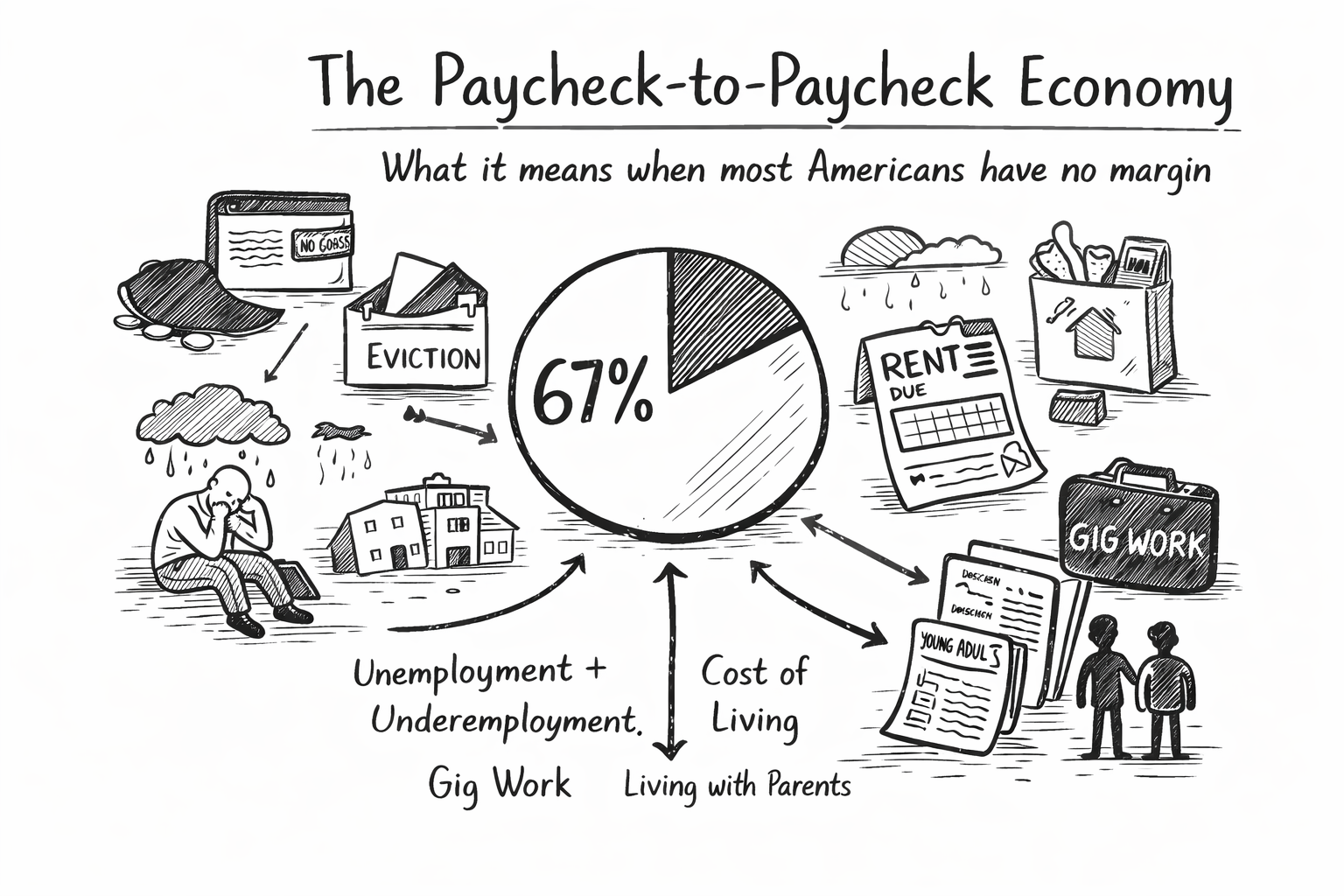
According to recent data highlighted by Investopedia, roughly 67 percent of Americans are living paycheck to paycheck — not struggling to save aggressively, but struggling to create any meaningful distance between what comes in and what goes out. For most households, income arrives and disappears at nearly the same velocity. What looks like stability from the outside is often just the absence of a crisis, so far. The margin has not just shrunk. For many people, it is gone.
Housing, groceries, insurance, utilities — these costs have not dipped back to where they were. They reset upward, and wages did not follow at the same pace. The result is a compression that happens quietly, without a headline. A car repair that would once have been an inconvenience becomes a decision. A higher grocery bill, an annual fee that hits without warning, a prescription that isn’t covered — any of these can set off a chain: what gets delayed, what gets put on credit, what carries over into next month and the month after that. As What Doesn’t Make It Into the Cart documented, that compression is already reshaping what everyday life includes — and what quietly disappears from it.
Unemployment numbers tend to make this invisible. When most people are employed, the economic story looks stable. But employment is not the same as sufficiency. Millions of workers are employed at wages that do not match the cost of living in their cities. Others are stringing together gig work and contract roles — arrangements that offer flexibility but rarely the consistency needed to build anything lasting. The headline figure says stability. The bank account says otherwise. As When the Economy Slows, Some Communities Feel It First made clear, the gap between what the data reports and what households actually experience is widest for the people already navigating the narrowest margins.
The downstream effects are structural. Younger adults facing stagnant wage growth and elevated housing costs are staying home longer, delaying the financial milestones that previous generations treated as givens. What gets framed as a lifestyle choice is often a rational response to an economy that has made the standard path inaccessible. As Stability, Pending Approval examined, even housing — once the foundation of financial stability — has become something you have to qualify for before you can afford it.
This is what The Access Shift is tracking: the quiet ways that systems once designed for broad participation are becoming conditional, selective, and increasingly sorted by who has margin and who doesn’t. Financial stability used to mean preparation — the ability to absorb the unexpected. For a growing majority, it now means something far more precarious: staying current. Not falling behind today. When that is the baseline for most households, financial strain is no longer the exception. It is the architecture.
The Access Shift
The gradual redefinition of who systems are designed to serve.
Across sectors—from public infrastructure to healthcare to everyday spaces—access is no longer assumed. As costs rise and systems face increasing pressure, services once built for broad reach are becoming more selective, more conditional, and less universal. The Access Shift explores how these changes are unfolding in real time—and what they reveal about who is included, who is left out, and how the structure of everyday life is quietly being reshaped.