
The United States has been deporting third-country nationals to Cameroon — people who are not Cameroonian citizens and who, according to lawyers representing some of those deported, have no meaningful connection to the country. The practice is part of an expanded deportation strategy that uses third countries as deportation destinations when direct return to a person’s home country is not immediately feasible, politically complicated, or logistically blocked by the origin country’s refusal to accept returns. The mechanism is not new, but its current application — sending people to a country they have never lived in, whose language they may not speak, and where they have no family, employment, or legal status — represents a use of the third-country deportation framework that collapses the distinction between deportation and exile.
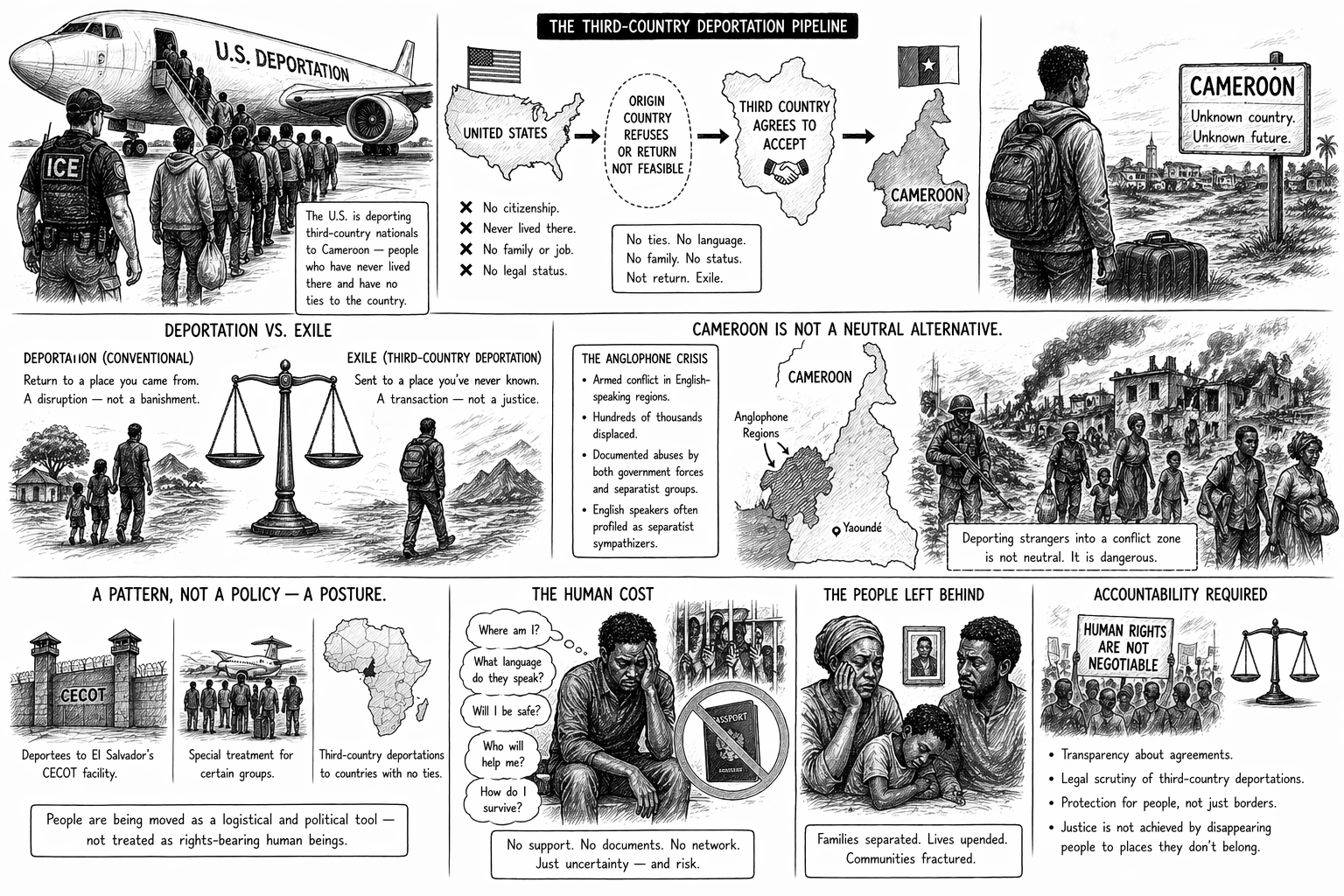
That distinction is not semantic. Deportation, in its conventional legal and moral framing, is the return of a person to a place they came from — a disruption of presence in one country justified by the existence of another country to which the person has a genuine connection. Third-country deportation to a place with no such connection removes the justification that grounds the conventional framework. The person being deported to Cameroon who has no Cameroonian ties is not being returned anywhere. They are being placed in a country that agreed to accept them as a transaction between governments — an arrangement whose logic serves administrative convenience rather than any principle about where the person belongs or what rights they retain. The legal structure permits this. The humanitarian and human rights implications of it have not received proportional scrutiny in coverage focused on deportation numbers and enforcement metrics.
The choice of Cameroon as a destination carries specific context that makes the human rights dimension more acute rather than less. Cameroon is not a stable, neutral third country that offers a reasonable alternative environment for people with no connection to it. The country is in the midst of an active anglophone separatist conflict in its western regions — a conflict that has displaced hundreds of thousands of people and produced documented atrocities by both government forces and armed separatist groups. The Anglophone Crisis, as it is known, has generated its own refugee population seeking protection from exactly the conditions that now exist in the regions where English-speaking Cameroonians are concentrated. Deporting English-speaking third-country nationals to Cameroon — into an environment where English speakers are associated with a separatist movement that the government has responded to with documented violence — is not a neutral administrative act. It places people with no Cameroonian connection into a conflict environment they have no framework for navigating.
The broader pattern this represents deserves direct naming. The administration’s deportation strategy has consistently sought to expand the category of acceptable deportation destinations beyond the conventional framework of returning people to their countries of origin. The use of El Salvador’s CECOT facility for deportees, the Afrikaner refugee admissions that SSC covered separately, and now third-country deportation to Cameroon are all expressions of an immigration enforcement posture that treats movement of people across borders as a logistical and political problem to be solved rather than a human rights question to be governed by principle. The communities absorbing the consequences of this posture — the people being deported to countries they have never lived in, the families being separated, the individuals placed in conflict environments with no institutional support — are not the communities whose interests are centered in the political conversation about immigration enforcement. They are the people for whom the enforcement architecture was designed, and the invisibility of their specific circumstances in that conversation is itself the structural failure the story names.