
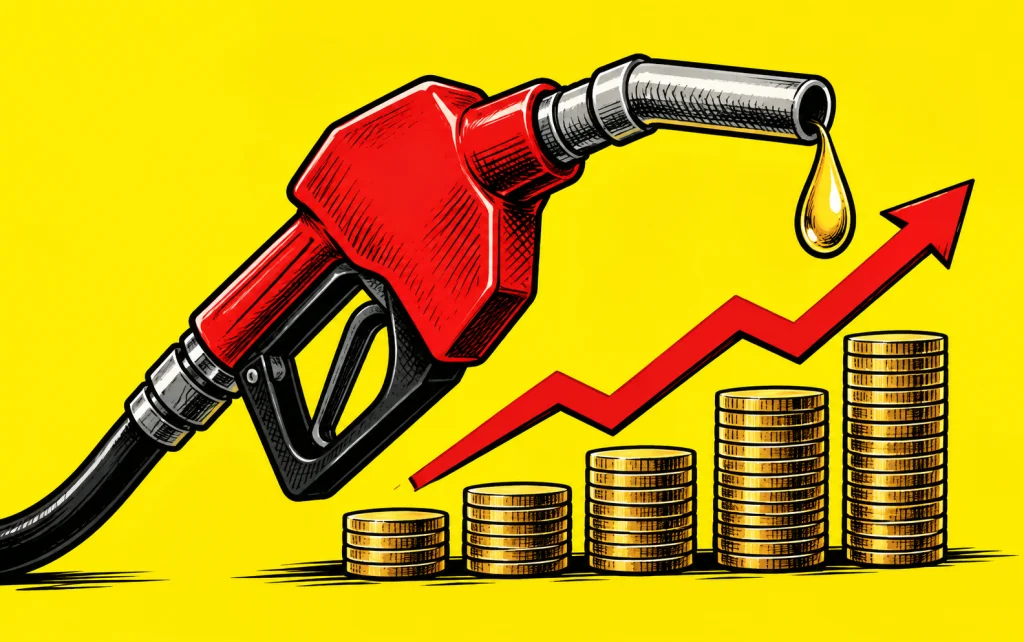
New Pew Research Center data shows gasoline was more expensive 18 years ago after adjusting for inflation. But Americans aren’t comparing today’s prices with 2008. They’re comparing them with what they paid earlier this year.
There’s something about watching the numbers climb at a gas pump that makes the economy feel personal. You can hear politicians discuss inflation, wages and economic growth all day, but the moment filling your tank costs another $20, those statistics become considerably less reassuring.
Now, a new Pew Research Center analysis offers an interesting perspective: Gasoline was actually more expensive in 2008 than it is today, once inflation is considered.
That’s technically true. It also doesn’t make today’s prices any easier to pay.
The national average for regular gasoline reached $4.12 per gallon on October 26, up from approximately $2.80 in late February. That’s a 47.4% increase in eight months, largely associated with disruptions surrounding the U.S.-Iran military conflict.
For someone buying 15 gallons each week, that price difference translates into roughly $20 more per fill-up, or approximately $86 more a month. That’s money no longer available for groceries, savings or other expenses.
The Price People Remember
Pew found that gasoline reached its inflation-adjusted peak in June 2008, when the average price was equivalent to $6.18 per gallon in today’s dollars. Researchers also calculated that a typical worker needed approximately 16 minutes of earnings to purchase one gallon in July 2008, compared with 9.5 minutes today.
In other words, gas is more affordable relative to typical wages than it was during the 2008 crisis.
But here’s where the economic statistics and everyday experience part ways. In February, that same worker needed only 6.3 minutes of earnings to purchase a gallon. The sudden deterioration in purchasing power is something drivers experience immediately, regardless of historical comparisons.
The concern is widespread. Pew reports that 74% of Americans are very concerned about gas and energy prices, compared with 43% in January.
And the impact doesn’t end at the pump.
Diesel prices have increased 66.8% since February, reaching $6.35 per gallon. Because diesel powers much of America’s commercial transportation, sustained increases can raise costs for trucking companies, retailers and food distributors. How much reaches consumers depends on contracts, competition and how long elevated prices persist.
Geography also changes the experience. October gasoline averaged approximately $3.86 per gallon for regular conventional fuel along the Gulf Coast, compared with $6.06 for regular gasoline across all formulations in California.
Those differences help explain why Americans can look at the same national economy and describe completely different financial realities.
With the midterm elections approaching, gas prices are also becoming an increasingly visible economic issue. Voters don’t necessarily evaluate the economy using inflation-adjusted historical averages. They encounter it through recurring expenses, especially ones that change dramatically over a few months.
None of that makes gasoline prices a complete measure of economic performance, and elected officials don’t control every factor influencing global oil markets. But fuel costs are unusually visible, making them an immediate reference point for how people perceive economic conditions.
Pew’s research establishes that Americans have experienced worse gasoline prices in the past. What it cannot erase is the financial adjustment families have had to make this year.
The historical comparison may be accurate. The current expense is still real.