
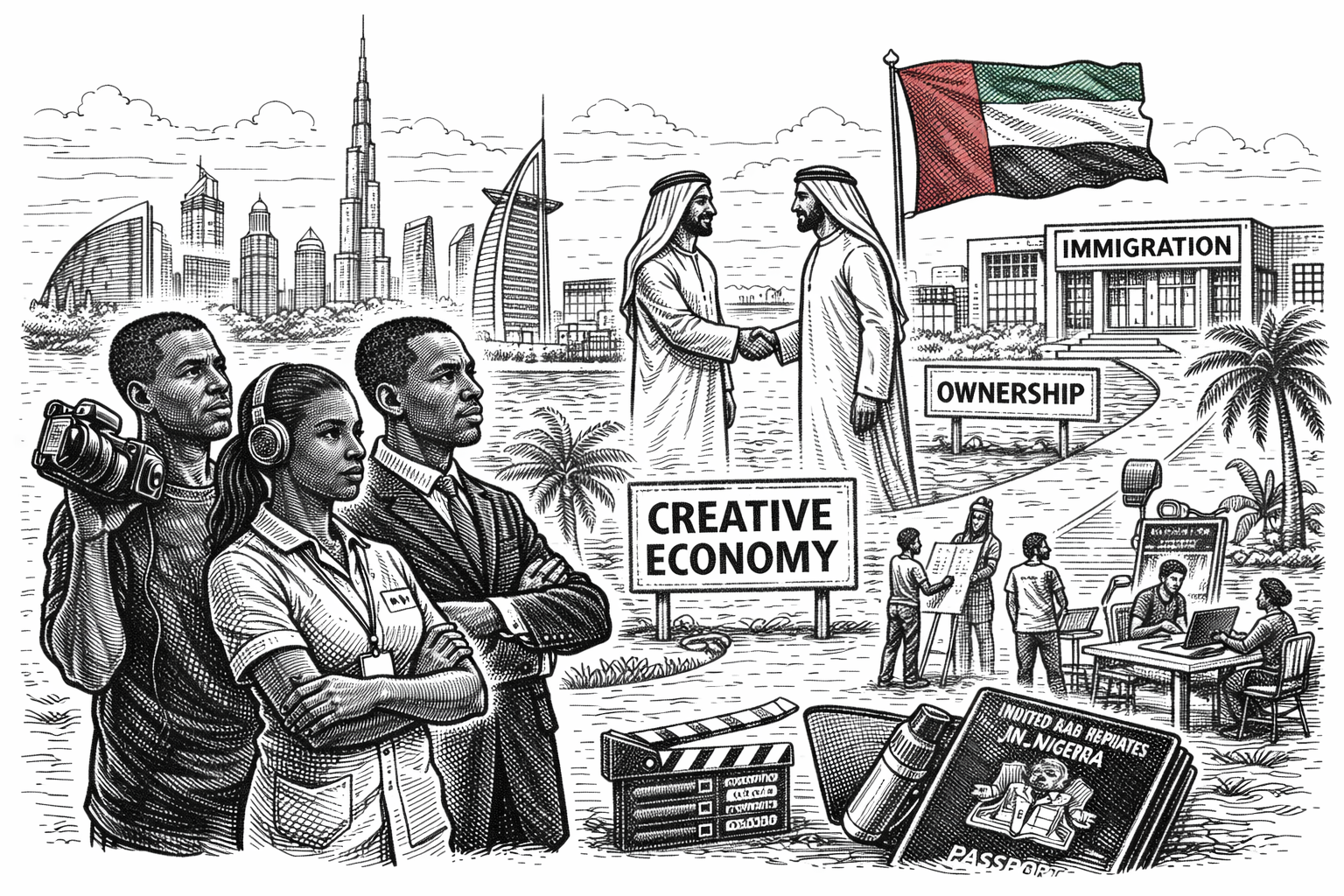
Dubai has been making a specific kind of announcement with increasing frequency. The emirate aims to double the creative industries’ contribution to its GDP to 5% by 2026 and generate 140,000 jobs in the sector. It is building dedicated creative zones, reforming licensing for artists and entrepreneurs, and positioning itself as a global hub for the creative economy — a place where culture is not only consumed, but produced, funded, and exported.
Alongside that ambition, a quieter migration has been accelerating. Nigerian creatives, Ghanaian entrepreneurs, Kenyan tech workers, and South African professionals are relocating to Dubai in growing numbers — drawn by tax advantages, reliable infrastructure, and a cost of living that, while high, is often lower than London or New York. For those with professional skills or business capital, Dubai also offers a level of immigration stability that the UK and US increasingly do not. It has become a third geography for the japa generation — not just London and New York, but the Gulf.
This intersection — a city building a creative economy and a diaspora arriving with the very capacity that economy requires — suggests alignment. In some ways, it is. Nigerian artists and entrepreneurs have found real opportunities in Dubai that were structurally unavailable at home. The infrastructure works. The market is international. The resilience developed navigating institutional instability translates into an advantage in a city that rewards ambition and speed.
But alignment at the level of opportunity does not necessarily mean alignment at the level of belonging. Dubai’s creative economy is being built within a specific political and social framework — one that offers no pathway to citizenship regardless of tenure or contribution, that maintains a kafala-style labor sponsorship system tying residency to employment, and that carries its own layered dynamics around race, nationality, and permanence. African professionals are not entering a neutral space. They are entering an existing hierarchy — and finding their place within it rather than shaping it.
As SSC has explored in the Afrobeats crossover piece and Who Owns the Trend, the movement of Black creative labor into new economic systems consistently raises the same question: who captures the value that labor produces? In music, that question centers on masters and royalties. In Dubai’s creative economy, it shows up in ownership structures, visa pathways, and whether the workers building the city’s cultural brand are building equity for themselves or for an infrastructure they will never fully own.
That tension does not negate what Dubai offers. For many African professionals, the practical reality — functioning systems, access to global markets, and professional community — outweighs abstract concerns about belonging. But as SSC documented in The Black Immigrant Population Has Doubled and the japa analysis, diaspora communities make decisions based on more than immediate opportunity. They look for signals of long-term inclusion. They assess whether the place they are building in is building something for them in return. Dubai is still answering that question — and the professionals who have relocated there are watching closely.
Why This Matters
The japa story has largely been framed as a story of departure — leaving Nigeria, leaving Ghana, choosing London or Houston or Toronto over Lagos or Accra. Dubai introduces a different dimension: what happens when the destination is itself still being constructed, where the rules of belonging are evolving, and where the creative and economic energy of the African diaspora arrives at the moment it is most needed? Whether that timing ultimately benefits the diaspora or primarily benefits the city is the question that will define what Dubai’s creative economy actually means — and for whom.