
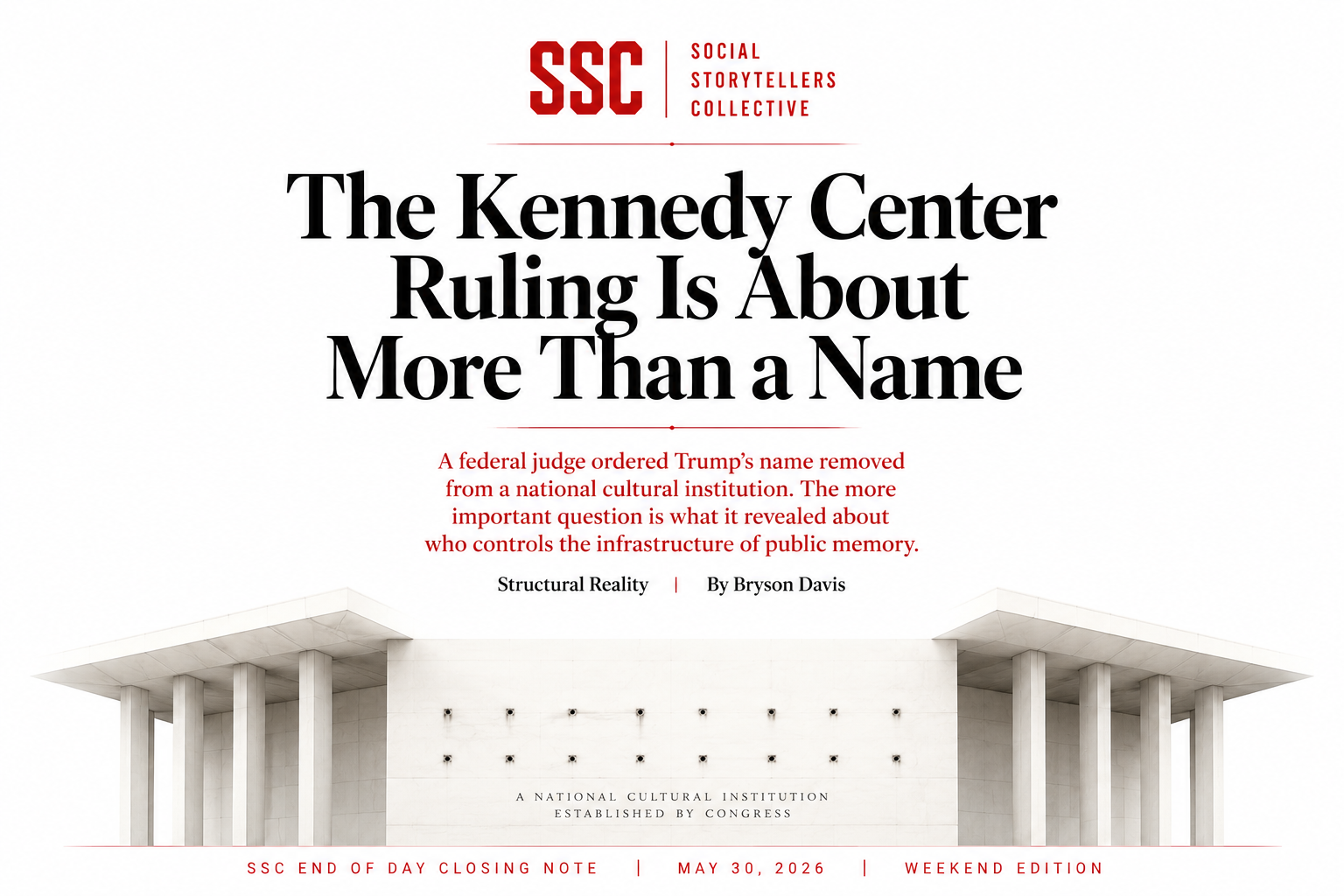
The ruling arrived on John F. Kennedy’s birthday, which was either poetic or coincidental depending on how much credit you extend to federal dockets. U.S. District Judge Christopher Cooper found that the Trump-appointed board of the Kennedy Center did not have the legal authority to rename the facility, ordered Trump’s name removed from the building and its website within 14 days, and temporarily blocked a planned two-year closure for renovations. The decision was clear on the law. The board, the judge wrote, had acted on “an insufficient, one-sided presentation of information” and had not followed proper procedures. Congress gave the Kennedy Center its name. Only Congress can change it.
The coverage has missed the more important story. The fight over the Kennedy Center is not primarily about a name. It is about a pattern of institutional capture that has been playing out across the cultural sector for years, and that the Kennedy Center controversy makes unusually visible.
This publication has been tracking the broader version of this argument. When the British Museum postponed a Jewish Culture Month lecture after learning of planned disruptions, the instinct in most coverage was to frame it as a controversy about speech or safety. The more accurate frame was about institutional authority — about who controls the spaces that confer legitimacy on cultural memory, and what happens when that control becomes contested. The Kennedy Center ruling sits inside the same argument. The question of whose name appears on a national cultural institution is not a branding dispute. It is a question about which figures get absorbed into the permanent record of national identity, on what terms, and through whose authority.
The legal record in this case names the mechanism explicitly. The judge did not find the renaming merely distasteful. He found it unlawful precisely because it bypassed the institutional process designed to prevent any single actor from making that determination unilaterally. “Congress gave the Kennedy Center its name,” the ruling states, “and only Congress can change it.” That sentence is doing more work than it appears to. It is a description of how institutional legitimacy is supposed to be distributed — across branches, through deliberation, with accountability — rather than concentrated in an appointed board or an executive who named himself chairman.
The administration’s response confirmed the stakes better than any critic could. After the ruling, Trump announced on Truth Social that his administration would move to transfer the Kennedy Center back to congressional control, framing the institution as a failing entity he no longer wished to manage. That pivot deserves attention. The logic of institutional capture has always depended on the captured institution remaining useful to the captor. When a court-ordered constraint makes that usefulness conditional, the institution gets repositioned as someone else’s problem. The cultural infrastructure is not the point. The branding is the point. When the branding becomes legally untenable, the infrastructure loses its value.
That pattern — institutions valued for what they can be made to represent rather than what they actually do — is precisely what makes the current moment so consequential for cultural organizations of every kind. Museums, archives, performance venues, and heritage institutions are increasingly being asked to carry political weight they were not designed to bear, by actors on every side of these debates. The Kennedy Center ruling pushes back on one specific instance of that dynamic. It does not resolve the underlying condition that produced it.
What the court affirmed on Friday is that institutional memory has a legal architecture, and that architecture exists for a reason. What it could not affirm — because courts are not equipped to — is whether the institutions responsible for preserving public culture have the internal capacity to protect that function when the pressure is not legal but political, sustained, and coming from the people who control their funding. That question remains open. And it will outlast this ruling by a considerable distance.