
The AI boom needs land, power and water, and much of that is being found in the rural South. A new report from the Joint Center for Political and Economic Studies, “Opportunities and Challenges of AI for Black Workers in the Rural South,” argues that this puts Black rural workers at the center of the shift. AI data center growth is highest in the South, which also has the highest concentration of Black rural workers. The brief, published Nov. 9, draws on interviews with people who work in higher education, workforce development and tech nonprofits serving rural communities. Most of them are based in Alabama, where African Americans are 26.1% of the state’s total population and more than 40% of its rural population, and where aerospace, automotive and advanced manufacturing are already absorbing automation.
What the researchers heard falls into four themes: curiosity, caution, culture and collaboration. People want to learn what AI can do, and one IT consultant said residents trying the tools for the first time “were blown away by the ease of use.” They also doubt the promises, especially about jobs. One tech-integration professional noted that “those data centers don’t employ that many people.”
Why This Matters
- 17 of 30: Black workers are overrepresented in 17 of the 30 occupations most vulnerable to automation, and underrepresented in the careers at lowest risk
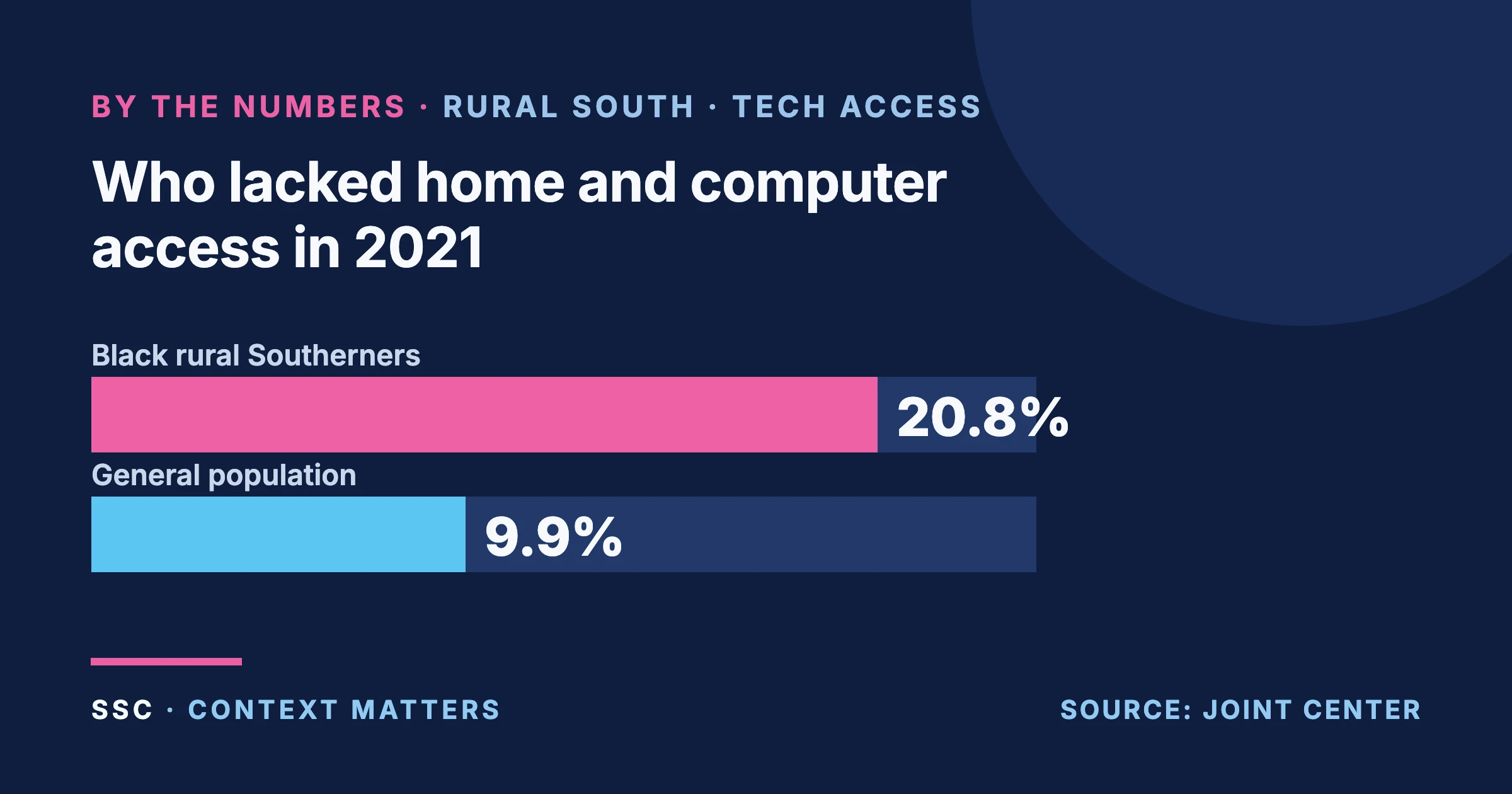
- 20.8%: the share of Black rural Southerners who lacked home and computer access in 2021, about twice the 9.9% rate for the general population
- 18.1%: how much lower the employment-to-population rate for rural Black men was than for metro Black men in 2021
The deal usually gets written without them
When a data center comes to a rural county, the terms are typically set between the developer and local officials, often through tax breaks offered to win the project. Residents find out after the land is bought. The facility then draws on local water and electricity, and the payroll is small because the buildings mostly run themselves. In Black communities that have held land for generations, the purchases themselves are a threat. The report warns that AI-driven land acquisition and infrastructure development threaten generational land ties and community life.
That’s the pattern SSC has been tracking: AI could be the boom that skips the paycheck, and AI skills are spreading faster than AI ownership. Rural Alabama shows what that looks like where the land and power actually come from.
A contract instead of a promise
The Joint Center’s answer is the Community Benefit Agreement, a legally binding contract between a community and the company building in it. The report sorts its terms into five E’s. On economics, the CBA would limit municipal tax breaks for AI companies and data centers, share profits directly with residents, and require minimum community payouts. The other four cover local hiring and reskilling, caps on water and electricity use, AI education from K-12 through college, and enforcement. That last one would create local advisory boards to negotiate and monitor CBAs, impose penalties for noncompliance, and develop best-practice templates.
Enforcement is the part that matters most. Promises of jobs and training cost a developer little to make. Penalties and a standing local board change who holds the power after the ribbon-cutting. The authors put the stakes plainly: without rural communities involved at every level, they write, the AI revolution becomes “just another story of gentrification.”
Expect the fight to move to county commissions, where tax deals are approved and where a CBA either gets written into the deal or doesn’t. Developers will likely accept training programs and hiring pledges. Resistance will come over water and power caps and profit-sharing, the terms that cost them every month. The counties that win those terms first will set the template for the rest of the South.