
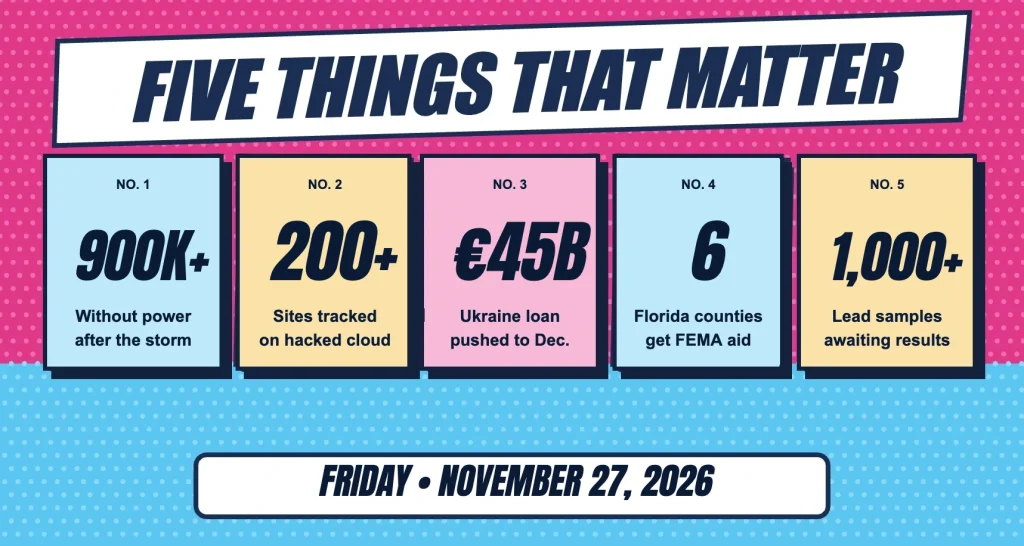
A Thanksgiving storm knocked out power up and down the East Coast, hackers reached the control room of the Air Force’s biggest cloud, Europe stalled on Ukraine’s next loan, Florida flood victims got federal help and Iowa waited on its lead tests.
Black Friday is here, and the news didn’t take the holiday off. Today’s stories are about the systems we count on until the day they fail: the power grid, a military network, a European budget, a disaster fund and a lab report. Here are five things that matter on November 27.
1. The Worst Thanksgiving Storm in Decades Left Hundreds of Thousands in the Dark
More than 900,000 homes and businesses lost power Thursday evening, including over 200,000 in Pennsylvania and more than 172,000 in Maryland, weather.com reported. Gusts topped 70 mph in Virginia and West Virginia, New York and New Jersey declared states of emergency, and the Chesapeake Bay Bridge-Tunnel closed. Fox Weather said Thursday became the windiest Thanksgiving Day on record in several I-95 cities.
Roughly 600,000 people were still in the dark Friday morning as the storm weakened over New England, the Washington Post reported, and more than 2,500 flights were delayed on the holiday, according to CNN. It also forced the first-ever postponement of the Macy’s parade, which now steps off Saturday. We’ve written about how extreme weather is outrunning the systems built to warn us, so watch how quickly utilities restore power before Sunday’s heavy return travel.
2. Hackers Got Inside the Air Force’s Flagship Cloud
Hackers breached Cloud One, the Air Force’s flagship cloud computing platform, three people familiar with the matter told Reuters, in a report carried by Yahoo News. The intrusion was found about a month ago during upgrade work, and one source said the attackers exploited a software flaw to reach the control plane, which works like a universal remote for the system. Cloud One hosts the munitions tracking system for more than 200 Air Force locations and the command center that pulls in air defense radar data.
Nobody has said who did it or whether data was taken, but the fallout is real: migrations are paused, updates to running apps are blocked and some users lost administrator rights, Forbes reported. Cyber Command was called in, and the Air Force declined to comment on specific systems. It lands after the FBI breach we covered in Sunday’s Five Things and our look at America’s single points of failure, so watch whether Congress demands a briefing before the year ends.
3. Europe Couldn’t Agree on Ukraine’s Next €45 Billion
EU leaders ended a special Brussels summit early Friday without approving an extra loan of up to €45 billion for Ukraine in 2027, Euromaidan Press reported. Twenty-four countries support it, but Hungary, Slovakia and Czechia did not, and German Chancellor Friedrich Merz has threatened to block the bloc’s next long-term budget unless all 27 share the cost. Leaders also failed to agree on that 2028-2034 budget, the Associated Press reported.
Ukraine needs at least €115 billion next year, and the Commission puts the gap at €70 billion. The delay came as Volodymyr Zelenskyy told the BBC it was “strange” that Donald Trump called Vladimir Putin “my friend,” ABC News reported. We’ve tracked how Germany has carried more of the load, and December’s summit is the deadline to watch, because the money is meant to keep Kyiv solvent from January.
4. Florida Flood Victims Can Now Apply for Federal Aid
Donald Trump signed a major disaster declaration for Florida on Thanksgiving at Mar-a-Lago, opening federal aid to residents in six counties after weeks of record rain that began Oct. 31, CBS12 reported. Households can apply for grants for temporary housing and repairs, plus low-cost loans for uninsured losses, after filing with their insurer. Trump called it “record-setting rains” and said many areas were “beaten up pretty badly.”
The aid doesn’t cover damage from this week’s Thanksgiving storm, Just the News reported, and South Florida was hit with another round of heavy rain as the declaration was signed, according to WPBF. We flagged the second wave of flooding, with more than 14 inches in three days, in Sunday’s Five Things. Watch whether Miami-Dade and Broward, which took some of the worst rain, get added to the list.
5. Iowa Is Still Waiting on Its Lead Test Results
The EPA has collected more than 1,000 samples since the Army blew up the nation’s lead azide stockpile in Middletown on Wednesday, on top of 1,591 taken beforehand, ABC7 Chicago reported. Its four real-time monitors have shown zero airborne lead, and teams sampled more than 130 homes, schools, daycares and churches, AOL reported. The first lab results could arrive as early as today.
Officials have declared the blast a success, but a doctor told CNN that more testing is needed before anyone can be sure the lead didn’t settle on nearby land and water, CNN reported. We followed the fight over this detonation in Monday’s and Tuesday’s Five Things. Watch the soil and water numbers, because those, not the air readings, will tell families downwind what they’re living with.
The Bottom Line
Today’s stories are about what happens after the switch flips. A storm cut the power, a hacker reached the controls, a summit ended without a deal, a declaration got signed and a detonation went off as planned. In every case, the people affected are now waiting on someone else’s repair, fix, vote, check or lab report. Context matters.
Five Things That Matter is produced by the Social Storytellers Collective News Desk. Get the End of Day Closing Note free in your inbox.