
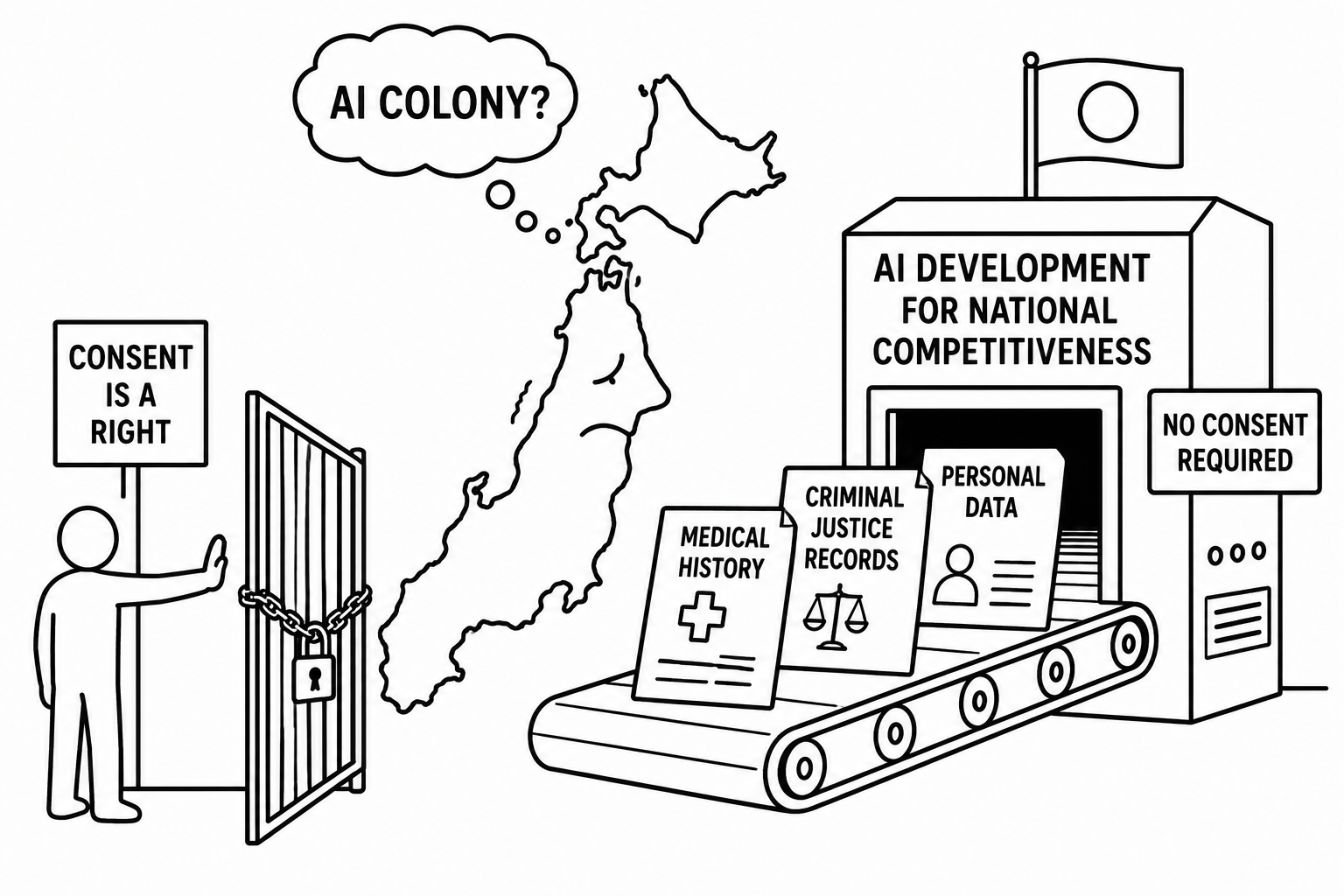
Japan’s digital minister has warned that the country could become an “AI colony” if it falls behind in the global race to develop artificial intelligence, Reuters reporter Kantaro Komiya reported Thursday. The warning comes as lawmakers consider legislation that would allow AI systems to train on sensitive personal data — including medical histories and criminal justice records — without obtaining individual consent. Supporters argue the changes are necessary to strengthen Japan’s position in a rapidly evolving AI economy. The minister’s framing deserves examination before the policy debate proceeds: invoking the language of colonial vulnerability to justify removing consent requirements shifts the benefit toward the technology companies that need data access, not the citizens whose records would be used.
Artificial intelligence increasingly depends on access to large volumes of data. Countries with significant datasets, advanced computing infrastructure, and leading technology firms are viewed as having strategic advantages. Nations worried about falling behind are searching for ways to accelerate development, and data access has become one of the most contested parts of that effort. Data has become a strategic asset — and policymakers are increasingly framing access to that asset as a matter of national survival rather than individual rights.
Three major economies are now offering three different answers to the same question. The European Union’s GDPRestablished individual rights as a legal floor — consent is required, enforcement is real, and companies face meaningful penalties for violations. The United States this week removed EEOC guidance on discriminatory AI hiring tools, leaving workers with less protection against algorithmic bias at the moment AI screening is becoming standard practice. Japan’s proposed legislation represents a third path: national competitiveness as explicit justification for overriding consent. Each approach reflects a different calculation about whose interests the data governance system is designed to protect.
The medical and criminal justice record detail buried in Japan’s proposal is the most consequential part of it. Medical histories are among the most intimate categories of personal information — their exposure carries financial, professional, and personal risks that individuals cannot fully anticipate at the time of disclosure. Criminal justice records carry a different problem: they reflect documented racial and socioeconomic bias in the systems that produced them. Training AI models on biased criminal justice data without consent does not simply raise privacy questions. It risks encoding existing inequities into systems that will make future decisions about employment, lending, housing, and public safety. The consent requirement is not bureaucratic friction. It is the mechanism that gives individuals some control over how their information shapes the decisions made about them.
As SSC reported today in The City Is Becoming a Dataset, urban surveillance infrastructure and national data policy are operating on the same logic — public and personal data treated as a resource to be harvested for institutional benefit, with individual consent reframed as an obstacle to progress. Japan’s proposed legislation and the city-level data collection SSC documented are not separate conversations. They are the same argument playing out at different scales.
Data sovereignty and data rights do not point in the same direction. Citizens view personal information as something that should remain subject to individual control. Governments focused on AI development view the same information as a national resource. Privacy advocates warn that weakening protections in pursuit of innovation creates precedents that are difficult to reverse — and that the populations least able to absorb the consequences of data misuse are the ones whose records tend to be most extensively collected by the state.
The next phase of the AI race will not be defined by algorithms alone. It will be defined by decisions about who controls the information that powers them — and whether citizens retain meaningful input into how much of themselves becomes part of that project. Japan’s “AI colony” warning is a real concern about technological dependence. It is also a rhetorical frame that places national competitiveness above individual rights. Both things are true. The question governments have not yet answered honestly is which one they are actually prioritizing.