
California’s Tech Unicorns Are Headquartered in California. Half the Workforce Is in India and Everywhere Else.
SSC News Desk
The address still says California. The workforce increasingly does not.
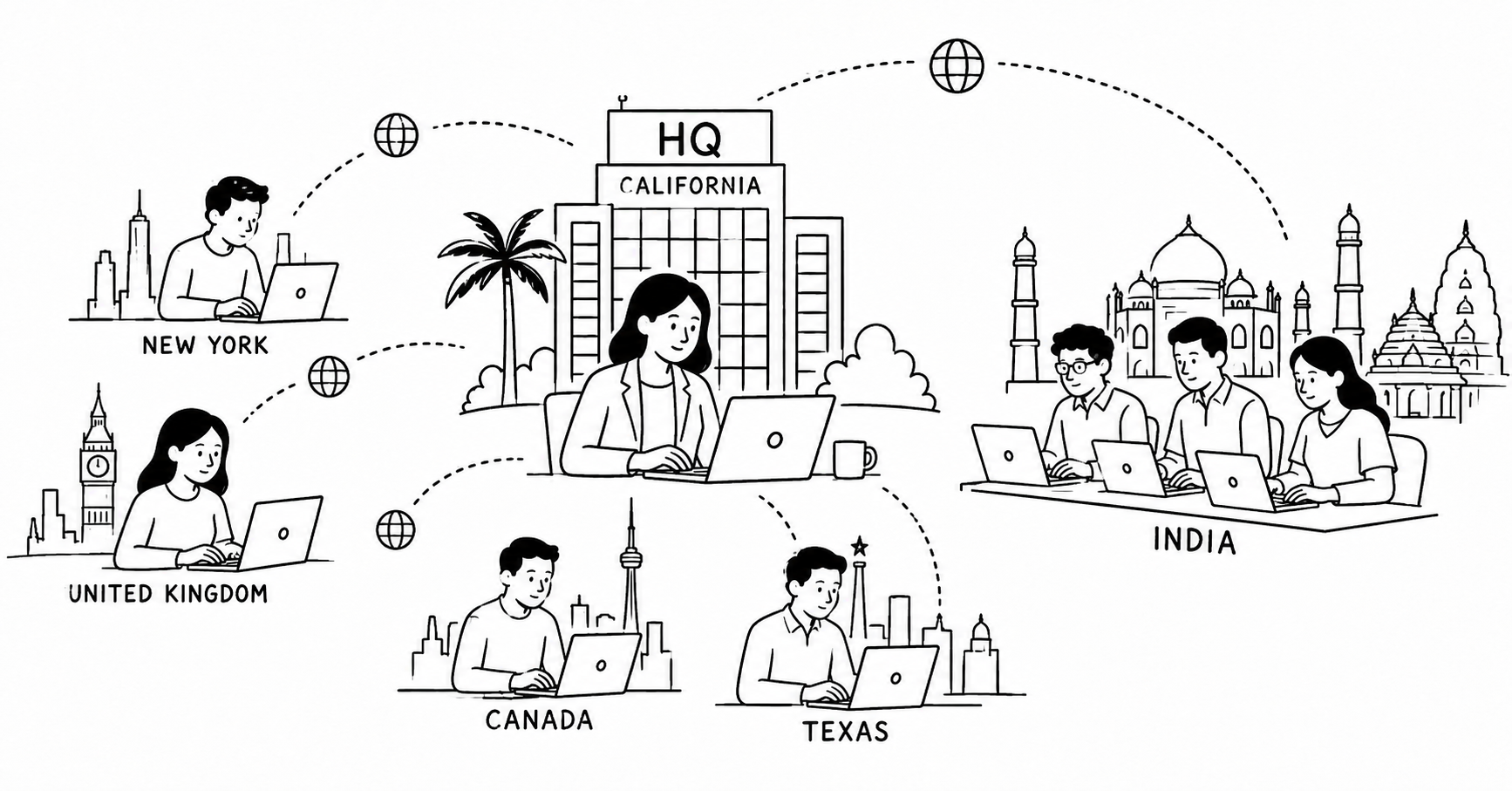
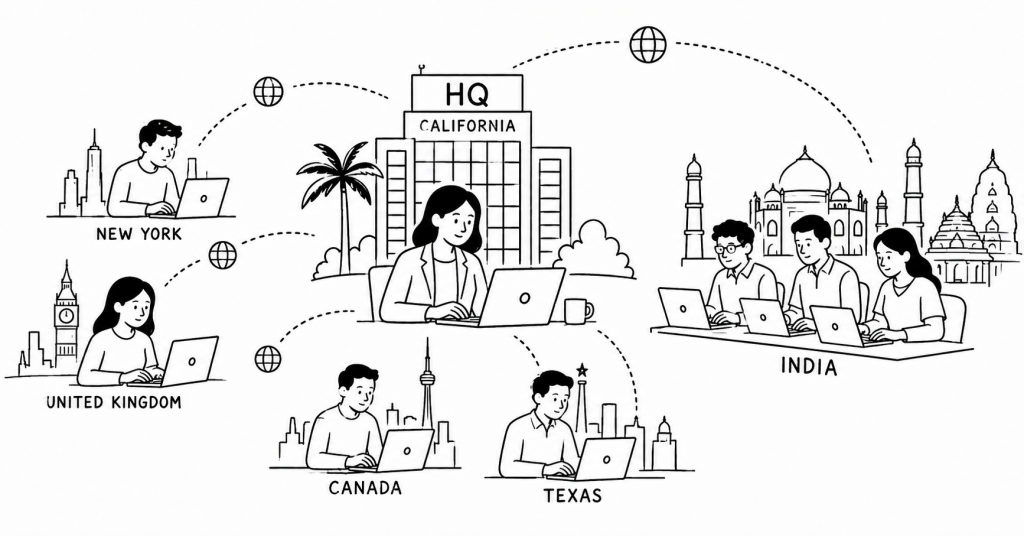
Stanford researchers analyzed 158,563 employee profiles across 334 private unicorn companies headquartered in California and found that only 21 percent of their employees actually work in the state. India was the second-largest location, accounting for 12 percent of workers. New York and the United Kingdom each held 5 percent. Texas came in at 4 percent, Canada at 3 percent. Most significantly: roughly half of the employees at these California-headquartered companies are based outside the United States altogether.
That is a different story from the familiar one about remote work. These are not primarily workers who left San Francisco for Austin or employees negotiating hybrid schedules. The Stanford Graduate School of Business Venture Capital Initiative data captures something more consequential: companies can maintain their headquarters, investors, leadership, and institutional identity in one place while building the majority of their actual workforce somewhere else entirely.
India’s position in the data is worth examining on its own terms — it is not simply another low-cost outsourcing destination. Business Standard reports that California startups can save an estimated 60 to 80 percent by assembling a core engineering team in an Indian technology hub rather than hiring the equivalent team in California. Immigration restrictions, long waits for permanent residency, and deep salary differences have made what some are calling “remote shoring” increasingly attractive to founders who need engineering capacity fast and cannot afford California rates or American visa timelines.
The distinction from traditional outsourcing matters. Conventional outsourcing meant handing a discrete business function to an outside vendor — customer service, back-office processing, IT support. A distributed startup does something different. Engineers in Bengaluru or Hyderabad can sit inside the same company, work on the same product, and operate within the same org chart as colleagues in San Francisco without ever relocating to the United States. Stanford’s data suggests this arrangement is no longer peripheral to how some of America’s most valuable private technology companies operate. It is becoming the operating model.
There is an important limit to what the numbers show. The Stanford dataset does not establish that jobs are being transferred one-for-one from American workers to Indian workers. California remains the largest single location. The companies themselves remain California-headquartered. But the more significant observation is not about transfer — it is about separation. The relationship between where economic value is created and where corporate power resides is loosening in ways the data makes visible for the first time at this scale.
A company can now raise money in Silicon Valley, maintain executives and a legal address in California, employ engineers across India, and sell products globally while continuing to be classified as an American startup. The headquarters holds the ownership and the capital. The org chart no longer has to respect the same borders.
That changes what it means for a city or a country to land a technology company. For decades, attracting headquarters was treated as shorthand for attracting jobs, talent, and economic activity along with them. The Stanford numbers suggest those things can be separated — and increasingly are. California can keep the unicorn. India can get a growing share of the engineers. The next competition over technology employment may be less about where companies choose to locate and more about where companies decide the work itself should live. Those are different decisions, and for a long time, policy and economic development strategy treated them as the same one.