
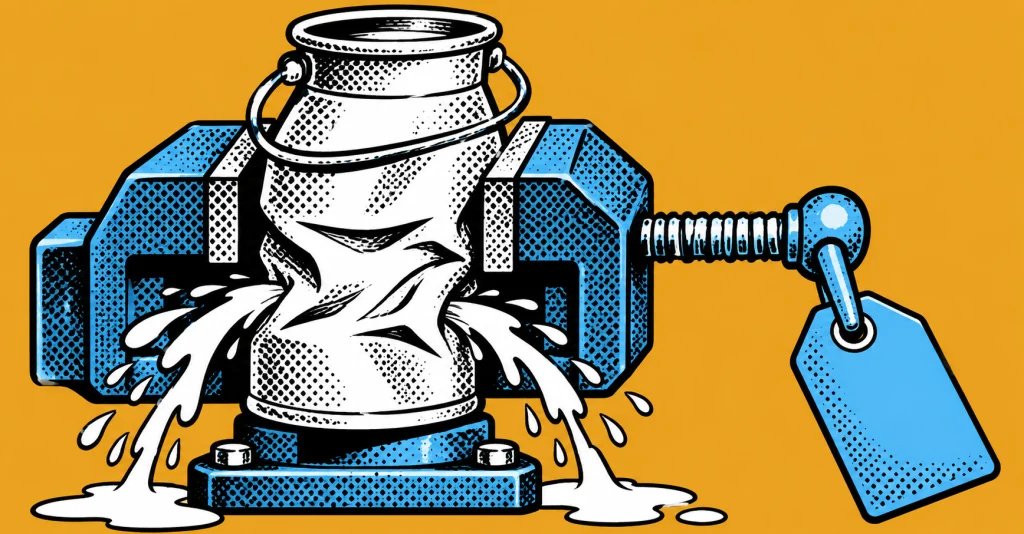
Freshways is slashing what it pays farmers weeks after raising it, and the gap between farm gate and checkout shows who in Britain’s milk chain carries the risk.
Starting December 1, Freshways, the liquid-milk processor that supplies British retailers, hotels, cafes and wholesalers, will pay farmers about 9 cents (7p) less for every liter of milk, The Guardian reported. The cut drops its base price to about 39 cents (29.4p) per liter. It also erases most of the 9p in increases Freshways gave farmers in September and October, Farmers Weekly reported, and dairy analyst Chris Walkland called it “a brutal cut.” At the same time, several major supermarkets have recently raised a four-pint bottle of milk to about $2.35 (£1.75), according to The Guardian.
Freshways points to weak dairy markets and rising operating costs. Walkland gave Farmers Weekly a sharper explanation: Freshways raised its price twice in the fall expecting dairy markets to recover, and when they didn’t, the processor was exposed. Its rivals moved more carefully. Müller, First Milk and Barber’s are holding December prices, and Arlatrimmed less than a penny (0.45p) per liter for November.
Why it matters: Milk prices don’t fall evenly, because the businesses in the chain don’t have equal leverage.
- Farmers can’t walk away. Milk leaves the farm every day and spoils fast, and many producers can’t easily switch processors or find another buyer.
- Processors push risk upstream. Freshways sells into a highly competitive liquid market where raising its selling prices risks losing volume, Farmers Weekly reported, which leaves the farm-gate price as its easiest lever.
- Protection depends on the buyer. Some supermarkets pay their dedicated farmers based on what milk costs to produce, but those arrangements don’t cover the whole industry.
None of this proves processors or supermarkets are padding their margins, since shelf prices also cover processing, packaging, refrigeration and transport. What the numbers do show is which way the loss travels: it hits the farm first and reaches the shopper last, if at all. SSC has reported that butterfat and weather, more than general inflation, drive dairy prices in the U.S. Britain adds a second lesson: the farm-gate price and the shelf price are set by different players with different pressures. Freshways’ cut moves power from dairy farmers to the processors and retailers who set the terms of sale.
Expect the squeeze to spread before shoppers see any relief. Walkland warned that more cuts in January can’t be ruled out if commodity markets fail to recover, and farms already carrying high feed, fuel and fertilizer bills will have even less cushion. If shelf prices hold through the winter while farm-gate prices fall, that widening gap will be the strongest argument yet for extending cost-of-production contracts across the whole industry.