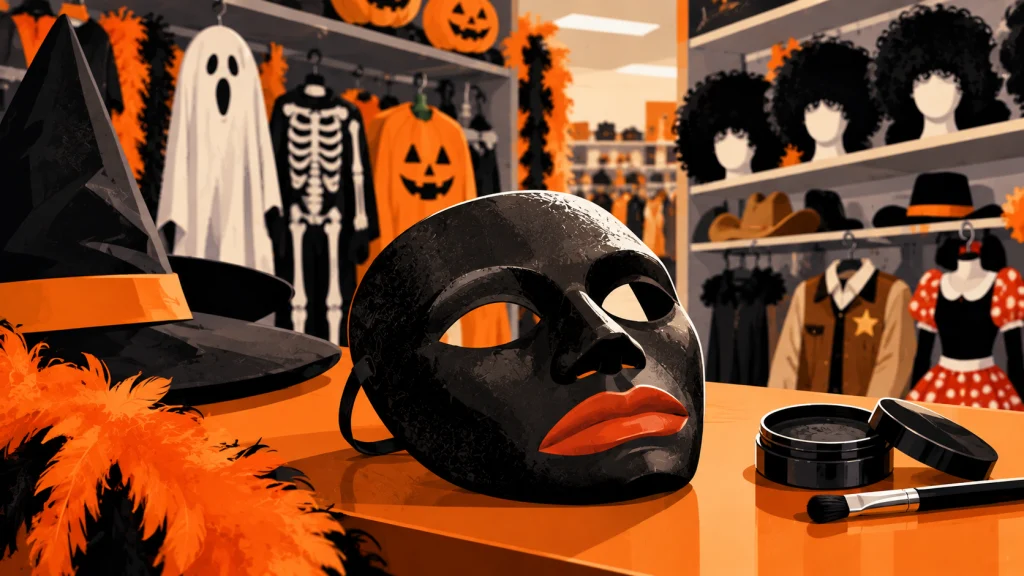
Seven years after a Pew Research Center survey exposed sharp racial and political divisions over blackface, newer polling suggests the disagreement hasn’t gone away. The findings raise questions about historical awareness, cultural expression and what Americans consider fair game on Halloween.
Walk into almost any Halloween store in October and the options seem endless: superheroes, movie villains, celebrities, historical figures and whatever dominated pop culture this year. Halloween invites people to become someone else for a night, often with little concern for whether the resemblance is convincing.
But one form of impersonation keeps dividing Americans: a white person darkening their skin to portray a Black person.
In 2019, the Pew Research Center found that 34% of Americans considered blackface in a Halloween costume acceptable at least sometimes. Five years later, a YouGov survey produced a strikingly similar number: 33% said it was acceptable. The two surveys asked different questions in different ways, so they can’t prove attitudes held perfectly steady. What they do show is that a substantial share of the country has continued to accept a practice with a long history of racial caricature.
What the 2019 survey found
Pew surveyed Americans from Jan. 22 to Feb. 5, 2019, almost entirely before news broke about the blackface photo on then-Virginia Gov. Ralph Northam’s medical school yearbook page. The timing matters: the results reflect attitudes before that controversy, not in reaction to it.
A slight majority, 53%, said blackface was rarely or never acceptable, including 37% who said it was never acceptable.
Views split sharply by race. White adults were about twice as likely as Black adults to call it acceptable at least sometimes: 39% compared with 19%. Hispanic adults fell in between at 28%.
Politics drew another line. About half of Republicans and Republican-leaning adults, 51%, said blackface was acceptable at least sometimes, compared with 21% of Democrats and Democratic leaners. Americans weren’t just disagreeing about costumes. They were judging the same racial imagery by different standards.
Five years later
By October 2024, the question was still unsettled. In a YouGov survey of 1,106 U.S. adult citizens, 33% said it was acceptable for a white person to wear blackface makeup to appear Black, while 52% said it was unacceptable.
Men were far more accepting than women, 41% compared with 26%. Among Black respondents, 70% called it unacceptable, compared with 52% of white respondents. Still, 24% of Black Americans and 33% of white Americans said it was acceptable. The survey’s overall margin of error was about four percentage points, with more uncertainty for smaller groups.
Party divisions persisted: 43% of Republicans considered blackface acceptable, compared with 24% of Democrats and 33% of independents. Two-thirds of Democrats, 67%, called it unacceptable, compared with 41% of Republicans. Those gaps resemble what Pew found in 2019, though neither survey can show how individual opinions shifted, or why people answered as they did. Some may have been thinking about free expression. Others may have been thinking about history and race. Without follow-up questions, we can’t know.
Years of high-profile controversies involving politicians, entertainers and public figures have not produced a national consensus.
Why the history still matters
Blackface didn’t begin as a harmless costume tradition that later became controversial. In America, it grew out of minstrel shows, in which white performers darkened their faces and portrayed Black people through exaggerated speech, movement and features.
According to the Smithsonian’s National Museum of African American History and Culture, these shows became popular in the 1830s and spread images of African Americans as unintelligent, dishonest and lazy. Minstrelsy was commercially successful and shaped theater, film, radio and television. Its caricatures helped normalize racist stereotypes at the same time Black Americans were fighting for basic civil rights.
That history complicates a common defense: that the person wearing it doesn’t mean any harm. Someone dressing as a Black musician, athlete or public figure may see the costume as admiration, not ridicule. But historians separate individual intent from what the practice has meant. For generations, blackface turned Black identity into a theatrical disguise, often for the amusement of white audiences.
The objection usually isn’t to portraying someone of another race. It’s to changing skin color as part of the portrayal. Dressing as a celebrity through clothing, hairstyle or signature accessories is different from reproducing a performance tradition built on racial stereotypes.
Where Americans draw the line
Polling suggests Americans don’t treat every cross-cultural costume the same way. In YouGov’s 2024 survey, 56% said it was acceptable for adults to wear traditional clothing from a culture other than their own. A slightly smaller share, 52%, said it was acceptable for a non-Native person to dress as a Native American. Only 33% accepted blackface.
People are drawing distinctions, even if they disagree about where the boundaries belong. A costume of a specific historical figure lands differently than one that reduces an entire group to a few recognizable features.
What the numbers can’t tell us
The most recent comparable national data comes from 2024, not 2026. A new Ipsos poll released Oct. 16, 2026, found that 55% of American adults celebrate Halloween, down from 62% in 2021, but it didn’t ask about blackface. So the Pew and YouGov findings show acceptance persisted through 2024. They don’t show exactly where opinion stands this Halloween. And because the two surveys differ in wording, populations and margin of error, the similarity between them is striking but can’t support a precise trend claim.
What it means
As Americans prepare for another Halloween, the debate is about more than whether a single costume is offensive. It reflects different understandings of history, personal expression and the responsibility that comes with borrowing from cultures other than your own.
Public criticism has made blackface a recurring controversy, yet awareness hasn’t produced agreement. The 2024 findings leave a stark contradiction: most Americans rejected blackface, but roughly one in three still found it acceptable. Seven years after Pew documented that divide, the evidence suggests the country hasn’t settled the question. It’s still worth asking.