
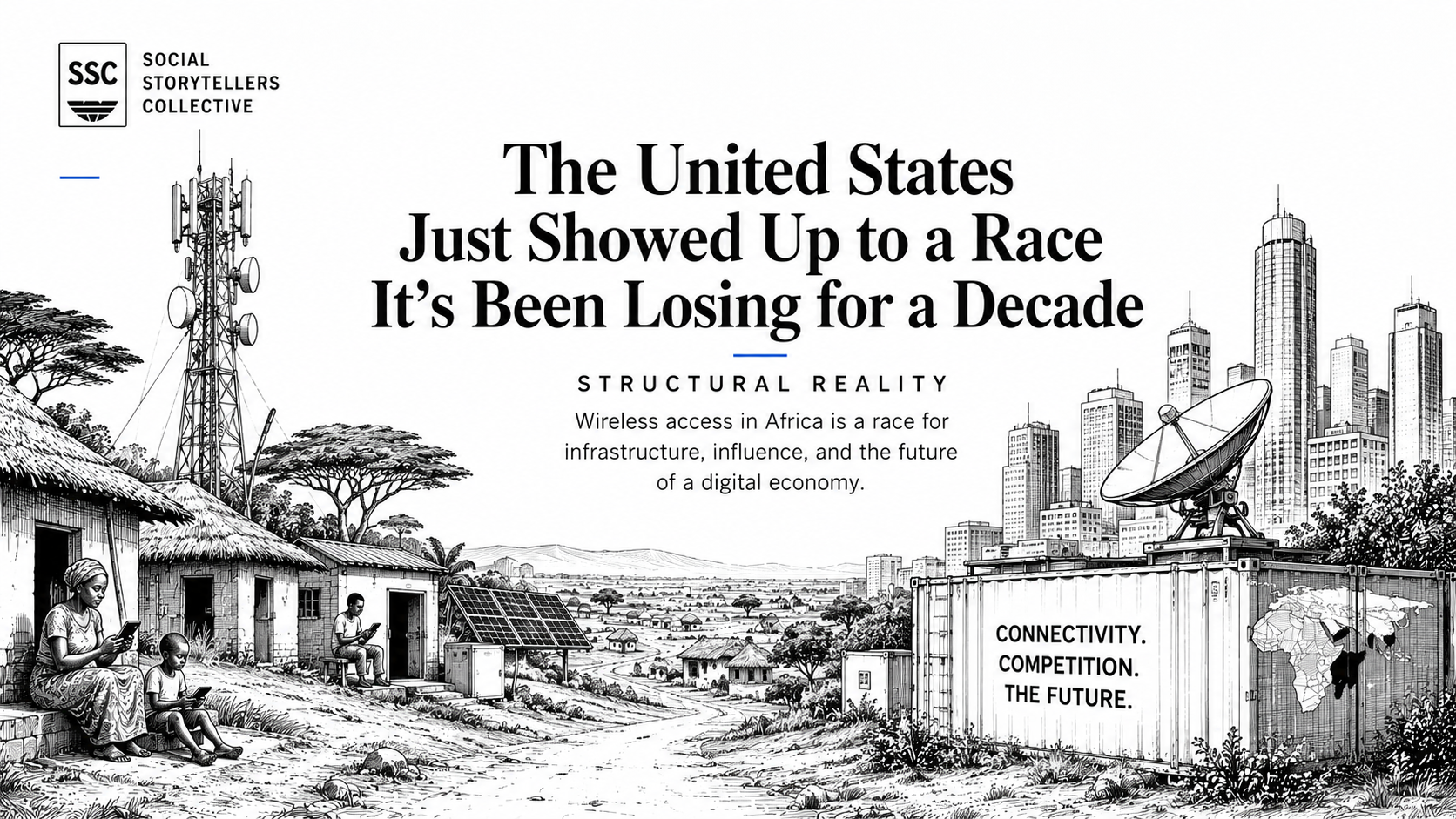
On May 20, the U.S. Trade and Development Agency announced plans to deploy approximately 1,500 American-made wireless base stations across Nigeria, Ghana, Benin, and Côte d’Ivoire to close the urban-rural connectivity gap in one of the world’s fastest-growing regions. The initiative is backed by Massachusetts-based Vanu Inc. and begins with a feasibility study. Officials described it as digital inclusion. Both things can be true: this infrastructure is genuinely needed, and the United States is genuinely late.
China became Africa’s largest trading partner in 2009. Since then it has built the fiber optic cables, 5G networks, data centers, satellites, and telecommunications standards that now govern how much of West Africa’s digital economy operates. At the 2024 Forum on China-Africa Cooperation, Beijing pledged $50.7 billion in investment across the continent through 2027. On May 1, 2026, China extended zero-tariff treatment to all 53 African countries with diplomatic relations — making it easier and cheaper for those countries to sell into a 1.4 billion-person market. The U.S.response is 1,500 base stations and a feasibility study.
The framing matters. The USTDA describes the initiative as offering “trusted and secure alternatives for telecommunications infrastructure in emerging markets.” That language — trusted, secure, alternatives — is not development vocabulary. It is competition vocabulary. The U.S. is not arriving in West Africa to fill a gap China left. It is arriving to compete for a market China built. Whether this initiative is the beginning of a serious, sustained commitment — or a press release designed to signal competition without funding it at scale — is the question West Africa will answer over the next five years.
West Africa has seen this sequence before. The announcement arrives. The feasibility study is conducted. The financing conditions prove difficult. The Chinese contractor breaks ground while the paperwork is still being reviewed. The 1,500base stations are a start. The communities waiting for connectivity are not passive recipients of whoever shows up next with a tower. They are the next 100 million people entering a digital economy — and the decisions being made right now about who builds their connection to it will shape what that economy looks like for a generation.
SSC covers access, technology, and the structural forces shaping economic life across the African diaspora and the continent.