

The Degree Economy is a Social Storytellers Collective series examining what happens when the credentialing system that previous generations used to build economic stability is stress-tested from every direction at once. MBA tuition is being slashed at schools that can afford to discount. AI is eliminating the entry-level jobs the degree was designed to access. The workers who most need a credential upgrade to survive the restructuring are the least positioned to use a sale that still costs tens of thousands of dollars and requires time away from an income they cannot afford to lose. And the institutions built specifically to serve those workers are absorbing funding cuts while a discount war plays out around them. This is not a story about business schools adjusting their pricing. It is a story about who the credential was always designed to serve — and what happens when the system that sustained that promise stops working.
The MBA was never just a degree. It was a transaction. You paid — in time, money, and opportunity cost — and in return, the most powerful firms in finance, consulting, and corporate strategy opened a door that was otherwise closed. McKinsey, Goldman Sachs, Bain, BCG, Deloitte. The pyramid was the point. Thousands of entry-level analysts feeding work upward, billing out hours, building the client relationships that eventually made partners rich. You bought access to that pyramid. That was the deal.
The pyramid is being dismantled. And the degree that bought access to it has not been updated to reflect that.
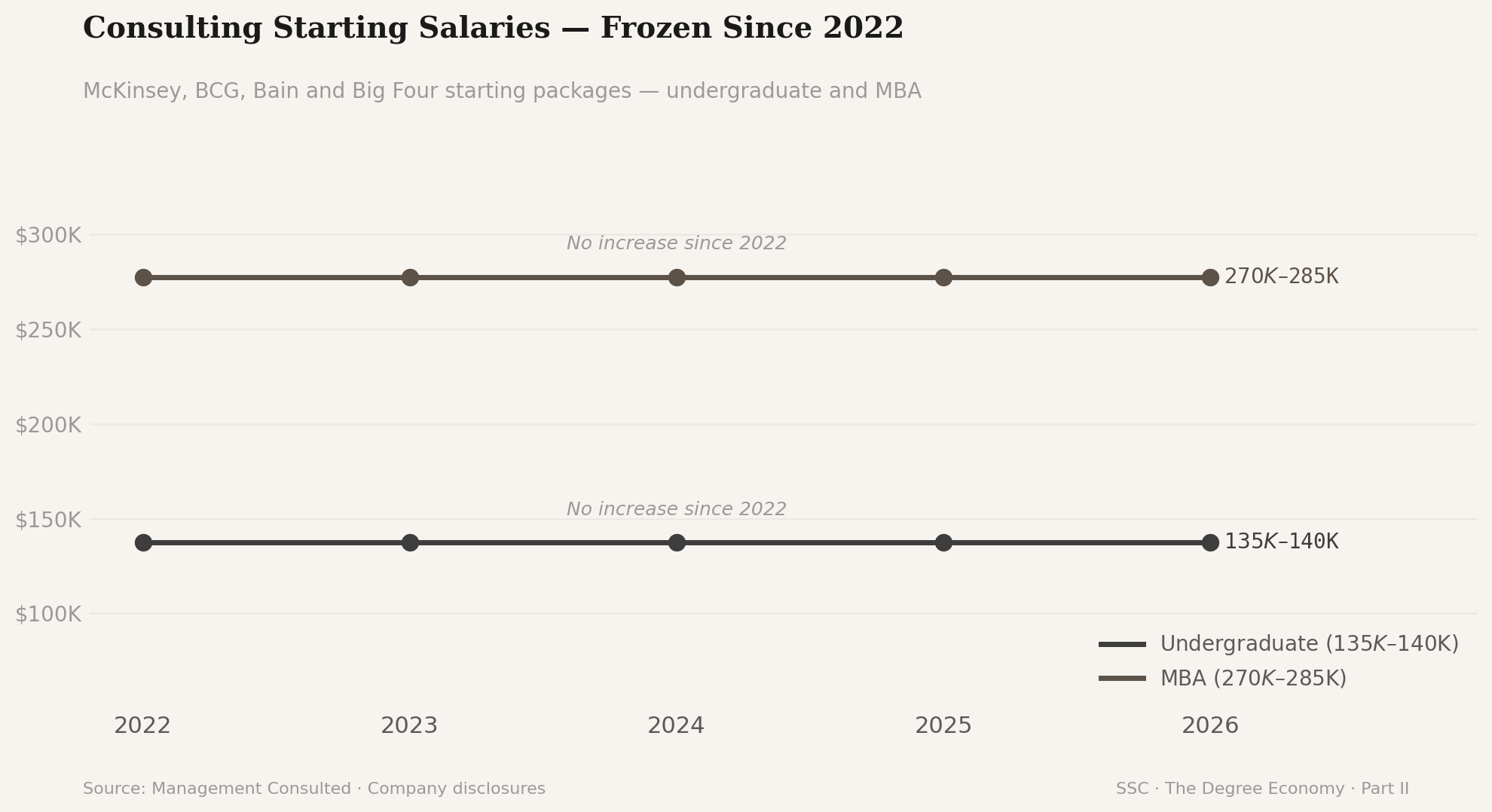
The data landed quietly but the implications are not quiet at all. McKinsey cut roughly 200 technology and support roles in late 2025, with global managing partner Bob Sternfels signaling further reductions in non-client roles over the next two years. The cuts targeted back-office functions — research, scheduling, compliance, reporting — areas where generative AI now does in minutes what analyst pyramids used to bill across weeks. BCG and Bain have followed parallel trajectories. The Big Four — Deloitte, EY, KPMG, PwC — have frozen starting salaries for the third consecutive year. Two senior executives at Big Four firms estimated that UK graduate recruitment would fall by roughly half in the coming year. PwC has already cut graduate hiring and missed a target to add 100,000 employees globally by 2026 — a goal set five years ago, before generative AI’s rollout made the arithmetic obsolete.
The entry-level postings that remain are changing in character. According to a 2026 LinkedIn Economic Graph review, roughly 25% of entry-level consulting and finance postings now list AI skills as a requirement — up from near zero three years ago. The job did not disappear. It transformed. And the transformation happened faster than any MBA curriculum could track.
This is where the MBA’s specific vulnerability becomes visible. The degree was designed for a stable pyramid. It trained graduates for the analyst and associate roles that served as the on-ramp to senior positions. Case competitions. Financial modeling. Stakeholder communication. Strategy frameworks. Those skills have real value — but they were taught in the context of organizations structured around large cohorts of junior employees who applied them repeatedly over years. That structure is contracting.
A Princeton graduate named Ezekiel Akinsanya — who co-founded an undergraduate consulting club, completed summer internships in the industry, and did everything the system rewarded — told Bloomberg this spring that he was looking to return to England and pursue government or military work rather than consulting. His reasoning was direct: “I want to be integral, and right now it’s not very clear that you will be integral as an analyst anymore. Those entry-level roles are maybe slowly becoming obsolete.”
He did not say the MBA is worthless. He said the role it was designed to fill is disappearing. That is a more precise and more damning observation.
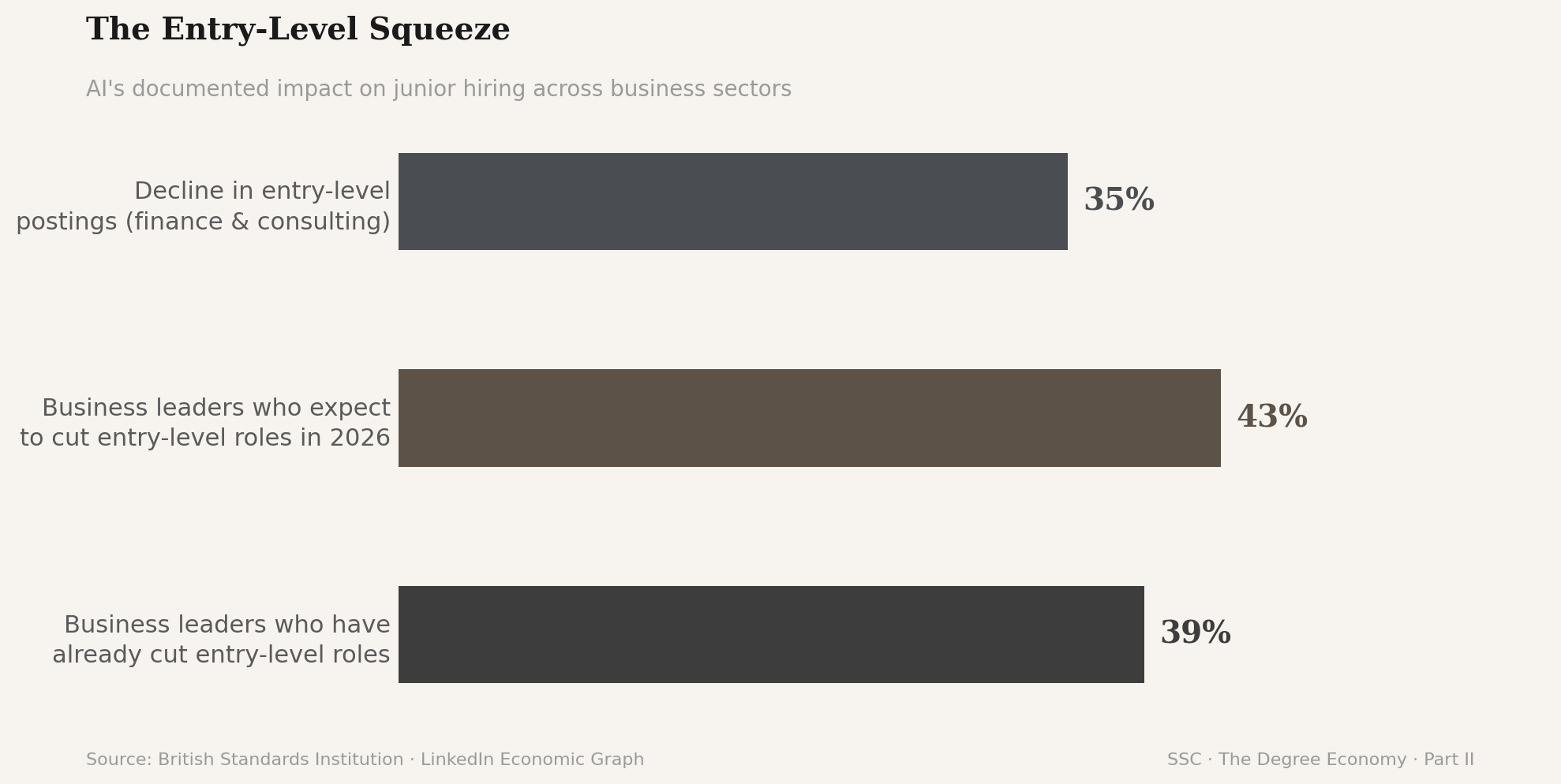
The displacement is not evenly distributed. A global study by the British Standards Institution found that 39% of business leaders had already reduced or cut entry-level roles due to AI — and 43% expect to do so in 2026. The roles most exposed are the ones that defined the MBA pipeline: middle management positions focused on information aggregation and reporting, routine financial analysis following fixed templates, and entry-level work dominated by structured data processing. These are not peripheral functions. They are the first rungs of the ladder that generations of business school graduates used to climb toward senior leadership.
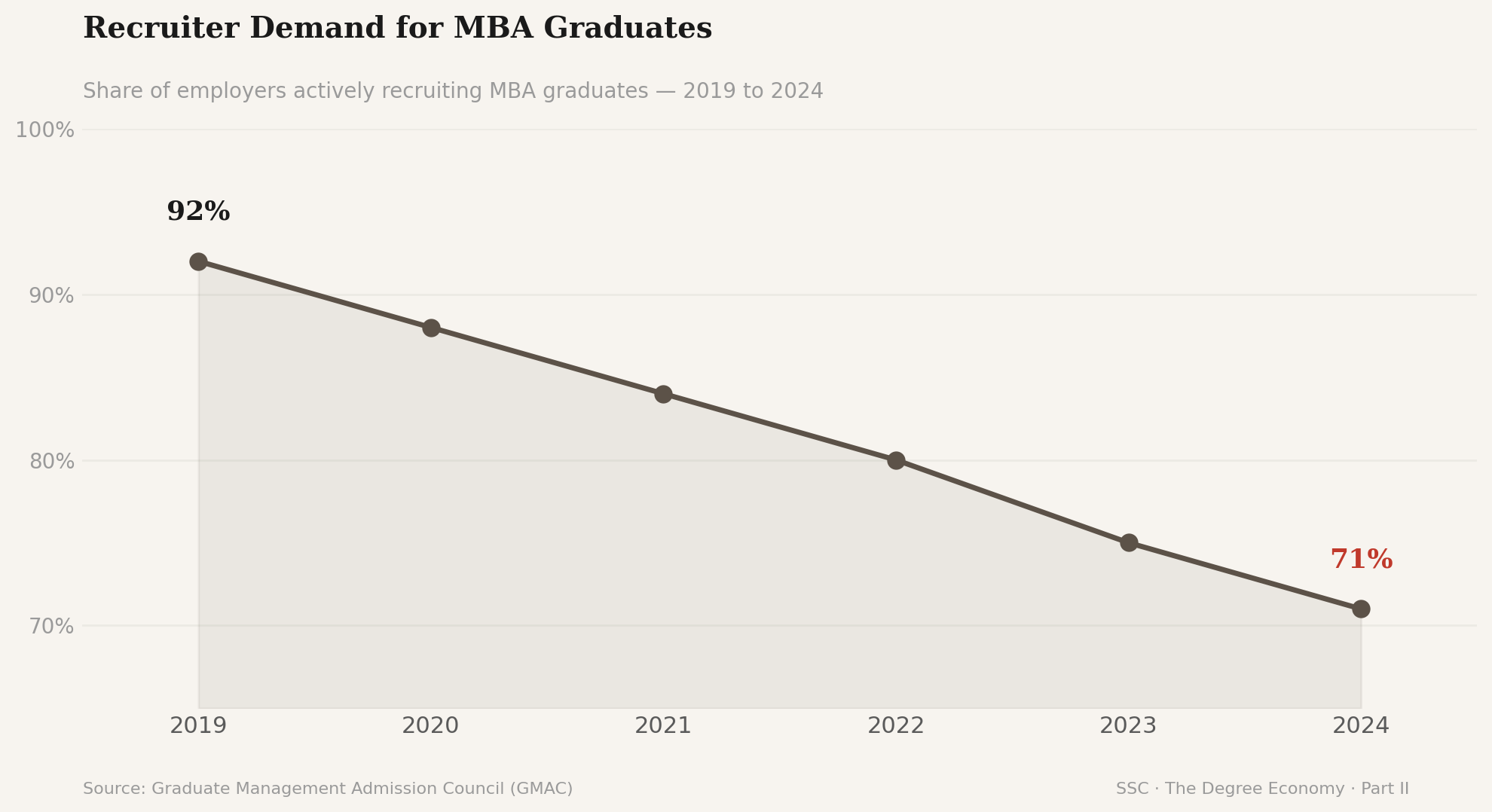
One Stanford study found AI has caused a net loss of roughly 20% of headcount in sales and marketing roles for workers aged 22 to 25. The recruiter demand for MBA graduates has fallen from 92% in 2019 to 71% in 2024. Entry-level postings across finance and consulting are down roughly 35%. These numbers do not describe a temporary disruption. They describe a structural repricing of what a new business school graduate can expect to be worth to an employer on day one.
The schools know this. The curriculum response has been to add AI modules, require AI fluency, and rebrand existing programs around “AI-integrated learning.” UC Irvine’s tuition cut was explicitly paired with a redesigned curriculum. The pitch is that an MBA with AI training is more valuable than an MBA without it.
That argument has surface logic but misunderstands the depth of the problem. The issue is not that MBA graduates lack AI skills. It is that AI is doing the work that justified hiring MBA graduates in the first place. Adding AI fluency to a degree does not restore the demand for the roles that degree was built to access. It makes graduates more efficient at a job the market is deciding it no longer needs as many humans to fill.
The pyramid did not collapse because consultants stopped being good at their jobs. It is contracting because the economics of the pyramid — built on billing out large volumes of junior hours — no longer work the same way when AI can do much of that work at a fraction of the cost. What Lores said at PayPal applies here too: the firms are not becoming AI companies. They are becoming companies whose work requires fewer humans to perform. The MBA was the credential that got you into that work. The credential is now outpacing the work that justified buying it.
The most telling signal is not the tuition cuts. It is who is not cutting. No top-20 program has reduced tuition. Harvard, Wharton, Chicago Booth, MIT Sloan — all holding or raising their rates. That is not because their graduates are immune to AI displacement. It is because the prestige signal attached to those degrees still functions independently of the job market beneath it. The Harvard MBA still opens rooms that the Purdue MBA does not, regardless of what the entry-level consulting job market looks like. For now.
The question Part III of this series asks is: who was relying on the non-Harvard version of this deal to work — and what happens to them when it doesn’t?
This is Part II of The Degree Economy, a Social Storytellers Collective series. Part III — Who Gets Left Out of the Sale — publishes next.
— SSC