Brand Authenticity — The Gap Between Statement and Action
Companies spent years building values-based identities. Then they spent 2025 and 2026 quietly dismantling them.
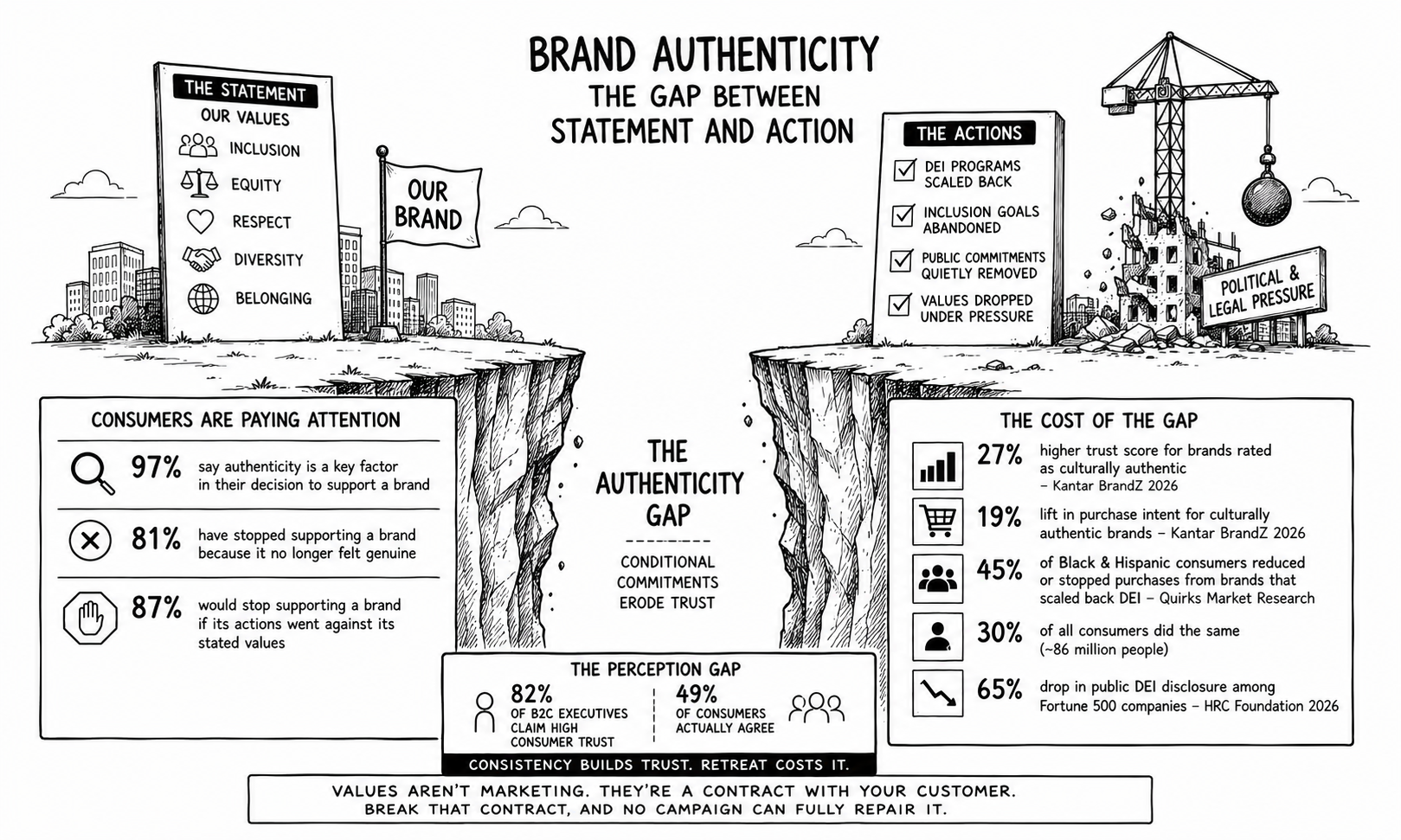
In 2026, 97% of consumers say authenticity is a key factor in their decision to support a brand, according to a Clutch consumer survey. 81% have stopped supporting a brand because it no longer felt genuine. 87% say they would stop supporting a brand if its actions went against its stated values. These numbers existed before the wave of corporate DEI rollbacks began. They are now being tested in real time against companies that built their market positioning on inclusion commitments and are unwinding those commitments under political and legal pressure.
The mechanism that makes the authenticity gap costly is not consumer sentiment surveys. It is purchasing behavior. Kantar’s BrandZ cultural relevance study, spanning 12,000 consumers across 18 countries in 2026, found that brands rated as highly culturally authentic had a 27% higher trust score and a 19% lift in purchase intent compared to those rated as culturally performative. After Target scaled back its DEI programs in early 2025, Reverend Jamal Bryant organized a 40-day consumer boycott against the retailer. Quirks Market Research has documented that 45% of Black and Hispanic consumers reduced or stopped purchases from brands that scaled back DEI, while 30% of the broader consumer population reported similar shopping behavior changes — roughly 86 million people adjusting where they spend. Public DEI disclosure has plummeted 65% among Fortune 500 companies in 2026, per the Human Rights Campaign Foundation, as companies navigate competing pressures from the Trump administration’s DEI executive orders and the consumers who built their loyalty around the commitments those orders are targeting.
The brand authenticity problem is not that companies took political positions they should not have taken. It is that they built market value on those positions and then discovered that exiting them carries a cost the original commitment did not. A brand that stands for something and then retreats when standing becomes expensive has not become neutral. It has become legible. Consumers read the retreat as information: the commitment was conditional. Conditional commitments produce a specific kind of trust damage — not the anger of betrayal exactly, but the colder judgment that the brand cannot be read as consistently as it once appeared to be.
The PwC Consumer Intelligence Series documented the perception gap most precisely in 2026: 82% of B2C executives claimed high consumer trust while only 49% of actual consumers agreed, the largest recorded divergence since the study began in 2019. The executives who built DEI programs as brand strategy and then scaled them back in response to political pressure are operating inside that gap. They believe their consumers understand the pressures they are navigating. Their consumers are processing the behavior directly, not the explanation for it. The brands that will come out of the current rollback period with their equity intact are the ones whose consumers cannot point to a moment when the company changed its position because the environment changed. That is not a communication problem. It is a consistency problem — and consistency, once broken, does not respond to the next campaign.