
Part of The Access Shift — an ongoing series examining how access is being quietly reshaped across American life.
If you flew through LaGuardia this week, you already know what the data confirms. TSA PreCheck lines stretched to roughly two hours on Friday morning, with large crowds winding through Terminal B and backing up near security checkpoints. That came after a fatal runway collision between an Air Canada Express flight and a Port Authority fire truck that killed two pilots and cascaded disruptions across the entire Northeast corridor. The chaos is real. But it did not come from nowhere, and it is not primarily a story about one airport.
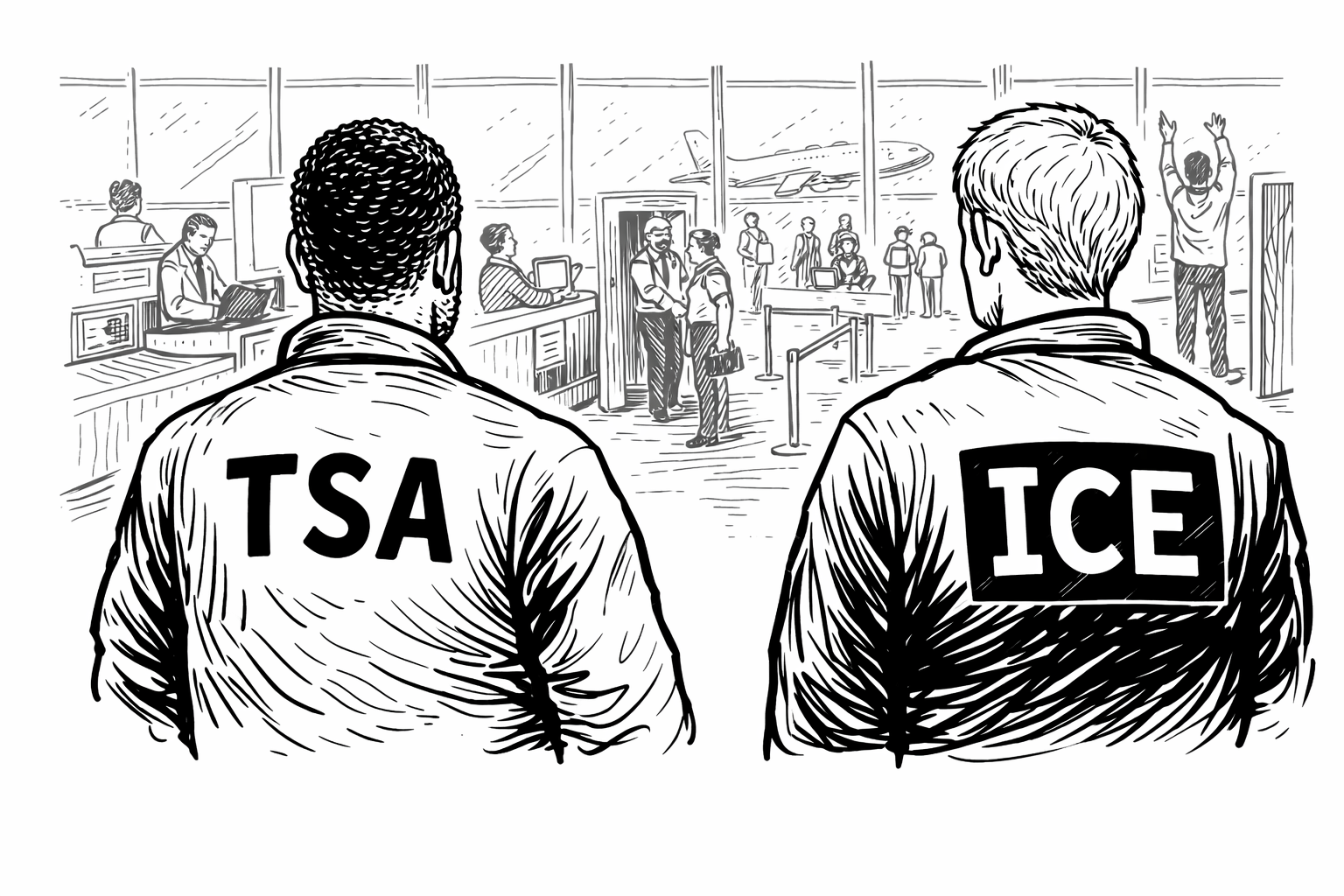
More than 450 TSA agents have quit since the partial government shutdown began, producing what a top DHS official described to Congress as “the highest wait times in TSA history.” Roughly 50,000 TSA officers have been required to work without pay — essential workers legally compelled to show up while Congress fought over whether to fund their agency. The administration’s solution was to deploy ICE agents to airports to manage lines, a move TSA union leaders called an insult, and one that solved nothing given that TSA certification takes four to six months to obtain. Meanwhile, private jet charter business spiked 39% since mid-February — in an industry where 4 to 5 percent annual growth is considered significant. The people who could afford to leave the system did. Everyone else waited in line.
This is the access story underneath the airport story. The TSA staffing crisis didn’t happen because the agency stopped functioning. It happened because workers were asked to absorb the financial consequences of a political standoff they had no part in creating. The lines got longer not because of operational failure but because of policy choices — and those choices landed hardest on the people with the least ability to work around them.
The structure of air travel already encodes this unevenness before any crisis arrives. TSA PreCheck, CLEAR, priority boarding, and airline status tiers all exist to sell back speed and ease to passengers who can afford it — layering a private system of access on top of a public one. In normal times that stratification is visible but tolerable. In a shutdown, with half the security lanes closed and lines stretching through parking areas, the gap becomes impossible to ignore. As SSC examined in The Paycheck-to-Paycheck Economy and the Access Shift series, the cost of disruption in systems built for efficiency is never distributed equally — it follows the same lines as every other form of inequality.
The Senate reached a deal Friday to restore TSA funding, and lines at some airports began to ease. But the underlying conditions remain intact — a workforce asked to do essential work without pay, a public system with no slack built in, and a private tier ready to absorb demand the moment the public one breaks down. The shutdown will end. The architecture will not change.
Why This Matters
We tend to think of access in terms of entry — who gets in, who is included, who is excluded. Increasingly, access is also about reliability. Who can depend on systems working as expected, and who has to navigate the risk that they might not. The system has not collapsed. It has narrowed. And when it narrows, the people who feel it first are the ones already carrying the most — the essential workers asked to show up without pay, and the travelers with no private tier to escape to when the public one breaks down.
The Access Shift
The gradual redefinition of who systems are designed to serve.
Across sectors—from public infrastructure to healthcare to everyday spaces—access is no longer assumed. As costs rise and systems face increasing pressure, services once built for broad reach are becoming more selective, more conditional, and less universal. The Access Shift explores how these changes are unfolding in real time—and what they reveal about who is included, who is left out, and how the structure of everyday life is quietly being reshaped.