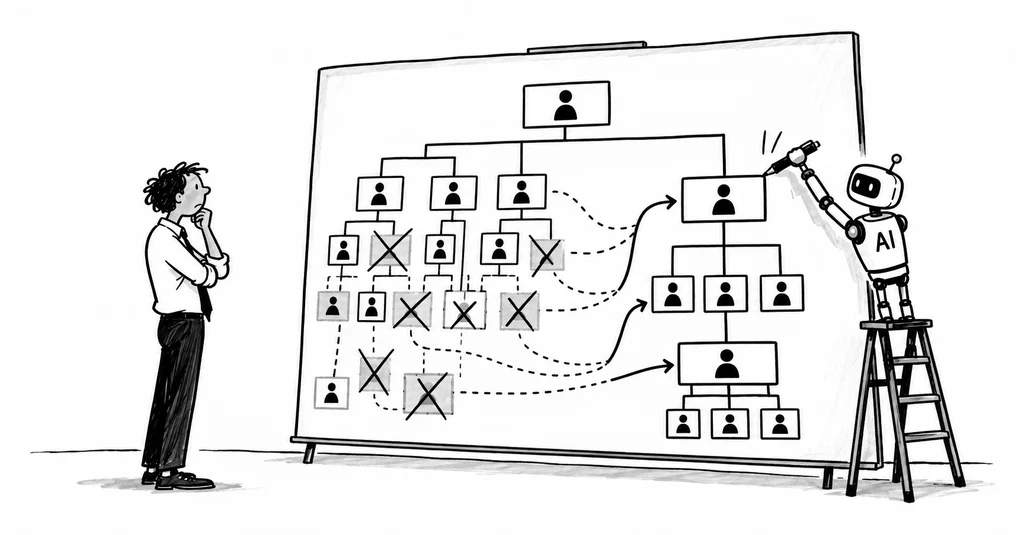
The next phase of AI-driven workforce change may be less about machines doing individual jobs and more about companies deciding they need different organizations altogether.
OPINION
By Bryson Davis
When HubSpot announced this week that it would eliminate roughly 7% of its workforce, or about 660 positions, CEO Yamini Rangan made an important distinction. The reductions, she wrote in her memo to employees, were “not driven by AI-related efficiencies.” Instead, HubSpot is reorganizing teams, reducing management layers and changing how the company operates as it builds around AI. That explanation sounds like a rejection of the familiar story about artificial intelligence replacing workers. It may actually reveal something more consequential. A machine does not have to take your job for AI to help make your job disappear.
For years, the public conversation about AI and employment has centered on substitution. Can a chatbot replace a customer-service representative? Can generative AI write the copy a junior marketer once produced? Can software generate code that previously required an engineer? Those are legitimate questions, but they encourage us to imagine technological disruption as a simple transaction: a company discovers that AI can perform Task X, eliminates Worker X and gives the task to the machine.
The Organization Can Change Before the Job Disappears
What is emerging is messier. Companies are beginning to reorganize themselves around what executives believe AI will allow them to become. That can mean smaller teams, fewer management layers, different combinations of technical and commercial skills, greater expectations for individual productivity and more investment in employees who can operate across functions.
In that environment, a worker does not necessarily lose a position because AI can perform their job. The position can disappear because management has decided the company should no longer be structured in a way that requires it. That difference deserves more attention.
HubSpot is particularly useful because the company has been explicit about the separation. Rangan told employees the restructuring was about building the organization required for its next phase, not extracting enough AI productivity to eliminate hundreds of people. Yet AI remains central to that next phase. As SSC reported, the company wants teams organized around delivering customer outcomes in an AI-centered software market. Both things can be true simultaneously. AI may not have replaced those 660 employees, but it can still be part of the reason HubSpot believes it needs a different HubSpot.
We Need a Better Vocabulary for AI Job Loss
That exposes a weakness in how we measure technological disruption. When companies announce layoffs, we tend to ask whether AI caused them. Executives frequently say no. Sometimes that is undoubtedly accurate. Companies cut jobs because revenue disappoints, strategies change, products fail, acquisitions create duplication or executives simply decide an organization has become too large.
But “Was this worker replaced by AI?” may now be too narrow a question. We should also ask whether AI changed the company’s assumptions about how many people it needs, which skills it values, how many managers should sit between an employee and an executive, how quickly work should be completed and what one employee should reasonably be expected to produce. Those effects are much harder to count.
A company can introduce AI tools and decide that managers should supervise larger teams. It can automate portions of several jobs without automating any single job completely. It can eliminate junior tasks and consequently hire fewer junior workers. It can decide engineers should perform work that once moved between several specialized functions. None of those decisions produces the clean headline “AI replaced 500 workers.” Collectively, however, they can produce an organization employing fewer people.
Productivity Has a Human Side
This is where the AI productivity conversation becomes uncomfortable. Businesses are supposed to seek efficiency. If technology allows an organization to produce more with fewer resources, executives cannot reasonably be expected to preserve every existing workflow simply because people are accustomed to it. Workers should also expect jobs to evolve. They always have.
But there is a difference between acknowledging technological change and pretending the only employment effects worth discussing are direct replacements. If companies expect AI to make individual workers substantially more productive, then the logical endpoint is not necessarily mass unemployment. It could still mean fewer people are required to produce the same amount of work.
And the workers who remain may inherit a very different bargain, one SSC has seen in teams that shrink while the work stays the same and in the strain on the people who stay after a layoff. A flatter organization can mean greater autonomy. It can also mean fewer opportunities to become a manager. AI assistance can remove tedious work. It can also increase expectations for how much one employee produces. Smaller teams can move faster. They can also leave fewer people carrying more responsibility when something goes wrong. Those trade-offs belong in the AI conversation too.
Watch the Org Chart
Workers trying to understand what AI means for their careers should therefore pay attention to more than whether a model can perform their current job. Watch what happens to the organizational chart.
Are junior positions disappearing? Are managers overseeing more people? Are previously separate functions being combined? Are companies hiring fewer specialists and more employees who can move between disciplines? Are productivity expectations rising after AI tools are introduced? Those changes may tell us more about the future of work than another demonstration of what the newest model can generate.
The first era of the AI jobs debate asked whether machines would replace humans. The next one requires a more complicated question: What happens when companies redesign themselves around the assumption that every human worker now has a machine beside them? HubSpot’s explanation should not end the conversation just because its layoffs were not driven by “AI-related efficiencies.” It should expand it.
Source: Yamini Rangan, memo to HubSpot employees, October 6, 2026; Lucia Maffei, “HubSpot cuts 660 roles, or 7% of its team,” Boston Business Journal, October 6, 2026.