
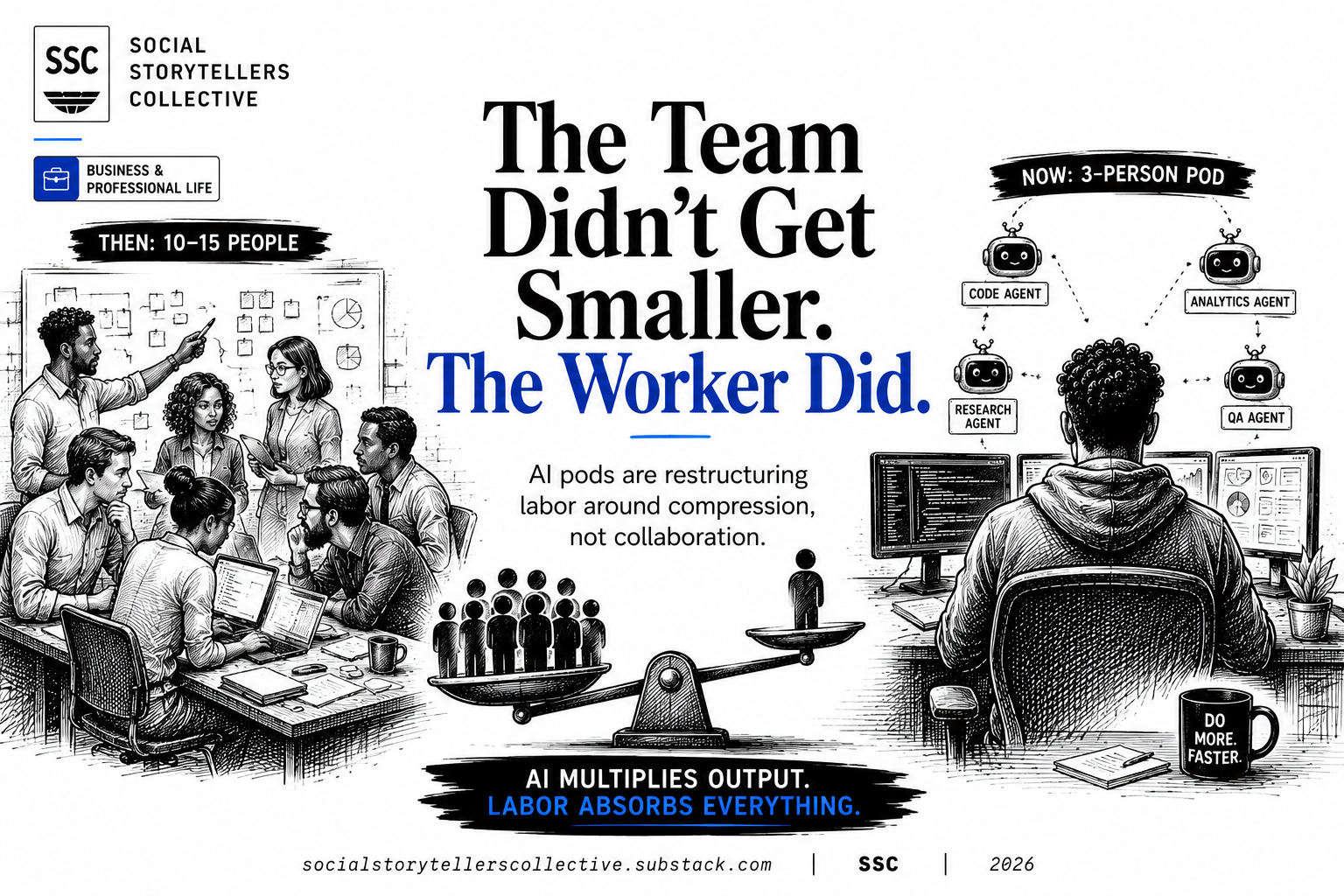
Coinbase did not simply announce layoffs earlier this month. It announced a new theory of labor. As the company cut roughly 14% of its workforce, CEO Brian Armstrong explained that Coinbase would increasingly organize around “AI-native pods” — smaller, faster teams built to manage fleets of AI agents instead of large groups of human employees. Rob Witoff, the company’s Head of Platform, later clarified the scale of the shift: a three-person pod can now perform work that previously required between 10 and 15 people. In the span of one earnings cycle, one of Silicon Valley’s most influential crypto companies quietly reframed workforce reduction as organizational innovation. The headline story was efficiency. The deeper story was labor compression.
The language matters because “pods” sound collaborative, flexible, even empowering. But structurally, what many companies are actually describing is the redistribution of institutional workload onto dramatically fewer workers supported by AI infrastructure. The Wall Street Journal reports that firms across the tech sector are reorganizing engineering departments into smaller cross-functional units where employees simultaneously absorb responsibilities that once belonged to multiple specialized roles. Engineers are increasingly expected to function as developers, project managers, QA testers, and product strategists while coordinating AI systems performing portions of the execution layer underneath them. Coinbase openly referenced experimentation with “one-person teams.” Amazon Web Servicesexecutives compared the model to an evolution of Amazon’s famous “two-pizza teams,” but the comparison obscures the scale difference. A small agile team is still a team. A one-person department fundamentally changes the relationship between labor, responsibility, and institutional leverage.
The shift is arriving because AI is finally becoming operational enough to alter corporate org charts rather than merely augment workflows. GitHub reports that more than 90% of developers are already using AI coding tools in some capacity, while Microsoft says GitHub Copilot users complete certain coding tasks up to 55% faster than non-users. The productivity gains are real. But the more important question is not whether AI makes engineers faster. It is who absorbs the economic value created by that acceleration. Historically, productivity gains in American labor markets translated into larger organizations, new categories of employment, or expanded middle management infrastructure. The pod model suggests something different: productivity gains may now be used primarily to justify organizational contraction itself.
That creates a contradiction companies are still trying to soften through language. The public framing emphasizes autonomy, agility, and innovation culture. Internally, many workers are experiencing something closer to role consolidation under algorithmic supervision. Smaller teams do not simply reduce meetings. They reduce redundancy, institutional memory overlap, mentorship structures, and negotiation power between workers and management. The worker becomes less defined by singular expertise and more defined by their ability to orchestrate systems at high speed across functions that once belonged to an entire department. The organization begins rewarding breadth under pressure instead of depth over time.
The pattern extends far beyond engineering. Healthcare systems are experimenting with AI-supported clinical documentation that reduces administrative staffing needs. Marketing departments increasingly expect single employees to manage strategy, copywriting, analytics, social distribution, and visual generation simultaneously. Media organizations continue shrinking editorial staffs while increasing output expectations through automation tools layered beneath remaining workers. The pod is not just a tech structure. It is becoming a broader managerial philosophy built around labor minimization disguised as flexibility.
Smaller AI-assisted teams do not merely lower payroll costs. They also reduce the organizational friction that traditionally distributed institutional power horizontally across workers. Fewer employees means fewer internal dissent centers, fewer promotion layers, and fewer long-term labor obligations during periods of volatility. AI is not only changing how work gets completed. It is changing how corporations structure dependency itself. The ideal worker increasingly resembles a highly adaptable systems operator — flexible enough to absorb multiple disciplines, technically fluent enough to supervise AI systems, resilient enough to operate with less structural support around them.
The real story is not that teams are shrinking. It is that corporations are redesigning work around the assumption that fewer humans should carry more of the system at once.
SSC covers the structural forces shaping work, technology, and the American economy.